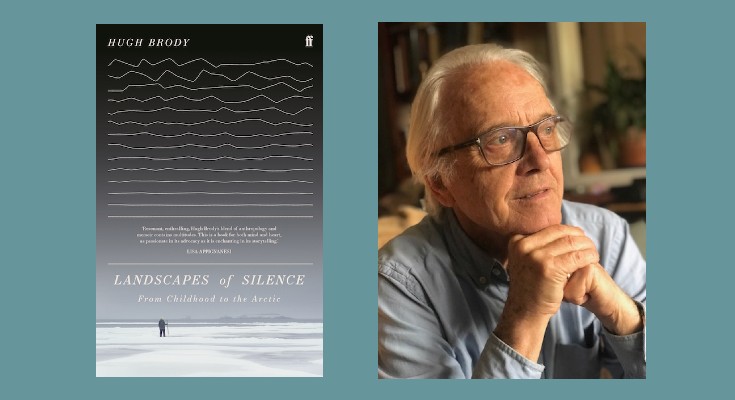
Renowned anthropologist and film-maker Hugh Brody weaves a dazzling tapestry of personal memory and distant landscapes: childhood in the Derbyshire hills in the shadow of the Second World War, a kibbutz in Israel and, eventually, the Canadian Arctic.
Conflicted and bewildered by the silence created by his concealed family history, he sought places to which he could escape. Yet everywhere he discovered deep and troubling silences, until he reached the High Arctic, a world far removed from anything he had known. It became a chance to learn, all over again, what it can mean to be alive – yet, even here, he encountered voices that had been silenced by the forces of colonialism.
In defiance of silence, Hugh Brody discovers, through memory and the land, a profound humanity – as well as hope.
Here is an extract from Landscapes of Silence: From Childhood to the Arctic by Hugh Brody:
At night, in a snow house or tent, I listened to the sounds of the north. In spring the quack-like calls of ptarmigan; in winter the hiss of a naphtha-fuelled stove; at every season the voices of the storytellers. Again and again I lay, almost asleep, as someone was describing a hunt, sometimes going over the events of the last days, bringing to mind some detail that was surprising or funny, sometimes remembering another time or place, taking us to mythic adventures. Speaking as they always spoke. In the quiet of the end of day, in the warmth of a one-room home, there was no question of silence – other than to pause between stories.
One family that often took me with them on hunting trips among a group of islands in southern Hudson Bay liked to end the day with ghost stories. We lay in a line, each sleeping bag right up against the next, and drifted off to sleep while someone told of an encounter with the supernatural. They had such skills as storytellers, playful and witty – seeing if they could make us shout out in surprise or feel a shiver of fear. Sometimes as we lay there, they would call on me to tell a story or answer a question. Once, as we lay in our sleeping bags, a young hunter asked me why it was that the southerners, white people, the Qallunaat, were always thinking about money. In his land, he said, if you were hungry or needed something, your neighbours would feed you or help you, but you didn’t ask for money. So here in the north, the most important things in life could work well without any thought of money. But, he went on, he understood that everything you needed, when living in the south, in the land of the Qallunaat, had a price. It was my turn to tell a story – about how people lived in the world I had come from. I tried to use what I had learned of this new language to talk about the old things, from far away, but I stumbled, became incoherent, and fell back on a ghost story. I lay in a tent, with the light of a candle and the warmth of a simple stove, with a family who shared everything with me because they shared everything with one another, far out on the land that was so much at the centre of its world.
Places where everything was bought and sold seemed too far away to think about. Yet they were, in political reality, not so very distant. The young man who asked me the question about money knew that everything was changing, and that the life in the family tent was at risk. Speaking in their own language, in their own homes or, best of all, out on their lands, the people I lived and travelled with were in no way silenced. Yet the new forces, already at work in their settlements and minds, threatened to stifle their voices, to be the cause of a new silence. Many Inuit, both elders and youth, said to me, in different ways but with considerable resolve, that they needed to confront the forces working against them, but theirs was a culture where confrontation should almost always be avoided. If they did overcome the reluctance to confront, they faced the problem of language – they needed to be understood, but many of those they most wanted to be understood by had to be spoken to in English. And those they needed to speak to had all the power – that alone could be a reason for keeping quiet.
I learned that there was a word in Inuktitut for this kind of fear – ilira. This was the feeling that those with frightening and unfathomable powers inspired in those they dominate. Ghosts caused you to feel ilira; so did the police constables and government officials from the south.
Landscapes of Silence: From Childhood to the Arctic by Hugh Brody is published by Faber. Available for £20.