
Karen Romano Young, author of our Children’s Book of the Month for May Antarctica: The Melting Continent describes some of the tech used in this far away part of the globe.
Going into “the field” — on adventures in nature — with scientists has introduced me to some of the incredible machines they’re using to find new data and make discoveries about Antarctica. Would you like to meet a small sampling?
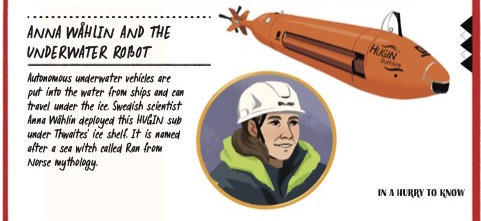
- Ran: Named for a sea witch in Norse mythology, the HUGIN underwater robot is remotely operated, so it can explore under ice where ships and divers can’t go. Swedish scientist Anna Wåhlin “deployed” it (puts it in the sea) to study the enormous Thwaites Glacier, the size of the UK.
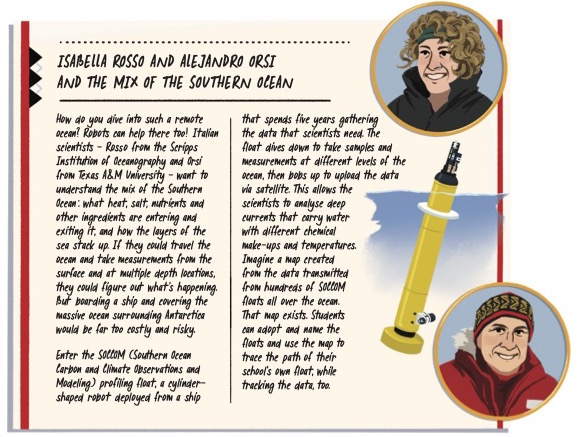
2. SOCCOM: This robot has a long name: the Southern Ocean Carbon and Climate Observations and Modeling (SOCCOM) profiling float. Deployed from aboard a ship, it travels the ocean for up to five years. Scientists program it to dive, make measurements, then rise to the surface, where it sends its data to a scientist’s computer via satellite. Isabella Rosso and Alejandro Orsi are two of the scientists who rely on floats for information.
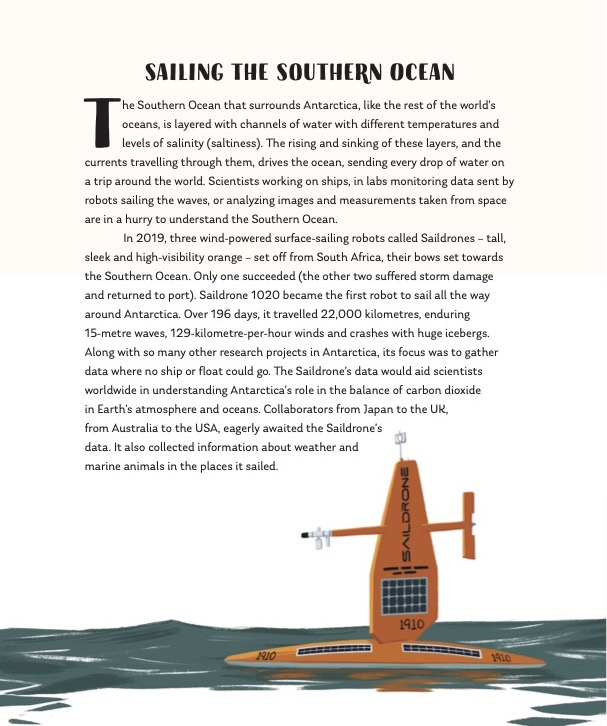
3. Saildrone: Powered by wind, this surface drone, shaped like a sailboat, can go where no other remotely operated vehicle or float can go. Saildrone measures carbon dioxide in the ocean and the air above it — and was the first robot to make it all the way around the continent of Antarctica.
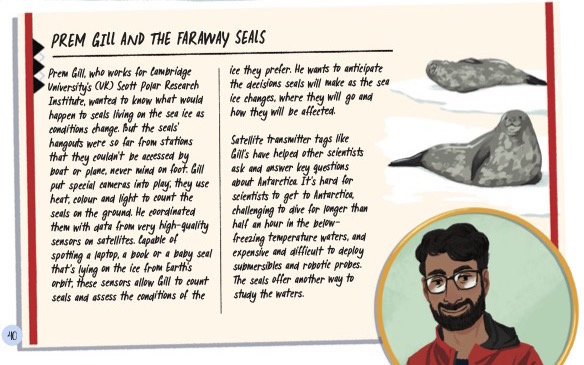
4. Seal-borne satellite transmitter tags: Glued to the heads of seals, these tags gather data wherever the seal goes — including depths divers and robots don’t go. Scientist Prem Gill uses this data — along with cameras on the satellites themselves — to learn about the lives of seals. If he can figure out what kind of ice and other conditions the seals prefer, he hopes to anticipate how their lives will change as Antarctica changes.
5. Halley VI Research Station: Is it a machine? It is a building? The Halley VI Research Station (UK) is both. Constructed on the Brunt Ice Shelf — where earlier stations were destroyed by shifting ice — Halley VI was made for walking. Each of its buildings stands on legs equipped with skis, so that when the ice shifts, the station can, too.


Antarctica: The Melting Continent is available now for £14.99
Watch Karen Romano Young introduce her new book: