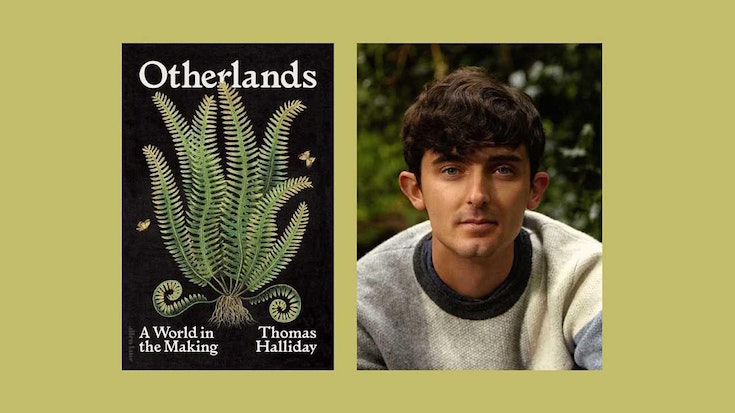
Our Book of the Month for February 2022 is Otherlands: A World in the Making by Thomas Halliday. It is an epic, exhilarating journey into deep time, showing us the Earth as it used to exist, and the worlds that were here before ours. Travelling back in time to the dawn of complex life, and across all seven continents, award-winning young palaeobiologist Thomas Halliday gives us a mesmerising up close encounter with eras that are normally unimaginably distant.
In this guest blog post, Halliday explores five otherlands to visit across deep time.
-by Dr Thomas Halliday
1. Monte Gargano, Italy
Monte Gargano is a mountain massif in eastern Italy, sticking out into the Adriatic Sea, and is preserved as a national park. Today, it is a promontory, connected to the Italian mainland, but it was not always so. Towards the end of the Miocene, from about 11 million years ago until about 4 million years ago, it was an isolated island filled with chalky caves, into which the remains of a unique island fauna were washed. Giant moon-rats, enormous owls, gigantic geese, and tiny, five-horned animals similar to deer lived here. 4 million years ago, the Mediterranean became isolated and evaporated, and the island became a mountain overlooking a desiccated valley of salt.
Planning a trip?
Welcome to Unspoilt Puglia (Apilia)
£19.99

2. Kanapoi, Kenya
Lake Turkana, in Kenya and Ethiopia, is the largest alkaline lake in the world. It is salty, hot, and its islands include active volcanos. Over the last few million years, the topography of the Rift Valley has changed, as the Nubian and Somali tectonic plates drift apart. Lake Turkana is only the most recent in a series of lakes that have formed and emptied in this time, all the while fed by the Kerio river and its precursors. 4 million years ago, along the banks of the Kerio, the distant ancestors of not only humans, but domestic cats, wildebeest, African elephants, antelope, marabous, and many other iconic species of African wildlife co-existed.
Planning a trip?
DK Eyewitness Travel Guide Kenya
£16.99

3. Nusplingen, Germany

Image credit H. Raab (User: Vesta) CC BY-SA 3.0.
The mountains of the Swabian Jura were once ancient sea beds. In the municipality of Nusplingen, fossils have been found that show the remains of an island some 155 million years old. At that time, Europe was a tropical archipelago, the meeting-place of three seas; the Boreal Sea to the far north, the Tethys Sea to the east, and the beginnings of the Atlantic, then only a narrow passage through to the west. Raised out of these oceans, Nusplingen was a peaceful lagoon, a reef island built of glass sponges, and inhabited by pterosaurs. Nearby Solnhofen, itself once a Jurassic lagoonal island, is the only place from which Archaeopteryx, the oldest known bird, can be found.
Planning a trip?
Lonely Planet Munich, Bavaria & the Black Forest
£14.99

4. Beipiao, China
The dinosaurs of the Jehol fauna revolutionised palaeontology. Here, a lake, known as Sihetun, formed within a volcanic landscape. Periodic ash flows coated the bodies of animals and plants with a fine covering, allowing exquisite detail to be preserved. Here, the flash of a lacewing’s eyespot pattern, the colour of dinosaur feathers, skin, and eggs, and the earliest flowers in the fossil record are all found, as close to lifelike as a fossil can be. The Beipiao Pterosaur Museum has a good collection.
Read more on the history of China:
The Story of China by Michael Wood
£12.99

5. Ediacara Hills, Australia
Some of the oldest evidence of communities of multicellular life comes from the eroded mountains of the Nilpena Ediacara National Park, in the Flinders Ranges of South Australia. Preserved as moulds on the underside of the layers of rock, the soft bodies of creatures, some of which are animals, and some of which may be something else entirely, are visible as faint impressions in the stone. They have sparked intrigue since humans first saw them, from timeless stories told by the Adnyamathanha owners of the land to the scientists still trying to understand how they fit into the story of life.
Read classic travel writing from Australia:
The Songlines by Bruce Chatwin
£10.99

Otherlands by Thomas Halliday is available from Stanfords for £20. All our copies are signed by the author.