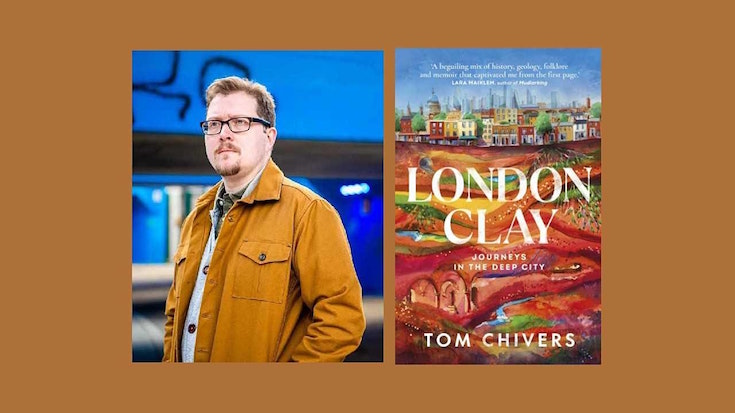
London Clay is an exploration of the stories that make a city. Written in rich and vivid prose, Tom Chivers leads us on a journey to find the source of his memories, and to discover lost rivers, secret woodlands, the marshes and islands long buried beneath the city he loves.
Here, Tom explains the importance of mapping in his work:
London Clay begins with a map: a Collins Streetfinder (scale 1:17,500) that I bought back in 2013. Using the British Geological Survey’s online viewer, I started to modify the map with felt-tips and highlighter pens to show the geological strata beneath London; the gravels, clay, sands and silt on which the city is built. Lost islands emerged from the street plan. Subterranean rivers. Drift hollows. This is the landscape I journey through in London Clay: the ‘deep city’ from which historical mysteries emerge – from abandoned Tube stations, buried temples and ancient crypts to flooded sewers and storm drains. In each chapter I walk a different route through the city, obsessively mapping the terrain – from the marshlands of south Bermondsey to the summit of Hampstead Heath.
During my research I drew on the work of historical cartographers such as John Rocque, the Huguenot refugee whose elegant map of 1746 captures Georgian London in remarkable detail, and the Flemish artist Anton van den Wyngaerde whose panorama of 1544 shows the expanding city from a vantage point on the south bank. I searched for technicolour geological maps in obscure research papers and engineering reports from infrastructure projects such as Crossrail and the ‘super sewer’. And I used the website Layers of London to locate the factories and workshops of London’s disappearing industrial heritage on mid-20th-century Ordnance Survey maps.
In London Clay I am as interested in the urban myths and eccentric theories that sustain the imaginative life of the city as I am in conventional cartography. While researching the early history of Westminster, I discovered the story of Victorian antiquarian William Henry Black who, in 1870, announced to the London and Middlesex Archaeological Society that he had located an ancient stone marker called the Ossulston. Using an ‘infallible’ method based on geometric principles, Black proposed that invisible lines connected ancient sites in the city, forming a network of isosceles triangles with some unspecified occult power. It’s a technique that re-emerges in Iain Sinclair’s 1975 book Lud Heat, the streetmap of London reimagined as a ‘system of energies’.
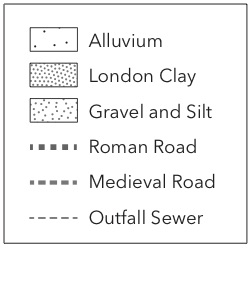
For my book I was lucky enough to collaborate with the Oxfordshire-based mapmaking company Lovell Johns to produce a series of maps showing the geology of London alongside historical features such as marshes, mounds, lost rivers and Roman roads. They also mark modern sites that I encountered on my journeys: the Olympic Stadium in Stratford, the MI5 headquarters and The Den, home to Millwall Football Club. I would begin by hand-drawing each map, before creating a layered digital version on my iPad. From this draft, cartographer Clare Varney would then produce a print-ready map in black and white, using different densities of stippling to delineate gravel and sands from outcrops of clay and the alluvium (or silt) marking the original floodplain of the Thames.
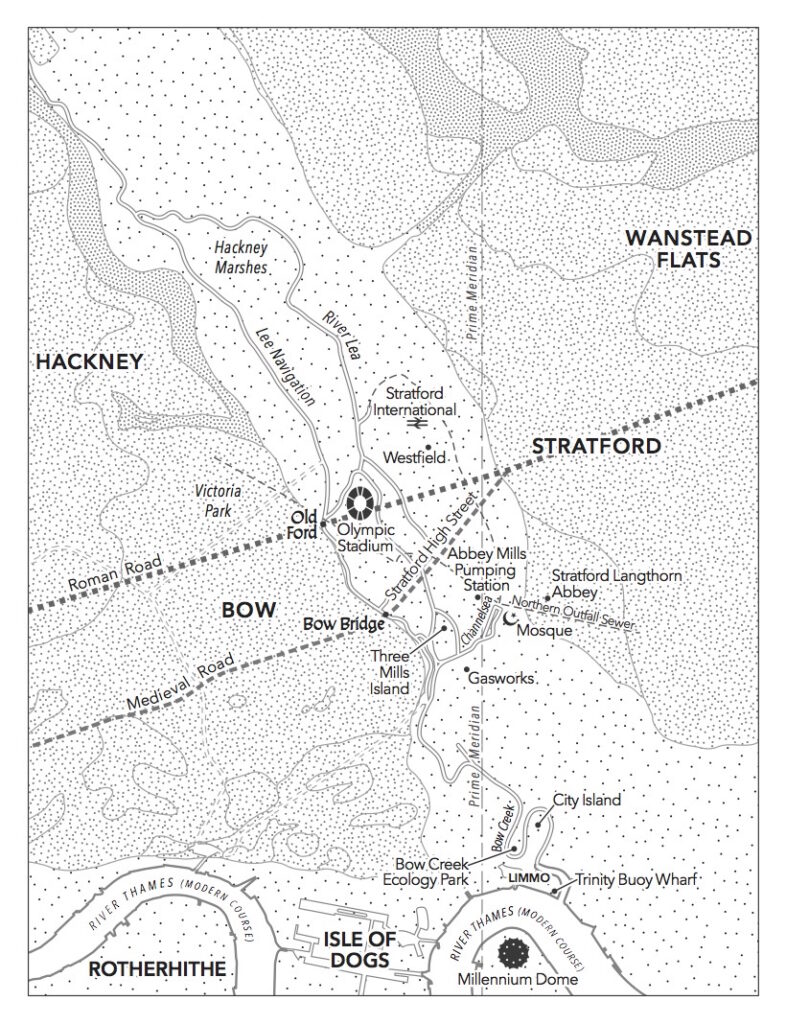
I have been captivated by maps since childhood. My dad kept a large 1960s hardback atlas in the sitting room into which I would often disappear, entranced by the beautiful relief maps of far-flung deserts and jagged mountain ranges. Growing up in south London, a trip to Stanfords in Covent Garden was a real treat and was often followed by a pint (for dad) in the Lamb & Flag. It has been a joy to rekindle my love of maps while writing London Clay. I hope that readers will be inspired to see the city differently; to explore its edgelands and backwaters on foot; and to conjure their own maps of its magical, hidden landscapes.

London Clay by Tom Chivers is available to buy from Stanfords for £20.00
STANFORDS LONDON IN STORE EVENT
Tuesday 28th September 18:30 – 20:00
We are delighted to welcome Tom Chivers to Stanfords with his remarkable new book London Clay: Journeys in the Deep city, talking to friend and fellow author Matt Brown.
Join us for an evening of brilliant conversation and find out London’s extraordinary secrets that lie beneath it.
Tickets available here.
Watch a short video of Tom introducing his new book: