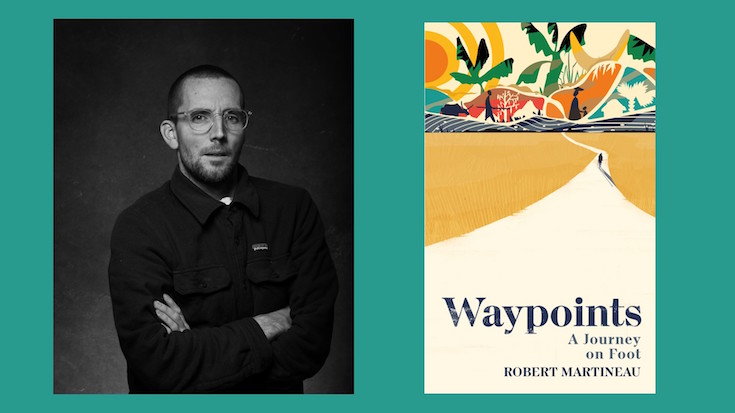
Waypoints: a Journey on Foot is the story of a 1,000 mile walk in Ghana, Togo and Benin, West Africa. I’d been unhappy in my life before I left, and, aged 27, I believed a long walk could help me. The book explores the psychology and folklore of escape, and the ways a long walk can be a healing experience.
Before the journey, I was inspired by many books about walking, solitude, and escape. In this blog I look at four journeys explored in Waypoints that taught me something about the power of walking.
The polar aviator
In the winter of 1934, polar aviator Richard Byrd travelled deep into Antarctic to spend five months gathering meteorological and astronomical data from the Ross Ice Barrier. His shelter, dug into the snow, was the only human settlement for over a hundred miles. In his book, Alone, Byrd records his experiences, exploring the routines he followed to keep himself sane, and his reflections on solitude.
Byrd began each day, waking in a sleeping bag coated in frost, with fifteen minutes of stretches. He recorded his first weather reading at 8 a.m. Much of the day was filled with keeping the components of his shelter in working order. For each maintenance task, he allowed himself an hour each day. When sixty minutes were up, he moved onto the next task. Without such a system to organise his time, he said, he believed his days would feel without purpose, and they, along with him, would break down.
Each day Byrd walked. For his daily trek, he carried with him a bundle of bamboo sticks, which he stuck into the snow every thirty yards. Such was the barrenness of that land that if a blizzard came, even if he was only a hundred feet from his shelter, he might never be able to retrace his steps. It was during these moments walking, Byrd said, when he attained a flow-like mental state. During that hour, he wrote, he underwent “a sort of intellectual levitation”, something that helped him survive in extreme isolation.
The herder
Across some of the regions of northern Ghana in which I walked, herders roam with their cattle. More regular droughts have forced many herders to travel further south, closer to farmed lands, in search of grazing. I often passed herders when I walked, as I travelled closer to the Burkina Faso border. Part of my own motivation for the journey was to connect with a different rhythm of life, with a simpler routine built around walking (normally for 8-10 hours a day), carrying everything I needed on my back, and sleeping outside in a tent. In the Fula language, spoken by many of the herders, there is the idea of ndimaaku, which in broad terms means freedom. It is wrong to romanticize the herders, and I cannot speak for their lives, but I was always drawn to the idea of ndimaaku. Freedom has many possible meanings, but for me, walking, it came to mean keeping as simple a routine as possible, to do nothing but cover the miles of the day, and to find a place to set my tent each night. Walking, by reducing the inputs around me, I began to find a feeling closer to the freedom I craved.
The monks of lung-gom-pa
In an account of the Himalayan pilgrimage he undertook in 1947, the Buddhist monk, Anagarika Govinda, described monasteries in the old Tsang province of Tibet in which monks sought the state of lung-gom-pa, a meditative practice said to enable a mystical trance-running. The monks lived as hermits for a period of up to nine years, Govinda wrote, in complete solitude, focussing only on their breathing. This training, the stories of the lung-gom-pa say, allowed the monks to reach a trance-like state through which they achieved new physical capability, enabling them to run for as long as forty-eight hours without rest. In his description of his own journey, Govinda seems to harness something of the levity rumoured to come to the monks through his walking. He wrote of his limbs moving as if in a trance: through his journey it was as if he was reconnecting his body with this mind, and in this union able to achieve a more balanced state of being.
The prisoner
Leaving Budapest in 1949, the doctor Edith Bone, then sixty, was detained by Hungarian state police, who suspected her to be a British agent. They held Bone without trial for seven years, including prolonged periods in solitary confinement in complete darkness.
Of all the horrors she encountered, Bone’s enforced isolation was the most threatening. Loneliness shows up in the brain like physical pain. Somehow over those years, Bone was able to insulate herself from the damaging effects of her isolation, to experience it as solitude.
Bone created, in her cramped cell, an interior world in which her mind roamed far. She kept an inventory of all the words she knew in the six languages she spoke. She made mental lists of the birds she could name, the trees, characters in Dostoyevsky and Balzac. She translated poems in her mind.
Bone remembered a story from Tolstoy in which a prisoner in solitary confinement occupied his mind by taking imaginary walks. She started to construct walks through the cities she knew, wandering among her favourite landmarks in Paris, Vienna, Heidelberg. One day she decided to walk home to London. She set a distance for each day, keeping record each night of the place she’d reached. She passed over the Hungarian border, across the Alps, through eastern France to Paris, and north to the Channel. She took the same journey on foot to that shore from her cell four times. Taking mental walks appears to be a common trend recounted by those held in solitary confinement: even when unable to move physically, or where only able to walk a few feet between walls, many seem to walk in their minds as a way to escape.
Robert Martineau is the author of Waypoints: a Journey on Foot, published by Jonathan Cape. All our copies are signed by the author.

Waypoints: A Journey on Foot
By Robert Martineau
£16.99