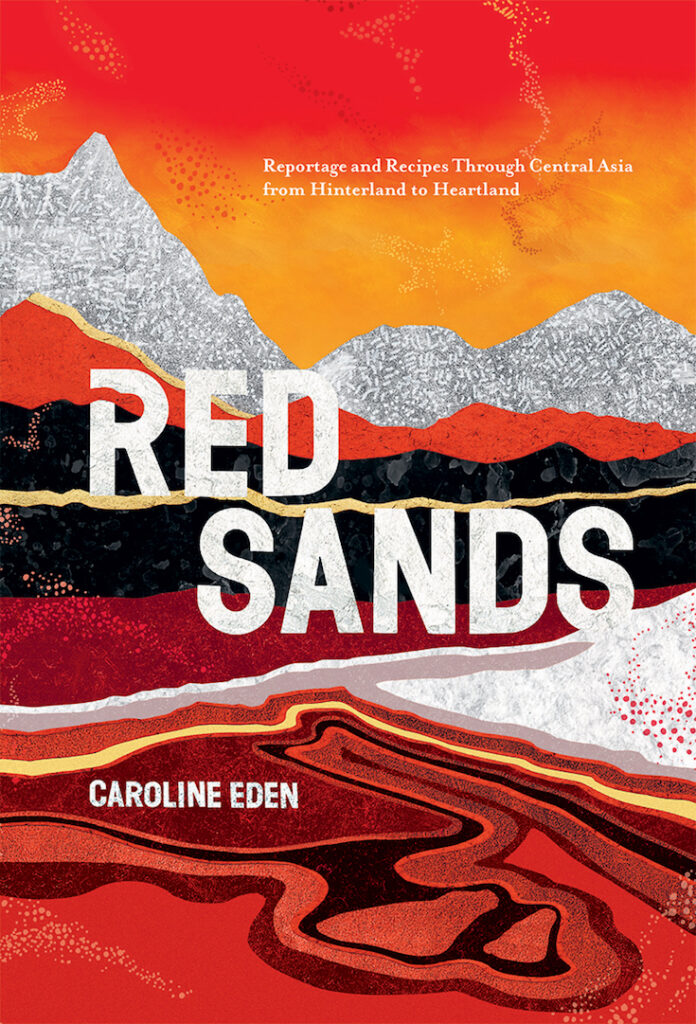
Extracted from Red Sands by Caroline Eden (Quadrille, £26) Photography © Ola O. Smit and Theodore Kaye.
In the shattered rear-view mirror, the land was pink from the rising sun. The fractured looking glass rendered the desert view, mainly sand dunes, scrub and small hills, broken and repetitive. On the road, between the cities of Bukhara and Khiva – some stretches good, others badly potholed – there was a sense of slowly evaporating, of being dwarfed by the Kyzylkum (‘red sand’) Desert.
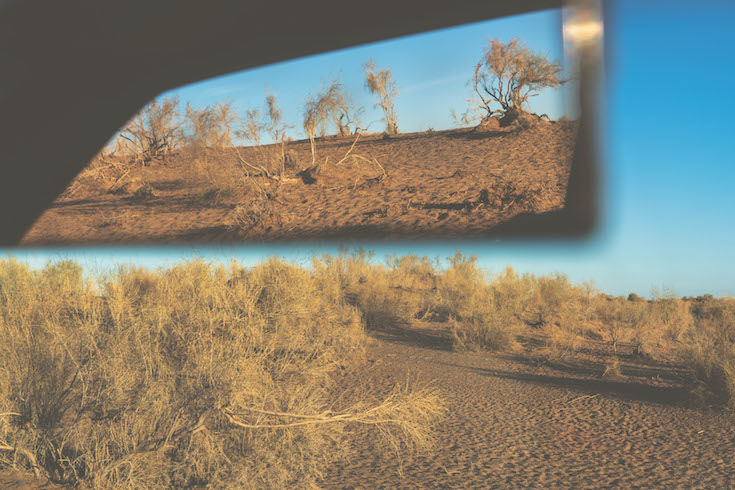
Life’s usual urban markers – glass, advertising, people and concrete – had vanished. Every mile crossed felt acute because, even in the safety of a car, deserts trigger intensities: uneasy mirages of lost directions and fears of supplies running short. But, despite imagined terrors, deserts also excite awe.
When Freya Stark flew over here in the 1960s, she admired the watery path of the life-giving Amu Darya (or the Oxus River, as it is historically known ), skirting this parched expanse, and she welcomed its geography into her breast. Looking down, she thought of warrior-rulers Genghis Khan and Tamerlane riding the riverbank on ‘small, strong horses, before they began to build where they destroyed’ but she dreaded the ominous inch and lurk of the Kyzylkum Desert that spans Uzbekistan and Kazakhstan: ‘The desert fear creeps even into the shiny surfaces of the aeroplane’, she wrote in a newspaper dispatch. Like the sea, a desert landscape is all waves and ripples and movement. Not dead, but alive.
Here, sand, blown by hot sticky summer breezes and by bitterly cold wintry winds, forms barchans, tall crescent-shaped dunes. Above fly eagles and bats, and below snakes zigzag past the smashed shells of too-slow steppe tortoises.
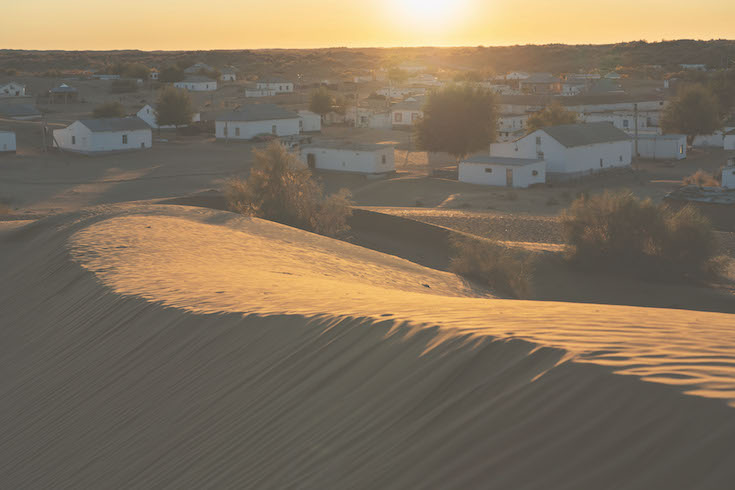
At some point during this six-hour drive, I don’t recall when exactly, a flatroofed structure appeared. In front of the rough, squat building a group of men reclined on a steel tapchan, a raised platform for tea drinking, topped with a thinly padded floral mattress, and upon that, a small table on four legs where cups, spoons and teapots glinted. A desert café: an island of comfort in a sea of saffron-coloured scrub and sand.
Out of the yawn-scented car, into the sun and onto so-as-felt sand. Right foot, left foot, right foot; boots gradually shifting the hot grains. The sun’s glare forced my eyes downwards until they met a hard-backed beetle emerging from its hole. Right-angled legs appeared one by one as it scuttled upwards and out, exposing its shiny bullet-shaped body to the sun. ‘Not a scorpion,’ I said out loud, to no one. Desert salt, carried on the dry wind, brushed skin and gritted teeth. Walking past the lounging men, through thick grey shashlik smoke corkscrewing up om the grill, I went into the kitchen to order what I could smell (for there wouldn’t be anything else). Inside the walls of the clay tandoor were roundels of non bread, each one slowly baking and expanding until golden on top, chewy in the middle and crispy underneath. What smell in the world is more innocent, more primevally reassuring, than that of bread? No smell. Nothing is more soothing than the scent of bread.
The kitchen was as ordered and sand-whipped as it was clean. A red Russian weighing scale stood on a steel table and next to it were empty rice sacks used as makeshift soueh, traditional squares of clean material used to prepare food upon. Alongside, a blue and white teapot, a handle-less teacup called a piala, and a wooden chekich bread stamp. Dense heat hung over it all and a small team worked in silent rhythm: a woman dressed in a red and gold tunic ferried plates and cutlery to the men outside; a chef in a paisley bandana pushed and pulled non bread out of the tandoor and outside, by the tapchan, a man fanned the cubes of lamb with one hand while turning the skewers with the other. Glossy caramel chunks of fat, threaded between the meat, glowed as the signature notes of Central Asian cooking – meat and bread – puffed and travelled on the wind out to the desert. Behind the kitchen lay the skeleton of a rusting Russian truck, baked by the sun. Stripped of any value, it had no roof, no windows and no wheels. Ruinously pretty, it looked like a piece of art that had been carefully wedged in the sand by a band of guerrilla artists.
I joined the men outside. The skin around their eyes was heavily lined, as if carved om redwood, and their demeanour was contagiously languid, suited to the heat. With their settled-in postures and sun-faded clothes it looked as though they’d been here an age already, and were happy to be here another more. In a busy world, the quiet desert has its pleasures.
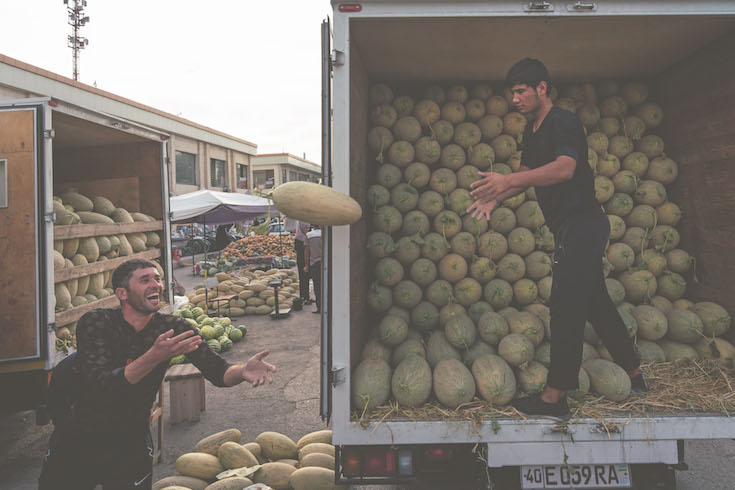
First from the kitchen came green tea, steaming in a stout teapot decorated with Persian-style birds. Then bread, still warm and good to chew, a plate of raw onion rings, a canister of salt, and lastly the juicy, fatty shashlik threaded tightly onto the rough-hewn metal skewers. We ate, and we ate together, anchored on the desert tapchan, our hunger collectively divided and divided again. The time – an hour or so – passed cordially, carefree. It was early autumn but the heat still oozed. Shashlik smoke quivered in the middle distance, mixing and melding with the desert’s glow, vibrating up om the sand, creating mirage-like waves. I split open a watermelon with a penknife, and placed dripping crescents of it onto a spare plate. Red water bled out from sugary wet flesh, quickly reducing and fading into a dry pale-pink stain. We ate it, then I wiped my hands on my jeans, stood up, and left.
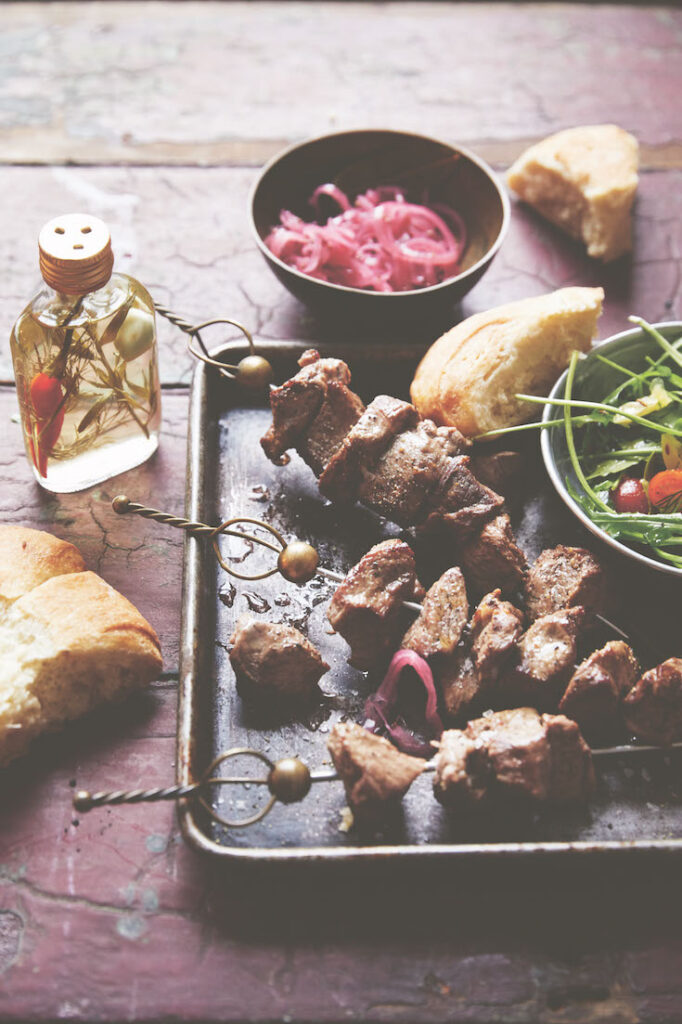
Setting is all, of course, and desert romance has a tendency to spill into memories like sand into boots, but that roadside meal in the Kyzylkum Desert – shashlik, bread, raw onion rings, salt and melon – eaten five or so years ago, had authority. Requiring very few tools, it was good and it created no waste. And, it was at that desert café that I considered whether I’d ever eaten anything, anywhere, so simple yet so harmoniously in tune with its extreme environment. So entirely suited to its surroundings. And, I concluded that I had not.
That lunch in the Kyzylkum Desert sparked the idea for this book. And that same desert forms a centre point within these pages, but the stories and journeys recollected here – drawn from a six-month trip to Central Asia split between spring and autumn of 2019 – travel far beyond its sandy edges.
Red Sands by Caroline Eden is available to buy here.