Caroline Sandes discovers there’s a lot more to Ankara than you might imagine.
Ankara has the reputation of being a vast and modern urban sprawl of a city fit only for business or other such reasons for visiting. It was then with some puzzlement the travel agent arranging my flight back from Tehran asked ‘What are you going to do in Ankara for two days?’ I had a flight booked from Ankara back to London as the original plan had been to get a train from Tabriz to Ankara but since I had failed to get a train ticket due to the Iranian Na Ruz holiday I’d had to organise a plane ticket, hence the couple of days in Ankara.

Ankara became the capital of the new Turkish republic in 1923. It is, though, a much older city, ancient in fact, with evidence of settlement stretching back beyond the Romans to the Bronze Age Hattic civilisation of about 2000-1700 BC. It was variously occupied by the Persians and the Greeks, and there was even a Celtic settlement, until it was conquered by the Romans under Augustus in 25 BC. Evidence of the Romans, and of course later periods including the Ottoman, are still to be found in Old Ankara, or Ulus as it is known, and it is very easy to visit. The airport bus comes straight in to this part of town, and everything is within walking distance.
I flew from Tehran very early in the morning. As I settled into my seat for the flight on Turkish Airways, there was something bothering me about the air hostesses that I couldn’t quite put my finger on until I realised what it was – they weren’t wearing headscarves. After three weeks of hejab, I could finally take my headscarf off. I was not the only one – other women likewise were shedding coats and scarves as they took their seats.
In Ankara I had reserved a room in a cheap but centrally-placed hotel. As I checked in the receptionist on hearing I was from London announced that he had lived in Hackney for several years but then had ‘had trouble’ so had come back to Turkey. I didn’t ask any more questions except to wangle breakfast from him, on the basis that I would be leaving too early to have it on the day I was departing. Turkish breakfasts are yummy – a plate of an assortment of olives, salami, hard-boiled egg, cheese, a cheese pastry, dried fruit, honey, jam, chocolate spread and bread, and of course a Turkish coffee. I love Turkish coffee. You get it in various guises, sometimes with cardamom and often ferociously sweet, all over the Middle East. Essentially it’s about the size and strength of an espresso but is made by putting very finely ground coffee and sugar into boiling water in a little pot that is boiled up again and all poured into a little cup. If you don’t want too much or no sugar, say this when you order it. Drink the last bit carefully – there is an inch of finely ground coffee in the bottom of your cup and you will get a mouthful of it if you try too enthusiastically to drain off the last of the delicious coffee. Be sure to ask specifically for Turkish coffee when ordering otherwise you will be given that foul apology for coffee that is instant coffee on the basis that you are a wimpish Westerner who will consider Turkish coffee too strong…
When I set out to explore old Ankara, it was quite warm, but there was a dust storm blowing giving the city a brown haze and making everything gritty so I headed for the Museum of Anatolian Civilisation. The buildings date back to the fifteenth century and once comprised a covered market and an inn, the Kurşunlu Han. Both are typical of Ottoman architecture, but were burned down and abandoned in the 1880s until Ataturk declared he wanted a museum. The restoration took some thirty years and the museum was finally opened in 1968. Some of the rooms were closed for renovations while I was there, but two main rooms were still open and there was plenty to see as the museum covers all periods from the prehistoric onwards – sculptures, pots, fascinating personal items and jewellery and all sorts of other artefacts from a variety of excavations all well labelled and exhibited. What was more unfortunate was my visit coincided with an entire school’s worth of children, from small to teenager, one lot more noisy and unruly than the last. I retreated for a while to sit outside to see if they would leave fairly quickly but no sooner had one batch come out, another went in, so I realised I was going to have to put up with it. A rather frazzled security guard doing his best to prevent the children from touching things or making so much noise caught my eye and smiled sympathetically.
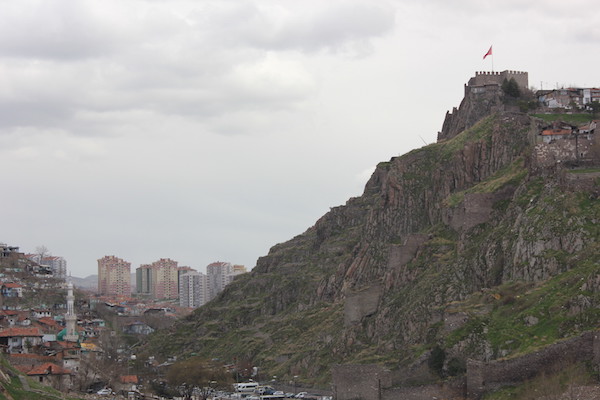
After that I braved the gritty gale to venture up into the citadel. This is a fascinating part of old Ankara. It encloses a hilltop and you enter through an imposing archway to find a maze of small streets and alleyways, some unpaved, running between higgedly-piggedly buildings including old Ottoman timber-framed houses. It clearly wasn’t yet suffering from gentrification and apart from some touristy places near the entrance and the odd smartened up property, it seemed to be still occupied by a community that gave the appearance of having been there forever: old women in headscarves, men in caps, children playing about the streets. Some parts of it seemed close to ruin, and if you looked closely, some of the great stone walls had stones with Roman inscriptions on them, one of which was upside down – clearly re-used. The view from the top took in Ankara in all its sprawl as far as the eye could see in the dusty brown haze.
I wandered back down and found myself in a bazaar full of fruit, veggies, sweets, cake, dried fruits, spices all heaped in great and precisely formed mounds or in barrels. That gave way to a more general shopping area where I sought refuge from the wind in a café to have another Turkish coffee.
Then it was off to another museum – the Museum of the Republic. It was originally built in 1923 as the Republican People’s Party Headquarters, later converted to the Grand National Assembly. It was opened as a museum in 1981, and has exhibitions on Ataturk amongst others, and the Assembly room is open to visitors as well. While some exhibits were labelled in English, most of it was not but thankfully there was an audio tour. You need a passport or bank card to leave with them while you have one of the handsets but I had neither, having carefully left everything in the hotel. After much discussion and offers by me to leave even my camera with them as security, they accepted a rather tatty photocopy of my passport that I did have on me. The museum is very interesting, especially if like me you don’t know a lot about Ataturk and Turkey’s change to a secular republic under his leadership.
Thankfully, the next day the weather had improved considerably as it had rained during the night – it was a bright clear sunny day, though colder. Well-stocked after another Turkish breakfast I set off in search of ruins of the Roman Baths. They cover an extensive grassed site that you can walk round; there were columns and Roman headstones dotted about too, and cherry blossom was just coming out on some of the small trees that bordered the site. Once again modern Ankara was visible, sprawling into the distance over the surrounding hills but looking better under the blue sky. From the Baths, I wandered over to the Justinian Column, not in its original position but situated in quite a pretty square in which there were some more preserved in situ archaeology. The excavation had apparently gone down four metres, uncovering Ottoman, Byzantine and Roman layers. A small section had been left in situ and was overlain with a glass viewing platform. Unfortunately the glass was covered in exploded dust bombs deposited by last night’s rain so it was hard to see into it.
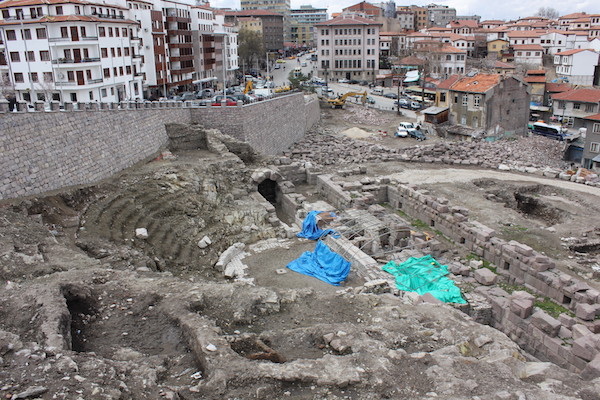
Next was the Temple of Augustus and Rome, still standing though roofless and with a later mosque attached to it. What looked to have been a large building nearby was in the final stages of demolition, a small older building surviving forlornly in a sea of rubble. There was a coffin draped in a flag standing outside the mosque around which some people , all looking a little at loss, had gathered. A call to prayer went out from the mosque accentuating the rather strange atmosphere, and men went in and out of the mosque adding or taking away from the pile of abandoned shoes at its entrance. Apparently the mosque is worth seeing but I had no headscarf with me and besides after some of the fabulous mosques I’d seen in Iran I reckoned it might be a bit of a let down. I wandered on to more Roman ruins, this time an amphitheatre that was between excavation and restoration and had that rather destroyed look that sites immediately after excavation can have – blue tarpaulin that’s inevitably come off from whatever it is supposed to be covering, stones in piles waiting to be reconstructed, columns lying about and the earthen skeleton upon which everything was built visible. It was worth seeing though – you could clearly see the steps and the shape and extent of it all, along with various surviving masonry features.
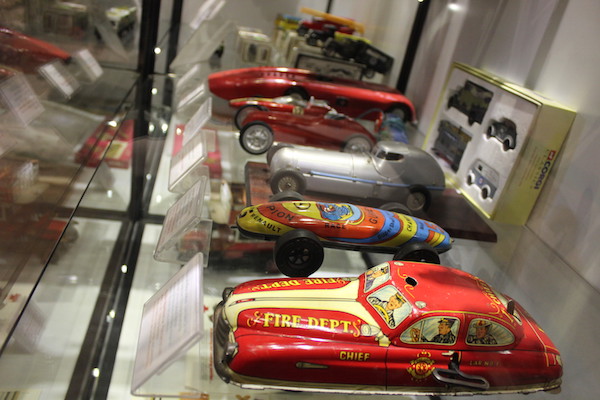
As if I hadn’t had enough of ruins and old buildings, I headed back up to the citadel for another walk around it, before then wandering into yet another museum. This one was completely different. Housed in old caravanserai, the Çengelhan Rahmi M. Koç Museuman is an industrial museum and it was fun! Full of everything from farming implements and maritime stuff to old computers and phones to teddy bears and model cars, it seemed to be aimed at both the geek and the nostalgic.
Having exhausted both my mental faculties and my feet, and it being the last day of my travels, there was only one thing to do but have a kebab. I walked into a large and busy restaurant cum café and was immediately swept up by a jolly maître d’ figure who greeted me in English and sat me down at a table with a menu. Having pointed out something to eat, I took out my book to read. This for some reason caused great interest and both the maitre d’ and another waiter came over to peer at it. Anyway in due course a huge and delicious kebab on a plate of bulgur, salad and a variety of other trimmings arrived, followed later by a tea in a little hour-glass shaped glass.
And so that was Ankara – definitely worth a weekend and another of its main attractions, not a carpet seller in sight…
Caroline Sandes