It was slightly crazy to drive across the north of Italy from our Tuscan beach in the west to a wedding party in Trieste in the east on the Saturday of Ferragosto. This day, on the closest Saturday to the 15th of August, all of Italy seems to be on the move. There are festivities everywhere and anyone who has not yet gone on holiday goes. Everyone takes a trip. The fact that lorries are banned from the roads on this day should have provided a clue for us. But however much we wanted to get to the wedding we also wanted to stay on our beach for as long as possible.
 We set out at the crack of dawn, which is 10.30 for us, after returning our hired bicycles and having breakfast at the beach. Well, you cannot rush on holiday. The travel apps said the journey would take four and a half hours but we were allowing seven: plenty of time. And it started out pretty well. We passed Florence on schedule before the motorway on to Bologna turned out to weave sinuously around the hills rather than adopting the Italian custom of tunnelling straight through. But the stretch on to Ferrara and Padua was pretty fast and we were only an hour behind schedule as we bypassed Venice… which is where the thunderstorm hit us with zero visibility for an hour. Nonetheless, as the old saying has it ‘this too shall pass’ and it did. Although no sooner had it done so than the going settled back to a crawl and we found the entire motorway was closed, due to sheer weight of traffic, with a fifty mile detour offered as the only alternative route. But our luck turned when we were just a hundred yards from the forced diversion and the authorities chose to reopen the motorway: except that we soon found out why it had been closed in the first place. Visitors from eastern Europe making their way home at the end of their holidays but eventually Poles and Hungarians took a more northerly route, leaving just us and the Slovenes to join a final queue to pay the road toll. By which time we were suffering a mixture of rage, anguish and despair.
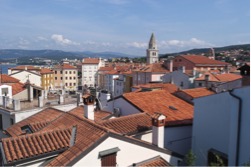
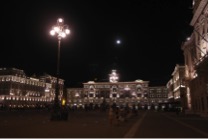
 A little over half an hour after the scheduled start of the wedding party we finally pulled up outside our hotel overlooking Trieste harbour. A hotel offering valet parking has its advantages in an emergency and a quick change later we were hurtling down the road on foot to the yacht club venue. Things could have been a lot worse, after all I was not the one battling with high heels and a tight dress. So we passed through the door less than an hour late, and just in time to see the bride and groom arrive by boat at the end of the pier to be greeted by friends, family and champagne, and all was well. The party was magical, Trieste is beautiful and particularly spectacular down at the seafront at night.
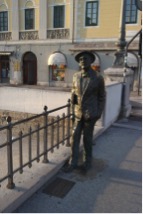
In the 19th Century Trieste was the principal port of the Austro Hungarian Empire and an important cosmopolitan cultural centre. Today statues in the streets celebrate important writers such as James Joyce, Umberto Saba and Italo Svevo, who all lived here and the tourist offices distribute leaflets to guide your walks through the streets, leading you to their homes, places of work and favourite cafes.
There is an unmistakeable middle-European atmosphere created, in part by the architectural legacy that combines with the Italian. An example is the Piazza Unita d’Italia, a handsome square, lined with cafes and opening out on the seafront. Interestingly, given the name of this square, Trieste was not joined to Italy during the Risorgimento but only after the first world war. The nearby Grand Canal, with its many restaurants provides a further example of this mixture of Austrian and Italian. There seems to be an unofficial division of restaurant sittings, with northern European tourists eating earlier and Italians coming out after 8.30.
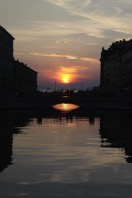
As Trieste is a City on the sea any trip there must include a boat trip or two.
The public ferry goes across the gulf to Muggia, a pretty little village, about an hour away. The journey itself is worthwhile, taking you past Trieste’s still important port, albeit shipbuilding seems to have disappeared. Behind the city you see the hills and mountains that merge into Slovenia and remind you again of its mixed heritage. Once at Muggia a stroll around the harbour and through its pretty streets and up to the castle, followed by a snack or an icecream will be complete just as it is time for the return ferry. One of the surprises observed from signs on street corners is that, like so many Italian towns, even a small one like Muggia is divided into Contrade or neighbourhoods of a few streets that may still, as at the famous Sienna horse races, provide teams for competitions and hold local events or may just be a lingering memory of small community organisations.
In the other direction from Trieste, towards Venice, you can take a short boat trip to Miramare Castle, built by Archduke Maximillian in the 19th century – he who rather unwisely accepted the crown of Mexico when it was offered and thereby became the subject of Manet’s famous painting “The Execution of the Emperor Maximillian”. The trip, rather than the unwise decision, was also highly recommended by our friends. The art gallery and museum in Trieste, Museo Revoltella, was closed on the only day we had available but, I believe, is also worth a visit.
When it comes time to return home it is worth remembering that Ryan Air’s description of the airport as Trieste is a bit misleading. It is actually a good 45 minutes from Trieste and half way to Venice. Nonetheless, frequent low-cost flights and a good bus connection make the city a great destination for a weekend break.
For a short stopover we did not bother with a guidebook to Trieste but for crossing Italy we decided to take “Touring Edition” of maps published by Touring Club Italiano in case we needed to make a detour. They were a heavy choice but easy to read and paper maps still have a considerable advantage over the digital variety, which do not work when you don’t have a phone signal