by Barbara Tognini
 The Italian region of Tuscany is one of the most renowned tourist destinations for visitors looking for culture and good food. A typical postcard from Tuscany would portray Pisa’s leaning Tower, or the pretty hills of Chianti, or a picturesque little village. This is definitely what the region is famous for.
However, it has much more to offer and a large part of it is almost completely overlooked by most of the tourists. Many people who visited the region didn’t even realise that it has a long coastline for example, and this is probably due to the fact that places such as Florence, Siena and the Chianti region steal the spotlight and very little room is left to anything else.
Local people are very proud of the history and landscape of their homeland and if it is debatable exactly how proud they are to be Italian, there’s no doubt that they are very proud to be Tuscan. They like boasting that “we have everything in Tuscany”: Like a perfect little country of its own (which was actually a reality until 1860, when the Grand Duchy of Tuscany became part of the Kingdom of Italy) Toscana has beaches and islands to enjoy the glorious summer, beautiful old towns full of history and culture, gorgeous food and wine and tall forested mountains to go hiking and skiing. Some enthusiasts claim that in April they can start the day on the slopes of Abetone and finish it with a dip in the sea on one of the Viareggio beaches.
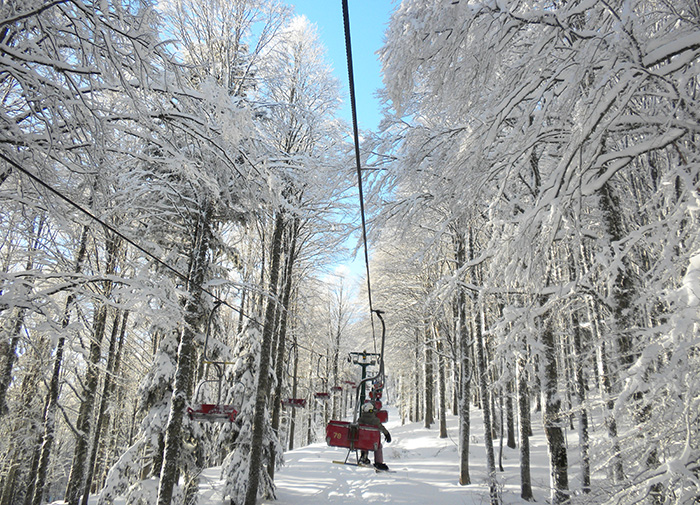
In the eyes of many this may seem unlikely and hard to believe, but skiing is actually a very popular activity in Tuscany. The region is equipped with everything necessary to enjoy winter as much as summer. There are many small ski resorts along the Apennines and in Tuscany the small town of Abetone (which literally means “big fir tree”) is undoubtedly the queen of winter leisure.
 The town sits on Abetone pass (1388 meters above sea level), on the border between Tuscany and Emilia Romagna. Until 1860, this was the border between the Grand Duchy of Tuscany and the Duchy of Modena. This character of border town is still recognisable to an attentive observer – there is a variety of local accents and typical foods of both regions are to be found in shops and restaurants. This pass has always been an important link used since Roman times and it seems it was also used by Hannibal on his way to Rome. The turn of the 20th century saw the arrival of the first skiers, but it was only during the Fascist era that the area started flourishing and was developed as a vacation resort.
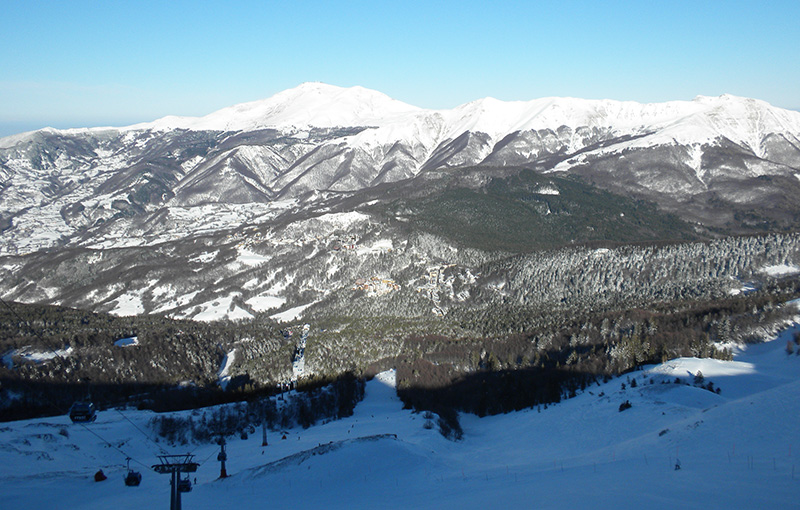
The ski resort is made up of four valleys, which are connected to one another by 21 ski/chair lifts, reaching the peaks of Monte Gomito (1892 m) and Alpe Tre Potenze (1940 m). It offers 54 km of slopes (for cross-country ski lovers, there is a dedicated 18 km circle path). If compared to the large and fancy Alpine resorts, Abetone would appear small and unpretentious, and probably cheap too, since the daily multi-pass is €30 (weekend €37). However, it has absolutely everything a skier needs to fully enjoy the sport and the mountain, to socialise and have fun. There are many cosy “rifugi” (mountain refuges) with fireplaces and good food (my favourite is “Selletta”), beautiful views, good infrastructure and services.
Another difference from the Alpine resorts is the kind of clientele as it is mainly people from the nearby cities, like Florence and Modena. It is definitely not the international environment of the Alps. One criticism that could be directed at the local authorities is the organisation of the ski bus service: it runs only twice a day, once in the morning and once in the evening, so it is not enough to tackle the traffic issue of the very busy resort.
In case one needs to rent the equipment, there are many shops offering everything necessary. Prices are reasonable for renting, but if you’re looking into buying something, things have to be chosen carefully, because they sell almost exclusively brand items and many things are overpriced. A good place for renting is Bibi Sport in the main square; the staff is friendly and efficient. Still in the main square, there’s another interesting shop, Il Baggiolo, which sells local organic products. Because of the woods and the natural parks surrounding the town, the local delicatessen are made with ingredients taken from the forests – mushrooms, honey, jams and berries, blueberry in particular (the blueberry tart and the raspberry liquor are a must!)
 A few meters away from the square, there’s the school camp on one side and on the other a ski lift that take skiers up to the top of the mountain, straight into the action! It has to be mentioned that it’s not an ideal destination for beginners, as the mountains’ flanks are steep and many slopes present some real challenge to newcomers. Unfortunately beginners or intermediate-level skiers will not have much choice. There is also a small snowboard park for the more and more numerous snowboarders, but since Tuscany and Italy in general are still quite conservative places from a skiing point of view, skiers still dominate the resort (fortunately!).
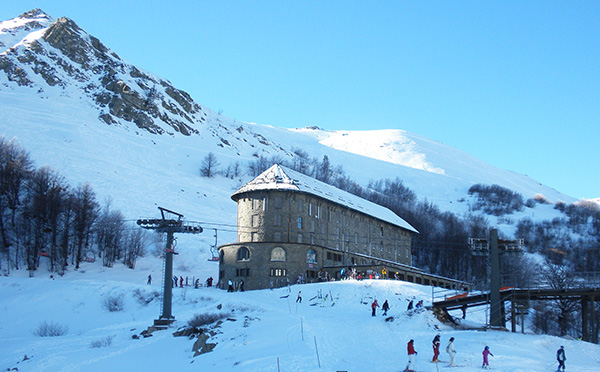
Skiing down from Monte Gomito into Val di Luce (Valley of Light) one comes across a large building, made completely of sandstone. It’s the Albergone (the big hotel), as the locals call it. Its unusual shape and its location definitely stir the onlooker’s curiosity; you wonder what it was, and why it lies in a state of semi abandon (see picture). As it can be easily guessed from its name, it was a hotel, built in 1935 by the local Fascist authorities in the attempt of launching Val di Luce (which originally had a much less elegant name, and it was called like this by the Fascists) as an upmarket skiing destination. Apparently the valley enjoyed quite a success for a few years, but Italy’s entrance into WWII in 1940 put an end to the development of the valley and its leisure activities.
The hotel reopened in the 1950s for a few years, only to be abandoned again, this time probably because of its remote location. Nowadays, there’s a restaurant on the ground floor. So, even if Abetone and its ski complex turned out not to be the glamorous holiday resort that its developers had wished, it still makes for a great destination for outdoors and mountain lovers, not only in winter but all year round.