by Barbara Tognini
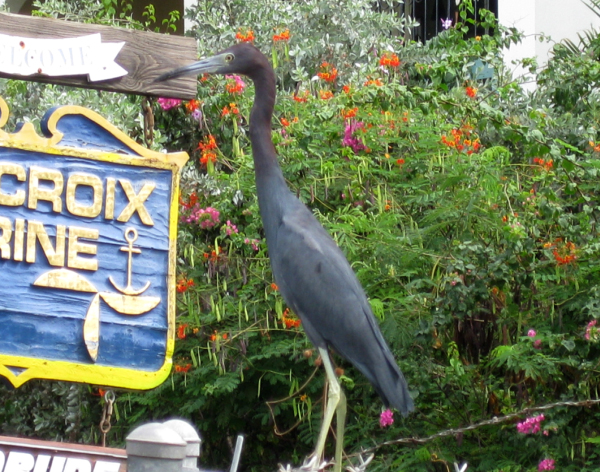 This trip to the Virgin Islands was organised by my partner’s family to celebrate the New Year in a different way, in a hot place. The US Virgin Islands comprise the islands of Saint Thomas, Saint John, Saint Croix and Water Island, and they constitute an unincorporated territory of the United States. During our sailing we touched only the first three, visiting mainly Saint Thomas and Saint Croix.
On our arrival to St. Thomas, the airport duty free shops had organised a very nice welcome: just before getting to the baggage claim, a free rum tasting was provided for the arriving visitors! It was the local “Cruzan” rum, which comes in many different fruity flavours. I loved it straight away: it’s light, refreshing and ideal for fruit cocktails. Unfortunately they don’t export it to Europe and it’s only available in the US.
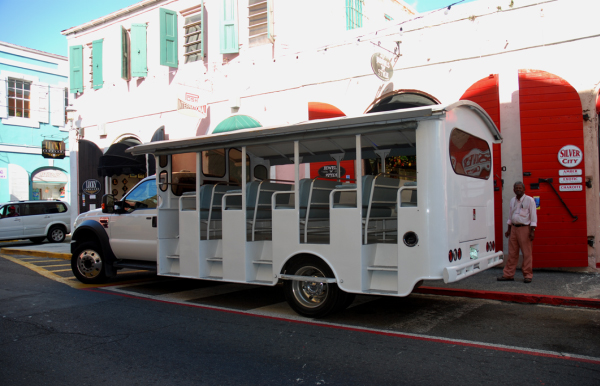
Outside the airport, we took a taxi to Charlotte Amalie, the territorial capital of the US Virgin Islands with the largest port. The city is named after the Danish queen Charlotte Amelie of Hesse-Kassel(1650–1714). It’s a pretty colonial town and nowadays tourism is its main source of income, cruises in particular. The main places of interests are the synagogue (apparently the oldest in the Americas) and Fort Christian (which was closed for refurbishment at the time of my visit).
Another distinguishing feature of the town that visitors can’t avoid to notice is the abundance of shops selling rum (with the inevitable Cruzan) and jewellery shops showing the beautiful Larimar in their windows. Larimar is a semiprecious stone that can be found only on the island of Hispaniola; it’s very rare and expensive outside the Caribbean. Usually it comes in shades of light blue/aquamarine, with some white marbling throughout. The man who started to export it outside the Caribbean, Miguel Mendez, renamed it as “Larimar” using his daughter’s name “Larissa” and the Spanish word for sea “mar” because the stone closely resembles the colour of the sea.
While I was admiring the stones, I came across a little shop that sold reproductions of old maps of the Virgin Islands, exactly the same maps that are also sold at Stanfords, but there they were at four times the price!
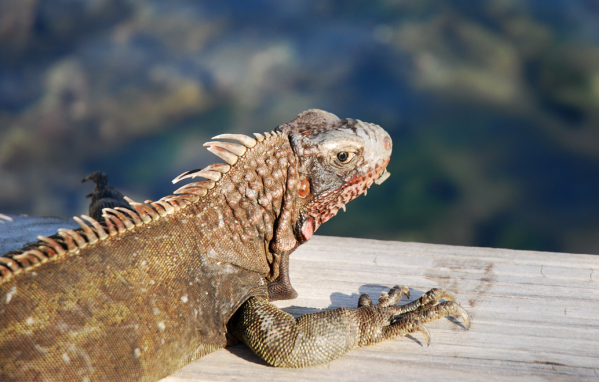 Once back in the marina, I was stunned to find three beautiful iguanas on the little pier and on the rocks underneath of the yacht club. One was busy eating salad and the other two were basking in the sun. They allowed people to get quite close, but touching was out of question! Those iguanas were without a doubt the only positive elements in the sailing environment of the US Virgin Islands. Normally, I don’t like to highlight the negative aspects of the places I visit, but in this case I think it might be useful to other travellers interested in sailing in that part of the world.
As far as I could understand from my experience, yacht clubs and marinas are an exclusive domain of rich Americans that decided to relocate and start a business in the USVI. Their customers are almost exclusively other rich Americans.
Having chartered a boat there, one would expect a certain level of customer service and to find people willing to help and give advice. We came across quite the opposite: non-existent customer service, they were actually behaving as they were doing us a favour and utterly bothered by our presence, especially at “American Yacht Harbour Bay Marina” in St. Thomas and at the St. Croix marina. I have never before come across such a level of rudeness and unfriendliness from people that you actually pay to receive a service. May be the fact that “it’s an island, silly” has something to do with this – you literally don’t have a choice.
 At the end of the second day of sailing the weather suddenly turned bad, with strong wind and rain. We hoped to find shelter in the above mentioned marina on St. Thomas, but as we were entering it, some people appeared on the pier shouting at us to go away. The radio contact with the marina office proved to be equally disappointing; they were simply not interested in giving us a shelter (a stark contrast with any marinas in the UK or indeed in the Mediterranean). In addition to that, a dinghy with other extremely “hospitable” people came towards us to tell us to go away, and warning that if we dared going too close to a particular yacht and scratch it, we had to pay $10,000 in damage. So we tried to get out of that place, but it wasn’t easy because of the strong wind and we ended up going particularly close to another boat. Of course the dinghy came after us claiming that we damaged that boat and threatening to sue us.
Finally we managed to moor on a buoy just outside the marina itself and we were hoping to spend the night there. Unfortunately, the wind was so strong that it was dragging the boat and buoy towards the pillars of the pier. It was getting quite dangerous, so we decided to leave and look for a better place. We couldn’t find any other sheltered bay, so Denis took the ultimate decision to go back to the open sea – away from the danger of getting smashed against the rocks – and try the crossing to St. Croix. We ended up in the middle of a storm, probably the most frightening experiences in my whole life. Our boat, a 45 feet Jeanneau, which in normal circumstances would seem solid and powerful, was thrown from one wave to the other by the fury of the elements as if it were a leaf. The storm lasted the whole night and at one point I even thought that it would have been the end…
 Eventually, we made it to St. Croix, exhausted and battered but still alive; of course, what I’ve mentioned earlier about the unfriendliness of marinas’ people applies here as well. I couldn’t wait to take a walk on solid ground, so I headed to Christiansted, capital of St. Croix. As I walked to the town, I was welcomed by the locals, who wished me Happy New Year with smiling faces and waving hands, such a contrast to the environment of the marina!
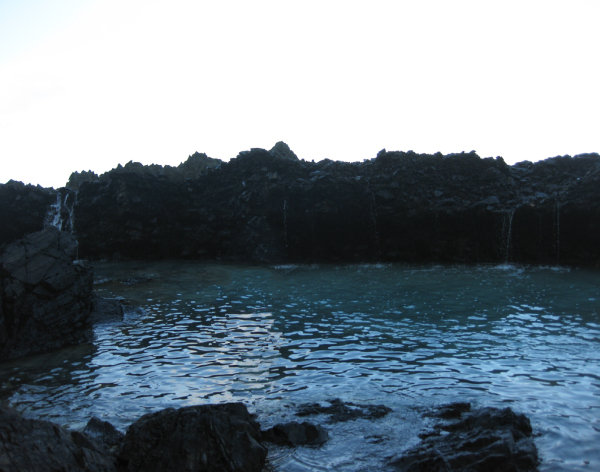
We spent three days on St. Croix (Americans pronounce it as “St. Croy”, which is not easily forgiven!) to have the opportunity to do some walking in the tropical forest, to enjoy the splendid beaches, to swim in the sea-water pools and to drink Cruzan rum, which is produced on the island and sold at every corner. After St. Croix our next destination was St. John: this time the sea was almost back to normal and the crossing didn’t present any problem, it was actually quite enjoyable – a group of dolphins joined us for a short while!
Most of St. John was fortunately converted into a National Park quite early, in the 1950s, so its nature and beauty has been preserved from over-development.
 We dropped anchor in Coral Bay where we spent two days, mostly swimming and snorkelling. We went ashore to visit Coral Bay village, which we found much smaller than we expected, with just a handful of houses and shops. The contrast with the atmosphere of cruise ships and super-yachts was striking. You could see how many of the locals live there and the picture will never make it to a holiday brochure. However, there was an interesting old Moravian Church built in 1919; the service was in a full swing when we got there and the singing sounded really good. The day after the service we sailed back to Charlotte Amelie.
I can’t say that I have fully enjoyed this trip as sadly the attitude of the inhabitants of the marinas often spoiled the atmosphere of the places and for sure the storm didn’t help in improving the situation. I’m definitely not in a hurry to go back sailing in that part of the Caribbean.