by Barbara Tognini
If one is thinking of visiting the Black Forest in southwest Germany, it would be difficult to ignore the charm of Germany’s most famous spa town: Baden-Baden. Surrounded by forested hills and lying along the small river Oos, Baden-Baden nowadays is visited mostly for its beautiful setting in the Black Forest, for its Art Nouveaux buildings, for the boutiques of popular brands, and as a base for walks in the forest. To judge from what it looks today, it doesn’t seem to possess any major attractions or sights, and it appears to be sleeping peacefully at the margins of the famous forest.
 However, there was a time when Baden-Baden was la grande dame not only of Germany, but of the whole Europe. Its thermae and casino used to attract la crème de la crème of European society, such as Queen Victoria, Fyodor Dostoyevsky, Leo Tolstoy, Otto von Bismarck, Austrian Empress “Sissi” – to name just a few. I decided to visit it exactly because of this prestigious past to try to understand what was so magnetic to les bons viveurs de la belle époque, and to see what it has to offer to the 21st century visitor.
Despite its fin de siècle appearance, the town has an ancient history. Due to the presence of hot springs (with temperatures ranging from 56°C to 68.8°C), the area has been inhabited since prehistory, and under the Roman rule it became an important regional centre. The name “Baden” probably comes from the Latin “balneum”, the same root that produced the English “bath”. The presence of the Romans is still visible in the ruins of the baths: what’s left of it is not in bad condition and it can be seen with a guided tour or individually with the help of an audio guide.
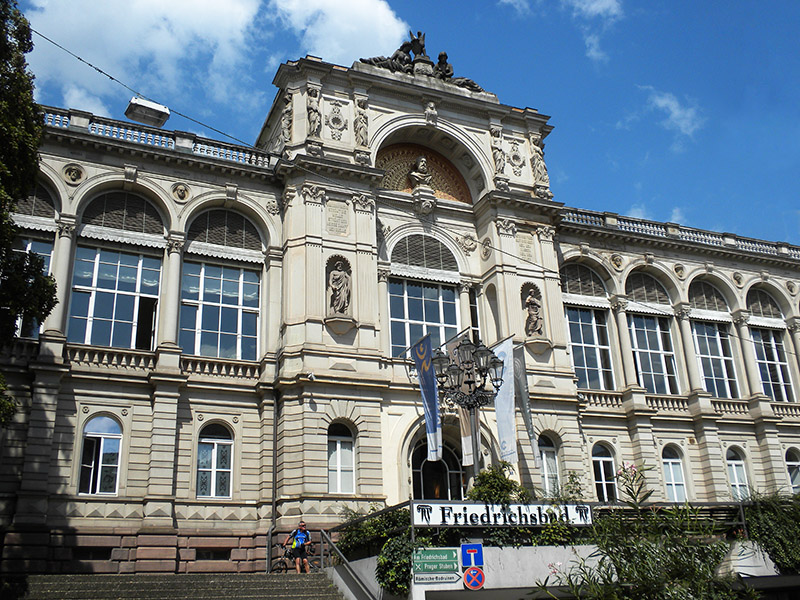
Friedrichsbad used to be Europe’s most famous Spa and still is the quintessential in the art of bathing. It opened in 1877 and was built in a neo-renaissance style, with sophisticated and richly decorated interiors and simple exteriors. The thermae experience, the “Roman-Irish bath” as they call it, develops through 17 stages. So the bath-taker is guided through different pools, saunas and steam rooms with different temperatures. Hence, it is not just leisure bathing, you’re supposed to follow precise steps.
The price is really accessible, especially if compared with UK prices for this kind of treatment. For € 47 you can get the deluxe package which includes two different massage sessions and you can enjoy the spa for 4 hours. At the end of the treatment, you really feel regenerated. However, things are not as easy as they maybe appear in the introductory brochure. Bathing is completely nude. Usually in the German spas, where they don’t allow swimming costumes, you can always take your towel if you want to shield your modesty. In Friedrichsbad, not even towels are allowed and in addition to that, the environment is mixed-sex (only once a week sexes are segregated). The nudity is disarming; it is definitely not an experience for everybody. For the shy ones who don’t feel like undergo this kind of exposure, there is Caracalla Thermae (named after the Roman Emperor Caracalla, a great thermae enthusiast, who spent some time in this town). It is a large and modern spa offering beautiful outdoor and indoor pools, Jacuzzis, fountains and a café. The saunas and steam rooms’ area is on the first floor and it is nude, but the use of towels is allowed. No programmes to follow here, just relaxation and chilling out.
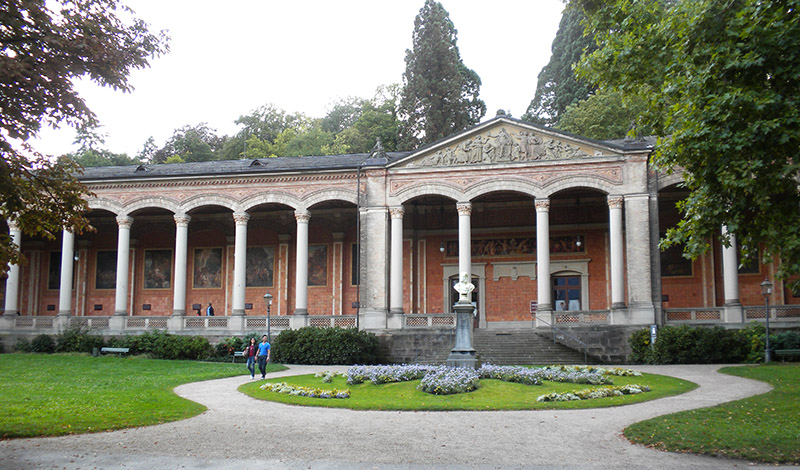 The other appointment in the day of the European elites of the turn of the century would have been a visit to the casino. To reach the casino from the spas we had to stroll through the narrow streets of the centre, constantly nose up in admiration of the exquisite art nouveaux architecture. After a meal in one of the many nice restaurants near Leopoldsplatz, we finally reached Kurhaus Park. In this park, on the right of the casino (coming from the centre), there is another stunning neo-renaissance building, the Trinkhalle. This is where the 19th century society used to gather to socialise and “take (mineral) waters” directly from the spring. Nowadays, there is a tourist information kiosk and a café, but the spring water is still there to deliver its curative properties.
I was particularly curious to visit the famous casino, mostly because one of my favourite writers – and without any doubt one of the major and most influential European writers – Fyodor Dostoyevsky, spent there a lot of his time, and most of his and his wife’s personal fortune. Apparently, he wrote one of his well-known novels, the Gambler, between his visits to casinos in Baden Baden and Wiesbaden.
The building was refurbished in 1855; its exterior is quite simple (neo-classic), maybe to compensate for the pompous empire style of the interiors, which take inspiration from Versailles Palace. My partner and I couldn’t restrain the temptation of trying some gambling, and we played the roulette for a couple of hours, let’s say with an alternate fortune… The crowd of fellow gamblers was quite varied. There was a group of smartly dressed Italian women was drinking at the bar and every once in a while betting a few Euros; a group of Chinese men was betting outrageous amounts of money on random numbers (and mostly losing it, of course), a group of Russians who were not exactly sure whether they were spending enough to be treated with due respect; and then individual lone gamblers, men and women, betting compulsory from one table to the other. After having tried la vie de la belle époque for one day, for the following day we decided to go back to the present and try some walking in the splendid forest.
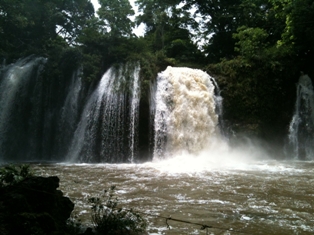 We took a path that started near our hotel and that led south of town to a small village named Geroldsau and from there to a small waterfall. For sure this one was the most beautiful and enjoyable of the walks we did, but the most interesting was definitely the one we took from the village of Forbach (southeast of Baden-Baden). We chose that area because we noticed a nice lake on the map. While we were walking towards it, suddenly the forest opened up, and what looked like a gigantic fortress wall appeared in front of us. After a few moments we realised that was actually a dam. It might have been the cloudy day, or the dark forest or the peculiar structure of the dam, but this unexpected apparition seemed truly sinister and disturbing. We scrambled to the side of the dam to reach the top, where we found a panel with information about the dam itself. Its name is Schwarzenbach-Talsperre and it was built between 1922 and 1926 to supply electricity to Baden-Baden. After being damaged in July 1944 by Allied bombs, it was basically left in a state of semi-abandon. It still holds the lake, which from the distance appears to be quite attractive, but after a closer inspection, reveals swamps around the fringes, and it is unsuitable for swimming or boating.
At the end of my visit to Baden-Baden, I could conclude that, even if it lost its status of “Summer Capital of Europe” long ago, the town still retains its charm and makes an excellent destination for a short break in any season.