 Previous blogs in this mini-series discussed the cottage industries and agronomic imperatives that have shaped the walking experience in high mountains, but not all our pathways to pleasure were beaten out in pursuit of such down to earth objectives. Some of the pioneers were looking further afield, a lot further, exploiting the elevation of mountains for triangulation surveys. The obvious incidence of this are the trig points in the United Kingdom that have become so popular that many hikers ‘collect’ them and, now that they have been superseded, campaign to preserve them. Trig points are less dense on the ground in Spain, but their geographical and historical reach is perhaps greater. For instance, the ruins on top of mainland Spain’s highest mountain, Mulhacen (see Walk! The Alpujarras) and the remains of the track zigzagging down its southern flank, date from a nineteenth century survey of North Africa that took advantage of the summit’s views of Algeria. But for my money the best story involving scientists in high places concerns François Arago, the nineteenth century French astronomer, mathematician, physician and politician, who became an academician at the tender age of twenty-three.
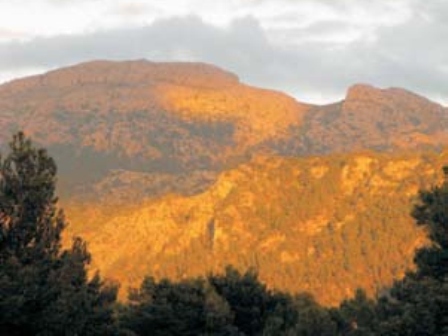 Employed by the Paris Observatory in the French meridian survey(they couldn’t be doing with that English thing running through Greenwich), Arago spent a couple of years in the Spanish mountains establishing various points of latitude and determining the varying force of gravity in each, fetching up in Mallorca in 1808 and settling in a small cabin on the summit of the Mola d’Esclop with a view to measuring a meridian arc determining the exact length of a metre.
Unfortunately, though he may have been a dab hand at latitude and longitude, Arago’s timing was not otherwise impeccable, because his arrival in Mallorca coincided with the Spanish leg of Napoleon’s world tour, an invasion that some people maintain to this day was motivated by the Little Emperor’s desire to steal the recipes of Spanish cheeses – I’m not making this up! I say his timing was poor, but to be fair Arago was perhaps just being a bit bloody-minded, determined to complete his scientific researches come what may. Somewhat more prudently, his colleague, Jean-Baptist Biot, fled to France the moment Napoleon installed his brother Joseph Bonaparte as ruler of Spain. Arago, meanwhile, disguised himself as a peasant, albeit a peasant possessed of a lot of costly scientific equipment.
 In the circumstances, the Mallorcans took an understandably dim view of a French official sitting incognito on top of a remote mountain and setting mysterious fires in the dark of the night when any number of nefarious Frenchmen might be out there in their nefarious French fleets nursing their nefarious French intentions, so the hapless scientist was imprisoned in the Bellver fortress in Palma on suspicion of being a nefarious French spy. Thereafter, he engaged in a series of misadventures that would have done a penny-dreadful proud. Escaping from prison with the connivance of the fort’s philomathic commander and absconding in a fishing boat, Arago fled to Algeria where he took passage for France. Unhappily, within sight of Marseille, the ship was captured by a Spanish privateer, and Arago was locked up again, first at Roses and then at Palamos on the Catalan coast. After three months inside, Arago managed to persuade his captors that he really was a scientist and not a spy, whereupon he was released and again set sail for Marseille, only to get caught in a gale and blown back to North Africa by strong northerly winds that deposited him in the obscure port of Béjaïa, where he was jailed yet again, this time by the local potentate. Currying favour by promising to convert to Islam, Arago got himself out of choky for the third time and, with no sea transit available for the next three months, walked the 220 kilometres to Algiers, where he was (yup, you’ve guessed it, he seems to have had ‘issues’ when it came to people who possessed big keys and dark cells) duly incarcerated and informed that he’d shortly be shipped off to a penal colony. Released thanks to the intercession of the French consul, he hung about for a further six months before finally embarking for and actually landing in Marseille, where he was promptly banged up in the lazar house for three months’ quarantine!
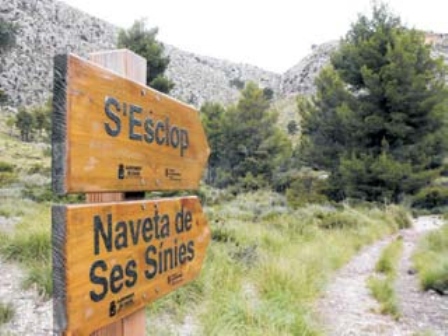 We pass the remains of his hut on top of S’Esclop in Walk! Mallorca West and pass below them on the island’s LDP, the GR221. Of themselves, the roofless ruins are nothing very spectacular, but taken as a monument to a remarkable career, they’re a sight more appealing than having a statue raised to your memory and being turned into a public toilet for the benefit of every passing pigeon.
Read the two previous posts in this blog series: