There are a lot of amazing festivals out there: Steve Davey should know, he is the author of a book detailing 500 of the best cultural celebrations around the world.
I have recently returned from one of the most breath-taking festivals I have ever visited. Breath-taking as it is an incredible traditional Buddhist festival held in a rickety monastery on the shores of the beautiful lake Tsomoriri; and breath-taking due to the high altitude. Tsomoriri lies at 4595 m (15,075 ft) and is primarily fed by the spring snow melt in this harsh, yet stunning region.
The dusty village of Korzok lies at the edge of the brackish lake, and is noted for the ancient Korzok Gompa – a Tibetan Buddhist monastery, which is home to around a dozen monks.
The annual festival, or Gustor, attracts Chang-pa herdsmen from the surrounding area. These devout nomads bring their yaks and Pashmina goats to the grasslands above the village for the Summer grazing. Many of the women wear elaborate headdresses, decorated with lumps of turquoise.
The festival stretches over two days, although the first is very much a day of preparation and practice. Everything warms up on the second day. The gompa is swamped by pilgrims, who line the galleries around the courtyard and even the flat roof. Parts of the structure creak alarmingly at the unfamiliar load of so many people and bits tend to break off and fall throughout the day.
The day starts off with the ceremonial release of various animals, which are ‘donated’ to the monastery for a symbolic release to brink merit to the monastery. A number of goats, horses, a dog and even a yak are brought into the courtyard, and amidst chaotic scenes are daubed in red paint, symbolising a blood sacrifice. The yak is particularly feisty and struggles to get away from its handlers and charged at the crowd. A number of monks and nomads grab hold of ropes and its horns to subdue it, until it is time for it to be released.
The moment of release feels like an anti-climax after the preparations. The animals are chased through the courtyard gates by a group of whooping pilgrims. Straight outside, the yak slows to a trot, and then strolls back down the hill towards its grazing.
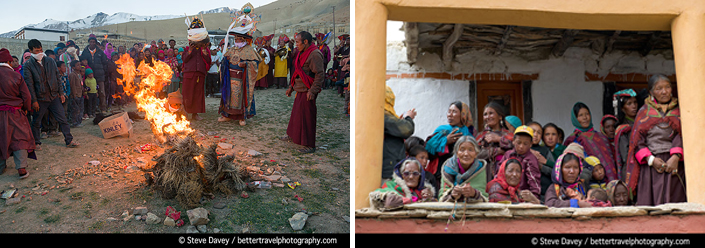
The pilgrims have come to watch the Cham dancing; a traditional religious art form, where masked monks perform dances that act out morality plays and even some of the history of the Gelupka religious order. The dancing is slow, rhythmic and repetitive; and the traditional masks that many of the dancers wear obscure any facial expressions. The pilgrims, both villagers and nomads, lap it up though. They watch entranced, although towards the end of the day, after a long lunch, some of the older people start to doze off, and some of the children start playing up. One child ducks away from his parents and starts to join in the dancing; imitating the pose of a dancer with a cheeky grin on his face.
The last dance is the Black Hat dance, which recalls the killing of an ancient king by a monk. The king was accused of renouncing his religion, and is still seen as a bad guy. The dance culminates in a disturbing recreation, where the ‘king’ is roughly paraded in front of the crowds and greeted with catcalls and jeers. After much mocking he is forced to bow in front of the portrait of the Lama of the monastery and then ‘dispatched’.
That evening, as the sun starts to go down, a lively procession led by monks playing horns and drums, leads all of the pilgrims to the outskirts of town, where Black Hat dances, perform again, and then burn a mask representing an evil spirit which is stoned in the flames.
The following morning and the village slips back into its usual sleepy torper. The morning bus back to Leh is packed, and the nomads have all gone back to their yak hair tents on the grasslands. Even the small stalls in the open ground outside of the gompa have cleared away, and as I have one last walk around, no one greets me, or tries to sell me anything. Inside the monastery, the monks have swept up the courtyard and are sitting around inside the prayer hall. Exhausted from early morning chanting and days of dancing, they drink sweet chai tea, chatting quietly; happy that the festival is over for another year.
Steve Davey is a writer and photographer who travels compulsively to festivals all over the world. He is the author of a major new book on festivals: Around the World in 500 Festivals (Kuperard, October 2013).
Steve is the author of Footprint Travel Photography (Footprint, November 2013), and has just finished the second edition of this guide to everything that you could ever need to know about travelling with your camera.
Steve leads photography tours to to some of the most exotic parts of the world, often coinciding with local festivals. More information of www.bettertravelphotography.com