 Annabel Barber visits the beautiful area around Lake Garda, ‘the land where the lemon trees bloom’.
“Kennst du das Land, wo di Zitronen blüh’n?” asked Goethe breathlessly, in one of his most famous lyrics. “Do you know the land where the lemon trees bloom?” He was desperate to share his secret of where earthly bliss could be found. He believed he had discovered it, on Lake Garda. “I have exchanged the cold, clammy north for the radiant air of Italy!” he exclaimed in one of his elegies. He was thirty-seven years old and was finally escaping to sow his wild oats, fleeing the constraints of his job at the court of Weimar and the manacles of a “platonic” friendship with a demanding older woman. Lake Garda, for him, was a dream come true. And he had never seen lemon trees before.
Lemon trees still flourish around the lake. Traditionally they are grown in great stone-and-glass greenhouses called limonaie. The roofs are made of wooden slats which can be removed in warm weather. At Torri del Benaco, perhaps the loveliest place on the eastern lakeshore, a large one still survives, built up against the great fortress of the Scaligeri, lords of Verona, whose castle dominates the small port town with its ivy-clad turrets and swallowtail crenellations. The limonaia windows are two-thirds plastic sheeting today, because just outside it is the area where local boys play football, and more than one bosh shot has fallen foul of a window pane.
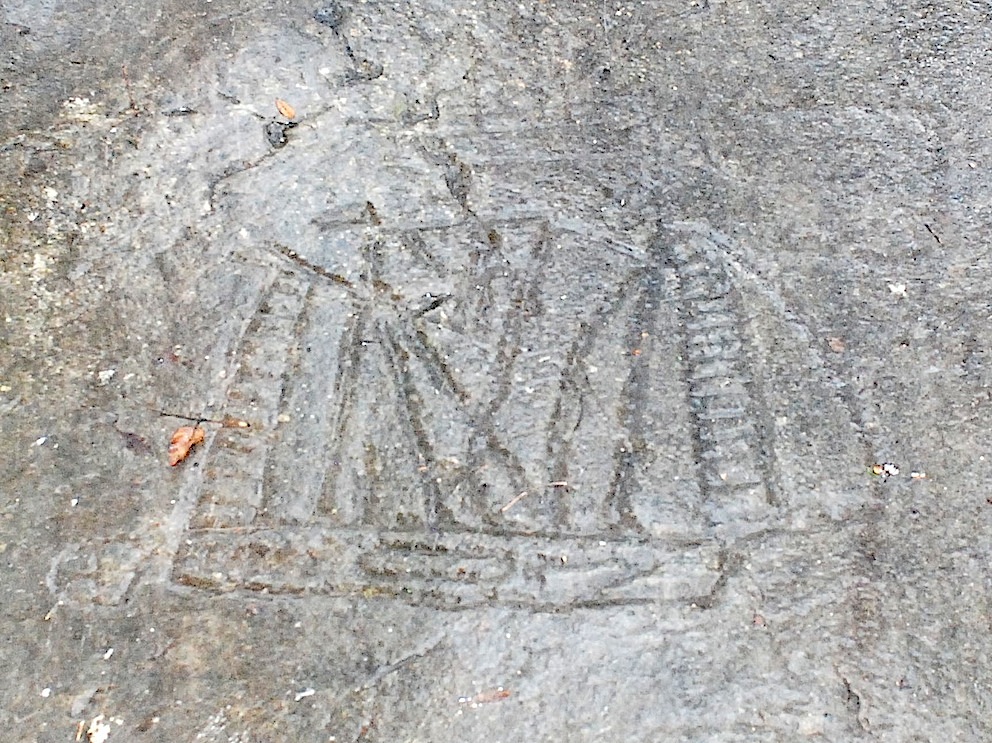 Right on the water’s edge at Torri, beside the old fishing harbour where boats still tie up and where cafés sprawl along the foreshore, is the Albergo Gardesana, a lovely and comfortable place to stay. From the harbour you can take a ferry across to the western, Lombard, shore; or else put on your hiking boots and take to the hills. Narrow paths lined with wild flowers lead between olive groves to the hamlet of Crero, where there is a place to have lunch overlooking the water (grilled lavarello, perhaps, a delicate-tasting fish that is native to the lake), or in the other direction, to the foothills of Monte Luppia, where you can inspect mysterious rock carvings of boats—all kinds of craft, from simple coracles to paddle steamers—and wonder how they got there. Were the first ones truly ancient, sparking a trend which has continued into our own day? Or were all of them put there by some hoaxer? There is an exhibition devoted to these carvings in the castle museum in Torri, but it is mealy-mouthed about their antiquity. It devotes a lot of wall space to comparisons with Lascaux. But hang on! Are we to believe that these two-masted schooners are Neolithic? The work of a stone-age Leonardo da Vinci? A genius of his time, his brilliant brain foreshadowing inventions yet to come? I doubt it. Still, the incisions are well worth a look. One day I hope someone will write a scholarly tome about them.
When I visited Garda earlier this month, everyone was out in the olive groves pruning the trees. The oil of Garda is famous; in fact there is a museum dedicated to the subject at Cisano, just south of Bardolino. In the evening, we returned to Torri for a valedictory drink on the waterfront, watching the sun set behind Monte Spino. If you like the taste of Aperol, it is important to know your mixtures. A “Veneziano” is made with prosecco, Aperol and soda. A “Spritz” is white wine, Aperol and soda. Goethe doesn’t write about Aperol. But I’m sure he would have loved it. It is made with citrus fruits.
Annabel Barber is Editorial Director at Blue Guides. Browse the Blue Guides range>