Iguassu Falls were confirmed as one of the New 7 Wonders of Nature in 2012, so , Rachel Ricks went to check them out…
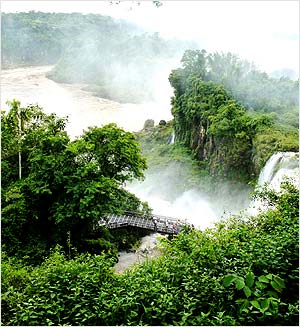 My visit to Iguassu Falls in Argentina was one of those highlights of a lifetime – and it turns out, not just for the spectacular waterfalls themselves – it was going to be an extraordinary opportunity to see wildlife close up, too.
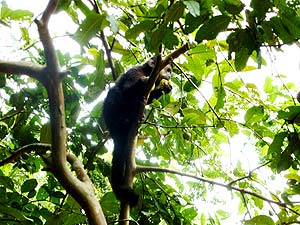
Within just metres of entering the Iguassu National Park, I spotted a family of capuchin monkeys crossing through the trees at arm’s length beside the footpath. Then more and more appeared, even a mother with tiny baby clinging on, swinging through the foliage, simply going about their daily business. Indifferent to us close-range tourists that gathered to coo and watch, one bold little ape even sat low in a small tree choosing fruits by picking them off the tree, tapping them on the branches and if they seemed satisfactory, peeled them to consume, otherwise they were tossed to the ground.
Now, back to the falls. We were following a trail through the rich forest, and soon it became a boardwalk that spectacularly wound through the trees, high above the river, crossing smaller falls and stopping at occasional viewing spots to finally reach a large viewing platform with panoramic views across the full range of the tremendous falls.
 Next was a lower trail which led to a platform within metres in front of one set of falls, where the spray drenched everyone through to the skin. No chance for worrying about appearances at Iguassu – some visitors had opted for waterproofs, some just winged it in their ordinary clothes, others were in bikinis and flip flops. Whichever way you choose, you’re going to get wet, very wet at Iguassu.
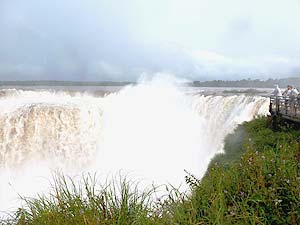
A small train powered by natural gas takes you for a 30-minute ride through the jungle to the beginning of the trail to the piece de resistance of Iguassu Falls – the Devil’s Throat. As we began traversing the 1km-long metal walkway that spans the broad river before it plummets over the edge, an almighty thunderstorm rolled in. We thought we must be over half way across, so there was no option but to continue in the thunder, lightning and pelting rain.
By the time we arrived at the viewing platform for the Devil’s Throat, we were drenched, and were to get even more so. As I looked down over the railings at the crashing waterfalls, my breath was taken away. Especially when all the other visitors on the platform started screaming and I looked around hurriedly to see what was going on. A massive cloud of spray from the falls came sweeping over us, drenching us with icy water. And this would keep happening every few minutes, making everyone scream with a mixture of horror and hysterical laughter.
 This is no place for vertigo sufferers, as you stand on the metal grate suspended right at the edge of the crashing, thundering falls that at a rate of 1750 cubic metres a second descend to 2470 metres below – the bottom wasn’t even visible on this stormy, rainy day we visited.
At the other side of the platform, the falls were slightly calmer and we were astonished as we looked down to see swifts circling through the mist to their nests, which are defiantly tucked into the rockface behind the roaring curtain of water.
Back at the centre of the park, the rain clouds had parted and we attempted the hopeless cause of drying off. As we passed through the café area, we had our final, delightful wildlife encounter of the day as we came within centimetres of snuffling coatis, both adults and babies. Undeterred by – or maybe because of – all the humans, these furry critters were scavenging for food under the café tables.
Tropical butterflies, birds, monkeys, coatis, oh yes – and one of the Seven Natural Wonders of the World. It’s quite a day at Iguassu.
How to do it
You need at least one full day to appreciate the falls.
I visited from the Argentinean side, entrance fee at time of writing was Ar.$130 (less for Argentineans and Mercosur inhabitants). Entry for the next day is half price with the same ticket, though you must get it stamped at the end of the first day.
In Argentina, you visit the falls from the town of Puerto Iguazu. This purpose-built town is dull but tends to all your needs – hostels, hotels, ATMs, pizzerias, bars, and two small supermarkets. A worthwhile walk is through the town to the Three Borders Monument, from where there is a great view of Brazil and Paraguay across where the River Iguazu and the River Parana converge, forming the natural borders between the three countries.
The bus terminal is in the centre of the town. You can reach Puerto Iguazu from Buenos Aires (18-20 hours) or Salta in the north, via Posadas or Corrientes (total journey time of around 22 hours). It is also from this terminal you take the bus to the falls (30 minutes), Rio Uruguay is the main company – you can’t miss the ticket offices as vendors will be calling to the “cataratas” or “falls”.
You can fly to Puerto Iguazu from Buenos Aires (1.5 hours).
On the Brazilian side, you can fly or bus into Foz do Iguacu. You can get a more panoramic view of the falls from the Brazilian National Park.
It’s easy and quick to cross the border between Brazil and Argentina – arrange a taxi for around Ar.$120, ensure they will stop and wait for you to get your stamps at the border control post. Buses also leave regularly from the terminal, or you can book tours in town.
You can also visit the falls under the light of a full moon on a guided walk. Normally running five nights a month; check by calling the Iguazu office: (+54) (03757) 491469 or email: [email protected]
The Puerto Iguazu Tourist Information Office can be found at Av. Victoria Aguirre 311; tel: (+54) (04757) 420800; www.iguazuturismo.gov.ar
Parque Nacional Iguazu, Argentina: www.paquesnacionales.gov.ar
Parque Nacional do Iguacu, Brazil: www.icmbio.gov.br/parna_iguacu