In the third post of her blog series on India, Isobel Wilson Cleary heads to Amritsar for Diwali.
Taking a last minute trip North to spend Diwali with the family of another volunteer who live in Delhi was one of the highlights of my time in India and a lot of that is thanks to the quick weekend getaway we did further North to the Punjab which I’d definitely recommend as a slightly less trodden tourist path than the Golden Triangle or Kerala.
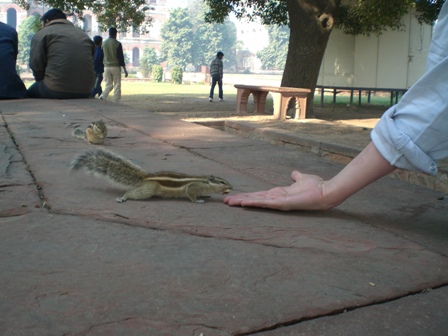
Diwali is the biggest festival of the year in India and the fanfare to which it arrives reminded me a lot of the pomp and circumstance Christmas enjoys here in the Europe and the U.S.A. Not simply because it seems to be celebrated by everyone regardless of religion. Along with the luxury selection of chocolates and nuts at pride of place in supermarket entrances we also learnt that just like home, there is very real possibility that suddenly travelling is a much costlier affair than you might first have thought.
Train ticket costs do go up but they’re still very reasonable for the distance and length of time you actually spend on them. If like me you’re unsure of where you’re going, who you’re going with or when exactly you are going then there’s the distinct possibility that you won’t be able to find any tickets at all. I’d heard that you really needed to get a head start if you wanted trains and I foolishly assumed a month prior was enough time. Around Diwali this simply isn’t true, there weren’t any available tickets except for the frantically last minute TatKal quota (which is quite like ebay-sniping and requires high-speed internet, something not in abundance where I was) or the possibility of tourist quota where you find out the day before whether you actually have tickets or not.
Safe to say we decided booking the flights to Delhi was the more costly but sensible option. In the end it was about the same cost as a cheap flight from the UK to Europe and there’s no need to pay extra to check baggage in with a generous 20kg limit!
We opted for private transport – a Tata Safari 4 x 4 rather than a train to take us from Delhi to Amritsar but we didn’t avoid the defining characteristics of travel in India; too many people in too small a space and a bad estimation of just how long it takes to cover 300 miles on a road so good it was likened to newly opened Yamuna Expressway between Delhi and Agra. For future reference, the NH1 is one of the oldest in India and follows the route from the capital to the Pakistani border and yes it might one day be like the Yamuna if it ever gets finished.
The journey up to Haryana was smooth, we stopped once for breakfast at the first of many roadside dhabas my mother would probably have despaired at before arriving in Ambala just before noon – a city about halfway with a reputation for a large cantonment area and the best clothes market in the area. The perks of travelling with a local – one of the other volunteers who grew up in Chandigarh – meant we were welcomed into the ancestral home of one of her friends for much of the day; provided with a great breakfast feast, a tour of the house and much of its original architectural features and the opportunity for a nap or a shower – both if you were lucky! It would have been great to see Chandigarh – the first planned city since Independence by Le Corbusier but then we would have missed out on that amazing Indian hospitality people always talk about.
We eventually left Ambala with 2 extra people and, consequently, a taxi late the same afternoon. About the time we had expected to reach Amritsar. No worries, the anticipation of Amritsar only gained momentum as the evening wore on and after a few stops and a bit of a buzz we arrived in the busy Amritsar centre just after dark. A group of 10 young people – most of us Western – we caused quite a stir for the many Sikhs who make the trip to this sacred gurdwara perhaps only once in their lifetime. We took advantage of the cheap accomodation on offer in the guest house within the temple complex, mere minutes from the temple itself with a tourist allocation, and comfortable, clean rooms.
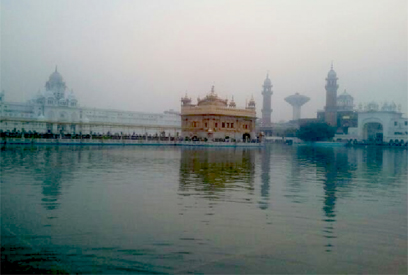
Rising early before first light we didn’t even manage to beat the Sikh devotees who spent the night in the hallways. Crossing the threshold into the temple we covered our heads and cleansed our feet in the pool that marks the entryway and made our way straight to the temple itself which was much smaller and not completely covered in gold (the lower half was marble) as I had imagined. It was one of the most relaxing experiences of my life, a sense of calm I never felt in the frenzy of visiting Ganesh temples elsewhere. Arriving so early we caught the first ‘hukamnama’ (daily decree) and ‘ardas’ (daily prayer) of the day before the sun had even risen, we experienced the three levels of the Golden Temple before the early morning mist had burnt off. There’s even the chance to catch up on breakfast with the traditional ‘langar’ prepared by volunteers.
 Later that morning, we took a walk from the guest house along streets with shops filled with items of Sikh worship – kanghas (combs), kara (steel bangal), kirpans (small swords) – into the centre to indulge in some less sacred purchases including but not limited to; an abundance of jewelry that could weigh you down, jutti slip-ons in a range of colours and decorations, Patiala pants (named after the second-largest city in the state) and more scarves and quilts than I’d even thought of since arriving in India but it was a lot cooler up here on evenings and at night than further South.
After tasting authentic pistachio kulfi from one of the streetfood stalls we took the narrow passage to Jallianwala Bagh, the site of the 1919 massacre David Cameron recently apologised for. Perhaps somewhat oddly it’s now a park. The juxtaposition between families and friends enjoying their day off in the sunshine and the memories which linger not even a century ago in the bulletholes that still marr the walls and the water well where people jumped to their deaths to escape the bloodshed is a poignant one but somehow it works.
Perhaps because unlike other cities, there hasn’t been such a technological explosion of IT companies and foreign corporates in the city, Amritsar feels much like how I imagine many of the other larger cities to have been like only a decade ago. Up until this point I hadn’t even seen a cycle rickshaw in Pune and sure enough we rectified this with a 45 minute journey across the city; down side streets, up bustling thoroughfares and across railway lines – it was so different from the usual autorickshaw and not just because you don’t have to crouch for fear of hitting your head on the roof fabric or missing out on what’s going on in the street.
We squeezed in a late Punjabi lunch featuring Amritsari fish curry, dal makhani and kulcha )similar to roti) before rushing to complete the final leg of NH1 up to the Wagah border – named for the village divided by the Radcliffe line during Partition in 1947 – with only 25 minutes to go. After a little speeding and a lot of running we made it to our seats just as the flag lowering ceremony began with cheers of ‘Jai Hind’ and ‘Pakistan Zinaband’ from the full crowds on both sides of the gate. This rapid-fire ceremony of goose-stepping and shouting accentuated by towering headgear and military garb has to be seen to be believed, not so much “carefully choreographed contempt” (as once described by Michael Palin) as just, well, weird, given the uneasy relations the two countries still share. On returning to the car we passed a large sign welcoming you to “the largest democracy in the world’.
- If you would like to know more about Isobel’s trip please visit:
- www.everyclick.com/isobelgoestoindia
- www.developmentinaction.org
- www.deepgriha.org
- >Read Isobel’s first and second post.
> Want to find out more about India? Take a look at our collection of maps and travel guides.