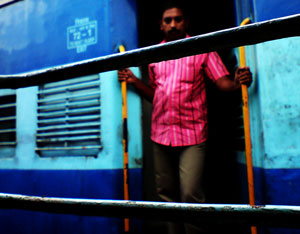
 Travel blogger Aditya Akhauri explains how the railway has become a microcosm of Indian society.
When the British started their Indian railways project in 1853, their intention was to have a means to transport troops, supplies and goods as a means of controlling the country’s political and economic landscape. However, what they didn’t envisage was that if they were able to use the railways to move around swiftly, so too could the Indians. Soon, the huge flow of people across different regions led to the unification of the country – and ultimately the end of the British Raj.
Interesting history apart, the Indian railways today are a network of 65,000 km and more than 7,500 stations. They are the veins that run through India, letting its life cells flow across different regions. They are the reason somebody from Assam in the rural north-east can pursue their dreams in Mumbai and the west. They are like the ligaments that tie different organs and make the body functional. When India moves, the iron tracks of the railways are the nerves which turn the flow of ideas into meaningful action.
No institution better showcases life in India like the railways. One can go to the train station and meet all sorts of people. Walking into a big station like Mumbai or Howrah (in Kolkata) or New Delhi, one sees a sea of humanity like a teeming rainforest. People from all walks of life are chirping and buzzing around, their voices forming a humdrum that engulfs the mind and cuts out all other noises. At that point in time, the station and its people are all that exist. Disabled beggars drag themselves across the platform, attempting to forge an existence from the scraps of others; the rich cocooned in their own world; a middle class trying to work its way away from the chaos of the platforms to the organised lines of the airports; and the daily wage-earning masses whose major concern is punctuality. It is where the so called ‘sadhus’ and ‘mahatmas’ start their journey towards spiritual enlightenment and where kids turn into adults, when they undertake their first journey alone.
A train’s different classes are reminiscent of the economic disparities that exist in India. Politicians, rich businessmen and heirs to their thrones travel in first class air-conditioned cabins where they are waited upon by attendants, whereas the poorer working masses travel in general compartments where there are seemingly no limits to the number of people who can be crammed inside.
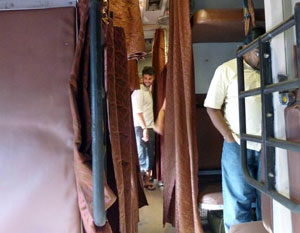 Despite the way economic and political divides in Indian society are amplified by the railways, the cultural disparities are done away with. People from all castes, regions and religions intermingle with each other, and while travelling it’s hardly anyone’s concern as to whom the man next to him is (providing he’s not a thief, of course). In a train nobody asks the vendor what their name is before buying snacks from them; at that point of time it is a state of social utopia that the liberal thinkers of the country only dream of achieving.
Everybody in India is in one way or other attached to the railway. It acts as the umbilical cord between families divided by geography; it gives one a chance to enjoy the beautiful vistas of the country when one travels on the mountain railways; it allows one to live like a maharaja while travelling on some of the world’s finest luxury trains; it transports goods from one place to another, making it possible to feed all the people of the country; it is a bread earner and a political bandwagon – it is all this, and yet it’s still to be explored. One can go on discussing the faces that this Donna adorns in its various avatars, but one fact remains: that the railway is a microcosm of Indian society.
Indian railways: Top 5 facts
- The first Indian train departed for Thane from Bombay on 16th April 1853.
- It is the world’s second-largest railway network under a single management.
- Kharagpur in West Bengal boasts the longest railway platform in the world at over 2.5km.
- Over 14,000 stations depart on the network every day – the distance they cover in 24 hours is three and a half times the distance to the moon.
- More than 11 million people travel on Indian trains every day.
Ahmedabad-based travel writer Aditya Akhauri writes for the Lonelyronin blog.
For more on India’s railways, we’d recommend Samit Roychoudhury’s excellent Great Indian Railway Atlas.