 Caroline Sandes continues her Balkans adventure in Dubrovnik, exploring the city’s old town, staying in rather questionable accommodation and meeting a lost puppy.
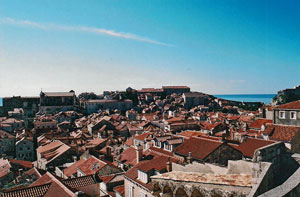
Dubrovnik is, of course, beautiful in a sort of quaint, picturesque fashion. The historic old town with its trademark red-tiled roofs is contained within its city walls, keeping it apart from the more modern town that sprawls around it. It sits on the edge of the Adriatic, and for the couple of days I was there the sea was doing what it is known best for here, radiating blueness with rippling waves twinkling in the sun.
Dubrovnik was warm after the autumnal weather of Mostar and Sarajevo, and the almost complete absence of any evidence of the war that had left such scars on the previous two cities was something of a relief. Except, I have to admit, I’m a bit allergic to very touristy places. They seem overcrowded with people doing the same thing and are inevitably expensive. Furthermore, because tourism has often become the main source of income for most people in such places, the locals are, understandably so, at best jaded by a continuous stream of tourists, at worst aggressive in their view of you as a source of needed dollars. The old town of Dubrovnik as a World Heritage Site is clearly on the mass tourist trail and seemed correspondingly affected.
 I got off the bus slightly dreamily as the trip from Mostar had mostly followed the coast and it had been a stunning journey, curving back and forth above the Adriatic Sea in the sunshine. I was immediately pounced upon by a rather large and determined woman offering accommodation. As her price and location seemed reasonable, I agreed but she handed me over to another woman who took me across the road to a house. This was not exactly the location that had been indicated by the first woman, but never mind, at least I knew where I was: opposite the bus station.
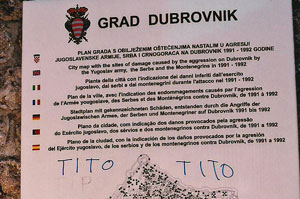
Dubrovnik old town is ideal for those who like to wander. Once you’ve ambled down the long central street, the Placa, with its lovely buildings, you can spend quite some time exploring alleyways and climbing up and down steps. Despite the excessively touristy nature of the Placa and its immediate surroundings, people do still live in the old city, as is evident from the laundry on lines and children playing football as you get away from the central part. There are churches, art galleries and in the Franciscan monastery near the Pile Gate is what is reputedly the third-oldest functioning pharmacy in Europe. There is almost no evidence of the bombing of the Balkan wars of the 1990s except some of the red-tiled roofs of repaired buildings are a brighter orangey-red than older ones, and near the gates of the old city there are some signs mapping what was damaged (one of which had ‘Tito’, the Yugoslav revolutionary, graffittied across it).
 The highlight of any wandering in Dubrovnik is to walk round on top of the city walls, but as these get very crowded I had saved them for the following morning. Added to which, the only way to get up there is to pay the fairly substantial admission fee, so I wanted to be able to make the most of it. The next day I set off early, though feeling a little tired due to a sleepless night. Very occasionally, I find myself staying in a place that makes me feel decidedly uncomfortable for no apparent reason and my accommodation in Dubrovnik turned out to be one such place. It was slightly odd – someone’s small house with a ground floor converted into rooms, one bathroom and a kitchen area. There was a lower ground floor where the lady who had escorted me lived. I wasn’t the only one there – there was an American next door who beat me to the shower in the morning and used all the hot water.
Even first thing in the morning, the walls were busy (have you noticed how people on coach tours often subject themselves to the most gruelling of schedules? 9am and there they all are, dutifully following their guide around whatever VIP site it happens to be). Nevertheless it was fun to stroll round, looking down into the town and out over the sea, and I whiled away several hours up there in the sun.
The rest of the morning and early afternoon was taken up with browsing in bookshops, drinking coffee at the many cafes with their outside tables – perfect for people-watching – and visiting the odd exhibition and church. I then took a long walk away from the old town along the coast, round the harbour area with its plethora of small boats, and back to where I was staying, interested to see something more of Dubrovnik and to get away from the crowds of the old town.
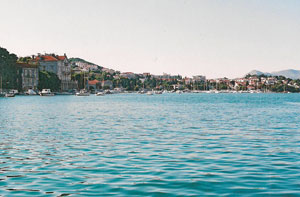 Dubrovnik is also a busy port for cruise ships and ferries that travel up and down the Croatian coast. In the evening, I ate at a roadside cafe near where I was staying but overlooking the port. A huge ferry was docked alongside – large enough that I hardly noticed it was there until it started pulling out, allowing the evening sun that had had sunk behind it to fill the café with light.
The next morning, after the predicted though not-quite-so-sleepless night, I was sitting again at a cafe having breakfast before going to catch the bus to Split. A black and white puppy with a red collar appeared on the other side of the road, gambolling desperately from person to person. No one was paying it the slightest bit of attention, not even a couple of policemen who wandered past and who it bounced up to. It sat down forlornly and shivered. Oh no – a lost puppy – what on Earth to do, especially as I don’t speak a word of Serbo-Croat.
I finished my coffee and went back to where I had been staying to collect my bag and thought I’d ask the person running the place. There was no sign of her. So, perhaps I could say something to the person I bought my ticket from earlier in the bus station – she spoke English at least. It was with immense relief I saw that the puppy was nowhere in sight by the time I got back to the bus station about 10 minutes later (and no dead one on the road either), so I can only presume that it had finally found its owner. I could carry on with my journey to Split without worry. And where Dubrovnik was pretty, Split was to prove fascinating.
For my month-long Balkan trip, I used the Lonely Planet Western Balkans guidebook, the Lonely Planet Eastern European phrase book and the Freytag & Berndt Balkans/South-East Europe map.
Discover more of Dubrovnik with the following Dubrovnik travel guides and maps:
- Dubrovnik Flexi Map – save 25%!
- Dubrovnik and the Dalmation Coast Eyewitness Top 10 – save 25%!
- Dubrovnik MapGuide