If you’re considering a long-distance bus journey but aren’t sure how you’re going to cope, read Caroline Sandes top survival tips.
So, you’ve bought your mega-cheap coach ticket to wherever but now realise you’ll be spending hours cooped up in a small space completely disproportional to your height (unless you’re a shorty like me). The alternative to get to that place in the middle of nowhere you’ve got a vagary to visit, whether it be in west Africa or west China, is to spend hours jammed into an overcrowded ramshackle bus or minibus. How to survive?
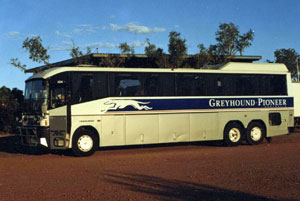
Having travelled in buses all over the world, including using a 10,000 km Greyhound bus pass in Australia, and routinely taking the overnight bus from London back to Ireland, here are my top 10 survival tips, along with a few stories:
 1. Travel light
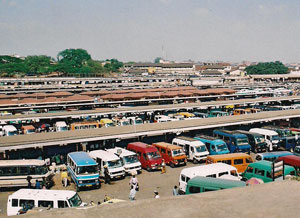
Travel as light as possible – in some countries the bus will be filled to bursting point with both passengers and luggage, especially in Africa and Asia. Travelling in Ghana, for example, usually involves using small minibuses known as tro-tros; while a legal maximum has been set for the number of passengers, there will hardly be space for you, let alone luggage – that will have to go on the roof unless you’re lucky enough to get it into the small boot space. In Mali, on full-sized buses, once the main seats have been filled, extra seats are flipped down along the aisle. The bus feels so full with people and luggage that you wonder whether the whole thing is going to split at the seams.
I usually take a 20 litre day pack and a 35 litre back pack – both can be carried comfortably and will fit under most seats. If the worst comes to the worst, one can sit on your lap and the other under your feet without causing your knees to rise higher than your ears.
2. Take supplies
Stock up on water and snacks beforehand – you can never be sure when rest stops will happen. Even on the London to Cork bus the rest stops vary depending on the driver. Take fruit, nuts, anything healthy that is non-salty and non-sugary; this is not the time to be overly thirsty or fuelled up on sugar. Preferably take nothing that’s going to suffer from being squashed or stuck in a hot bus for any length of time – you really don’t want a mangled banana or melted chocolate all over your bag.
A few years ago I took the bus from London to Berlin and back. On the return journey, some 18 or so hours travelling time, I got on the bus at about 18:00 having not eaten since lunchtime. There were no stops apart from a brief one in Brussels. By the time we got to French customs I was so low on sugar and so thirsty (not to mention in desperate need of a coffee – it being about 06:00), I was afraid that if the rather stern-looking French immigration officer challenged me on anything I may either collapse in tears or take his head off. On the flip side, never have an espresso and croissant tasted so good.
When travelling in unpredictable countries it’s extra important to take supplies in case the bus breaks down and you have to wait, sometimes for hours, for the problem to be rectified. Travelling in Mali in 1999 between Bamako and Mopti, the overloaded bus broke down maybe three or four times and all one could do was wait in 40 degrees C while the driver tinkered around with the engine and got it going again. That bus journey took hours and hours…
 3. Take a map
Take a map so you know where you are should the bus break down and you find yourself in an unfamiliar bus station. On my first major world trip in 1996, I was on an overnight bus in Mexico when despite the driver’s efforts, the bus hit a deep crater in the road. He managed to get the unhappy bus to the nearest town but there left the passengers to catch another bus – fine if you speak Spanish and know where you are; not so good otherwise… I have never left home without a map since. The other advantage is that if you suddenly realise the bus is taking a route through somewhere you want to stop, or you simply get tired of sitting on the bus, you can change your plans accordingly.
A further positive is you can see the predominant direction of travel and work out which side of the bus will be out of the sun. Spending any length of time with the sun streaming in on you, particularly in hot countries, will leave you overheated, dehydrated and probably cranky. It’s also worth checking which side of the bus you’ll get the best view from, for example if you are going along a coastal route. In 2010 I travelled through the Balkans and took a bus from Dubrovnik to Split which wound its way along the beautiful Adriatic coast – well worth making sure I was sitting on the correct side.
4. Have small change to hand
Take plenty of small change for street food – in places like Ghana you can be offered food while the bus is waiting in traffic and if you’re dying for fruit, water, or a fried something or other, it’s best to have small change to hand. Also, many bus stations charge to go to the loo, or at the very least you may want to give something to the person keeping the place usable, so again small change is important. Having got off a long overnight bus journey from Podgorica to Sarajevo but with no Bosnian currency, I couldn’t go to the toilet until I had change, though once again it was 06:00 and I was in need of a coffee; thankfully the cafe in the station obliged by exchanging my euros.
5. Dress sensibly
Dress comfortably but wear layers and/or take something warm. Drivers can be totally inept (or couldn’t care less) about working the heating and air conditioning, if the bus has any at all, and you don’t want to find yourself cooked alive or freeze-dried.
 6. Sit towards the centre
Try to sit towards the centre of the bus – the back will be more bouncy and the enjoyment of sitting right up the front is directly related to the state of the road and the skill of the driver. On a 48-hour bus journey from Darwin to Cairns via Tennant’s Creek I had the front seat for an overnight leg of the journey. Kangaroo after kangaroo bounced onto the road in front of the bus and were dazzled by the headlights – we must have hit 10 or 12.
It was gruesome and even the bus driver was rattled by the time we got to a rest stop the next morning; “Put that on a postcard home!” was his parting comment to me. Furthermore, in some countries what side of the road you drive on seems in practice flexible. Travelling in Nepal once I was immensely grateful not to be in the front seat of the minibus that the driver careered down the mountainside playing what felt like dodgems with the upcoming traffic – sustained horn blowing all the way and putting even my usually unflappable passenger nerves on edge.
7.Who not to sit with
For those who travel solo, by all means try to keep the seat next to you free – but be warned, it’s often better to sit beside someone reasonable rather than run the risk of ending up with someone less desirable. On one occasion I made the 16-hour ferry and bus journey from London to Ireland and had a 30-stone behemoth squeeze himself into the seat beside me, leaving me sandwiched between him and the window. Another time, I was travelling in West Cork when an old man sat down beside me and began to tell me outlandish and implausible stories about the behaviour of his daughter-in-law, accompanied by him repeatedly patting my leg. I quickly positioned my bag on my lap which put a stop to that; but not his stories.
Sit as far away from small children as possible, especially if you see the parents dishing out bags of sweets, crisps or fizzy drinks – they’ll be bouncing off the walls within an hour. Alternatively, you may find that you become a source of entertainment. I had a very long bus journey, again in Australia, with a small child sitting beside me who insisted on playing I spy for hours even though she clearly didn’t really know her alphabet… and there was no way her parent was going to come to my rescue.
8. Take earplugs
I’ve had some torturous journeys because of high-volume music or films that no amount of asking to turn down will change. While in Jordan travelling from Aqaba to Amman, Arabic pop music was played so loudly that my ears were ringing by the time I got off. I won’t even start on the films I’ve had to endure, ranging from truly dreadful American should-never-have-been-released to violent Chinese gang movies.
 9. Take the train
If there’s a train and I can afford it, I take it. Having said that, I’ve made hundreds of bus journeys all over the place and the vast majority have been fine, not to mention cheaper. Worth special note are those in Mexico where there are three different classes of bus and you can book the seat you want; in Turkey where they treat you like royalty, zipping up and down the aisle with refreshments and scented handwash on a regular basis, and China where some overnight buses don’t have seats at all but beds…
10. And lastly…
Ultimately the most important things to keep with you are your sense of adventure, travellers’ patience, and a sense of humour – you’ll get there in the end.
Planning your own long-distance bus journey? Don’t forget these travel essentials:
- Snoozer: A travel pillow with a revolutionary design
- Spork: A handy spoon-knife-fork combination
- The Cooler Mini-Fan: A pocket-sized fan with three positions
- Travel Cushion: Lightweight and inflatable
- Travelogue: Record your trip on the go
Thanks for your precious info! I’m going from Seattle to Fresno, Ca. I hope I can make it fine. I’ll make sure I don’t eat something too salty and sugary.