After Nashville, battling a slight hangover, I headed towards another great southern state, Kentucky, home of bourbon, tobacco and horse racing. But as I don’t smoke and don’t give a damn about the horse racing I headed straight for some of the excellent bourbon distilleries. They are mostly located in small towns or even villages and getting there gives you the opportunity to explore some fantastic rural drives.
First, a few words about bourbon itself. It is a type of American whiskey; the name comes from an area known as Old Bourbon, (which, in turn, was named after the French royal family), around what is now Bourbon county, Kentucky. In the past the whiskey was transported in barrels with the name of the county on them and people started calling it simply bourbon. For a whiskey to qualify as bourbon, the law stipulates that it must be made in the USA. It must be made from at least 51% and no more than 79% Indian corn, and aged for at least two years (most bourbon is aged for four years or more). The barrels for ageing can be made of any kind of new oak, and are charred on the inside.
 One of the best distilleries I visited was Maker’s Mark which is located in the tiny city of Loretto (pop. less than 1000). You will need a good map (or a Sat-Nav) to get there, as you have to navigate some small rural lanes on your way, but it is well worth the effort. They offer a great tour of their relatively small but really interesting distillery. Maker’s Mark itself doesn’t have a too long a history as it was started only in the 1950s, but it utilises a much older distillery complex. Its distinctive listed buildings are painted black with elements of red and are located on neatly landscaped grounds. It looks more like a campus of some well to do university than a factory. The tour itself was as good, if not better than the one of Jack Daniels. We followed our funny and entertaining guide to all the corners of the distillery and it was possible (even encouraged) to take pictures absolutely everywhere. Maker’s Mark is a rather small operation and they are proud of that. Every single bottle is, for example, hand dipped into its trademark red wax.
If Maker’s Mark distillery looks like a campus, then Buffalo Trace looks like a proper factory. Its lovely historic red brick buildings are located on the outskirts of the Kentucky capital, Frankfort, and are much easier to find than many other distilleries. According to some sources, Buffalo Trace is the oldest continuously operating distillery in America. During Prohibition the distillery was even permitted to remain operational, to make whiskey for “medicinal purposes”. The tour they offer might not be as good as some of the others as they don’t take people to the distilling parts of their factory, but I really enjoyed my visit there. I guess it is because I prefer the old rugged industrial look of it over the gentrified look of some of the smaller boutique operations or the clinical industrial coldness of some big modern distilleries.
One of those big boys is Wild Turkey. Located in Lawrenceburg it is one of the biggest distilleries in the world. It is a huge industrial operation and touring it offers a different perspective of the industry to the smaller historic distilleries. There are a lot of stainless steel pipes and computer screens but far less charm. Fortunately its barrel warehouses are as old school as at any other distillery. During the tour you might have a chance of meeting Jimmy Russell the master distiller. He often drives his red pick-up truck to inspect the barrel storehouses. If you are lucky you can even chat to Jimmy – he is a walking institution. He started working here in 1954 and before that his father and grandfather both worked for the distilling business. Bourbon must be flowing in his veins.
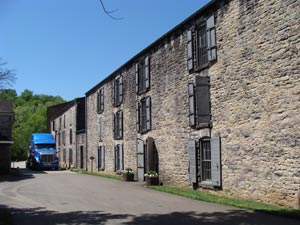 The last distillery I visited was Woodford Reserve. Located in Woodford county, eight miles from the town of Versailles, it is probably the most difficult to find of all the bourbon sites I visited. Distilling on the site began in 1797 and the distillery building itself was erected in 1838, making it the oldest of the nine bourbon distilleries in current operation in Kentucky–although the site has not been continuously operational as a distillery for that entire period. It is also the smallest bourbon distillery to produce a definitely premium brand. The stone buildings are immaculately renovated and somehow feel more like a museum than a factory. But there is no way of denying that it is a great place, especially on a warm spring day when, after the tour, you can relax on the lovely porch of its reception building.
One word of warning. All the distilleries offer free tasting after the tours. The tasting samples are small but remember that you will have to drive back. Don’t drink too many of them, regardless of how delicious they are. Bourbon chocolates might be a safer option.
In general, Kentucky is a great state to visit. It has a clearly southern feel, which might put some people off (especially Europeans), but it shouldn’t be the case as it is full of easy-going and friendly people. Come on, let’s face it, people who make some of the best alcohol, grow some of the best tobacco and bet on horses must know a bit or two about how to have a great time. Spring in the south is an especially good season to drive the rural highways connecting the distilleries, or to sit on a porch sipping great bourbon while warming up your old bones. Or how about having a great BBQ followed by the bourbon chocolates? I have spent some of the most relaxing days during all my American travels there.
> Browse our collection of travel guides and maps to Kentucky
Author: Gregor Swiderek