 Choosing a mode of transportation is one of the most important decisions when you are planning your trip. Technically, you don’t have to rent a car, but let’s be straight and honest: public transport in the US sucks and if you don’t have a car your mobility will be greatly reduced.
Anyway, let’s start with public transport.
Probably the most romantic way of travelling around the USA is by using the trains. Railways built America. Anyone who knows a bit of US history or even just watches the western movies knows what I’m talking about. However, the truth is that nowadays America has all but abandoned its passenger railways. American freight railways are one of the most efficient in the world, but passenger services are a mess. The government-owned Amtrak still runs the trains, but its services are severely limited and every year there is a fight for subsidies threatening the future of the company. Transcontinental trains are more expensive than flights but they offer a great experience and often fantastic scenery. If you plan to use them a lot, the cheapest option is to book a multi-day pass before you arrive in America. Summarizing, American trains are rather expensive, services on a particular route often run only a few times a week, the network is rather skeletal, but on the other hand they offer a great American experience and scenery (especially in the western half of the country). Trains are fun, but they won’t really be practical during any slightly more complicated itinerary.
One of the cheapest options for covering longer distances is to use long-distance coaches. The biggest company with the most extensive network of connections is Greyhound. Its buses plough the interstates from coast to coast and from the Canadian border to the Mexican one and beyond. It offers reasonable fares and good value multi-day passes which can be bought even cheaper if you book them from abroad. However, it often offers only one connection a day on particular routes which often arrive or departs at quite ungodly hours. Its bus stations are often located in rather bad and not quite safe neighbourhoods. For example, I definitely wouldn’t recommend visiting the Greyhound bus station in Los Angeles after dark. On the plus side, you can meet some interesting if sometimes weird people on board Greyhound buses. Just remember that many Greyhound customers are not exactly the cream of society, including people who can’t get driving licences or have had them revoked for reasons you might not want to know.
There are some other bus companies, most notably Megabus, which in the last few years has aggressively developed new routes and at the same time offers very low prices. The problem is that its network is limited to a few hubs like, for example, Chicago. It mostly offers routes from its hubs and it doesn’t serve smaller destinations. On the plus side, its buses are modern and offer Wi-fi and its customer base is more diverse than Greyhound’s one.
In general, coaches are good only if you want to move between larger cities and don’t really plan to exploration the countryside. For example, as far as I know, none of the national parks can be reached by bus. For that you really need a car.
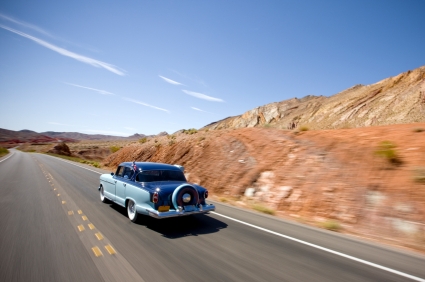
To really have freedom of movement you will need to get yourself a car. Fortunately renting a car in America is easy and cheap. One of the most common pieces of advice found in the guidebooks is to look for fly-and-drive deals. I can definitely say it is mostly not true. It might work if you want the smallest and cheapest junk car, but even then you can be better off choosing your own car rental agency. You can search offers and check prices directly on the car rental agencies’ websites or using aggregating sites, like with flights and airlines. Car rental prices do fluctuate, but much less than the prices of flights. I usually book cars quite late, directly on the car rental site and always choose the option of paying at the rental desk rather than in advance. That way I pay a bit more (usually only few bucks) but if I have to cancel my rental I avoid the hassle of applying for the refund or losing the “no show” fee.
Next important thing to remember is the insurance. If you book a car from the American site of the multinational companies your prices will be quoted in dollars and most likely won’t include the insurance (apart from third party coverage). The reason for that is that many Americans are covered by their own insurance when they rent cars. I would recommend using the European sites of the big chains because they quote full inclusive prices which come as a better deal than getting insurance later at the rental desk. Always make sure your price includes the CDW (collision and damage waiver) or LDW (loss and damage waiver), otherwise you will be responsible for any scratch on the car you rented.
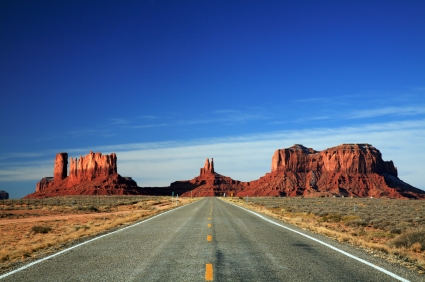 Next thing to decide is the type of car you want to rent. Of course, it all depends on how many people are travelling with you but remember that American cars in any given class are larger than their European equivalents. Having said that, I never choose the smallest class or two, even when I travel alone. There might be enough space inside but you can feel that such cars are good enough for shopping drives in the cities but not for the proper long journeys on the American highways. No, thank you very much. Also remember that when you book a car you book a vehicle from a given class but not the specific model. So booking “Mustang or similar” usually means the similar one, not the Mustang itself. Fortunately, if you have a bit more money available some companies offer booking specific models. For example, Hertz offers bookings for Mustangs and Camaros specifically on its website. It also pays to ask at the rental desk if there is any upgrade available. Sometimes for a little bit extra you can get some really nice cars (that’s how I managed to drive a Ford Mustang for the first time). Never pay for options you don’t need; agents often push for some extra insurance options because it is the way they make the extra money. Also don’t pre-purchase an extra tank of fuel. Normally you get the car full and are supposed to drop it off full. Agents often try to up-sell you the option of dropping the car off empty. It doesn’t make sense as the price of fuel they offer is not really competitive and you will never drop car off totally dry. Also think twice about the satellite navigation system. All the companies offer them as extras, but often you will be better off buying your own rather than renting one, especially on longer trips. Alternatively, nowadays you can easily use your smart-phone for navigation. I myself as a traditionalist and map lover use paper maps and atlases. They give me greater spatial awareness than just dumbly following the instructions of a sat-nav.
Once you finalize all the paperwork and check your car, it is time to finally hit the road. Be careful: You will be probably driving an unfamiliar car, possibly on the opposite side of the road than you are used to and you will be tired after many hours on the plane. Take it easy on the first day even if you are experienced driver. Take time to get a feel of the car you have rented. Also remember that American airports are a busy environment and driving around them is often frantic. Especially leaving the gates of LAX or ORD (Chicago), you will be dropped straight into the jungle of urban driving. But the same applies to most of the big hub airports.
In general, driving in the USA is quite easy and a rather relaxing experience. Especially for those used to the frantic pace of European driving. Speed limits are lower and people do drive slower. Of course there are exceptions, namely the big cities. One of them is New York City, where driving can be a nightmare. In NYC I would recommend using the public transport which is very efficient. It is in fact one of the few places in the US where you can actually survive without a car. Other places where driving can be crazy is greater Los Angeles. Its freeways sometimes resemble a war zone where every other driver tries to take you out. Unfortunately for those scared of driving, here you will need your own four wheels. In most of the cities it makes sense to avoid rush hours and while in downtown to park your car and simply walk.
There are very few speed cameras in the US, however highway patrol have a tendency to hide under bridges or in the central reservation and hunt for speeding drivers. If you want to speed a bit, do it in the middle of nowhere (like the Dakotas, Nebraska or Kansas) rather than in suburban America. Also bear in mind that interstates are patrolled much more heavily than the state highways. Also remember that each state has its own driving rules. They are broadly similar but you should make yourself familiar at least with the speed limits or some specific exemptions.
Luckily for intrepid travellers who want to cover a lot of ground, fuel prices in America are still much lower than in Europe and most of the roads are free. There are a few toll roads in the Northeast, Oklahoma and Kansas as well as short stretches around the suburbs of the southern cities (Dallas, Houston, Austin, Orlando and even LA).
Driving has one more advantage: you will be able to access much cheaper accommodation. More about this next time.
- Browse our collection of maps and guides to USA:
- > USA travel guides
- > USA road maps and atlases