 Marrakesh
Despite having a good map it wasn’t until my third day in Marrakesh that I managed to navigate my way purposefully and accurately through the maze of alleys in the souks to reach everyone’s primary and ultimate destination – the Jemaa el Fna square. But of course that’s the point of the souks – to lose your sense of order as well as direction, to give yourself up to the claustrophobic sensuality and vibrancy of the markets. If you really want to know where you are, the map does give you some idea of the layout, but the minute you open it to re-establish your position, a young boy will be insisting he leads you to “la place”, as the Jemaa is simply known. Better just to drift and head for any glimpse of daylight from an open square when you’ve had enough of shopping.
I highly recommend staying in a riad in the medina. They offer oasis of style and calm in the dust and chaos of the old city. Somewhere you can retire to in the heat of the afternoon to rest and read in the quiet courtyard, while soft-slippered staff bring you mint tea and sweet biscuits. Alastair Sawday’s Special Places to Stay in Morocco has a well-researched and described selection of the finest. I also suggest that you arrange for the riad to pick you up from the airport as it is can be difficult to find the address on first arrival – they are often signposted by no more than an anonymous door in the mud wall of an alley too small to accommodate a car.
The list of sites to see in Marrakesh is not long – it is the life of the city itself that is the point – but the courtyard and student cells of the Koranic school at the Ben Youssef Medersa offer a welcome respite from the hurly-burly of the modern world outside. Likewise the Jardin Majorelle in the nouvelle ville, where the cool greens, yellows and blues of plants and painted pots provide further relief from the “red city”.
When we returned to Marrakesh at the end of our time in Morocco we stayed in the nouvelle ville and were lucky enough to follow Lonely Planet’s lead to the “Café des Livres” for lunch. A stylish (and air conditioned!) café/restaurant with lovely salads and sandwiches alongside a small bookshop featuring mainly second-hand paperbacks – a touch of recognisable Western culture amidst the stew of Arabic and African urban life.
Toubkal
We had a brief sojourn of a few days at a wonderful lodge that sits on a hill under the face of Mt Toubkal in the High Atlas. The location of the “Kasbah du Toubkal” cannot be beaten: to sit in the clear mountain air on the terrace of the lodge surrounded by the stunning scenery of the Atlas is a life-restoring experience. The Kasbah itself offers simple but stylish accommodation and service – your luggage is carried by mule from the village -and it is operated by and for the benefit of the local Berber population. They can also organise guided treks: to the summit of Toubkal (2 days) or shorter local walks, after which I recommend recovery in their hammam!

Essaouira
The wind! It never stops in Essaouira. When I put this to our hotelier she smiled and said “pas toujours, mais souvent”!
The huge beach was a splendid site nonetheless, particularly on a Sunday morning when no fewer than twenty separate football games were being played on pitches marked in the sand.
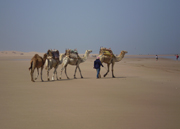
Don’t miss the fresh fish stalls where you can have your choice of the latest catch grilled on the spot. Although the prices per kilo are marked on an official board, you should still haggle, as you do for most things in Morocco! Including for our ride on the camels along the edge of the sea – the highlight of the trip for my children at any price!
Maps & Books
Although the streets of the medina of Marrakech defy orderly navigation, the Street Map of Marrakech and Essaouira is the best attempt to chart the chaos. It is clearly drawn at a good scale, including enlargements of the souks and Gueliz. The additional coverage of the surrounding region and Essaouira is a bonus if you are travelling out of the city. The reality on the ground is that most of the streets in the medina are not signposted, and those that are, are in Arabic, which simply makes the map reading a bit more challenging!
The TimeOut Guide to Marrakesh also includes coverage of the Atlas and Essaouira, and is reliable and informative as usual. I’m a fan of the Rough Guide to Morocco too. The Lonely Planet Guide to Morocco has just been updated.
Barnaby Rogerson knows more about Morocco than most and he shares his wisdom with wit and enthusiasm in the Cadogan Guide to Morocco. The depth of his coverage on the country’s culture is second to none, but if you’re only going to Marrakesh it’s a big book to carry!
Barnaby also edits Marrakesh – Through Writer’s Eyes– a varied collection of writings about the city that provides glimpses of the enduring fascination Marrakesh has had for travellers over many different eras of history.
While I was in Morocco, I also read Tahir Shah’s The Caliph’s House, his story of moving his young family to a ruined mansion in the outskirts of Casablanca. The book is not only about the practical challenges of renovating the house – which in Morocco makes Grand Designs look easy! – but is also about a personal and at times moving search for his family roots. With a cast of lively characters and Shah’s light touch, the book reads like a novel, and it left me with a sense of the rich cultural rhythms that propel Moroccan life but which are largely unseen by us tourists.
Author: Douglas Schatz