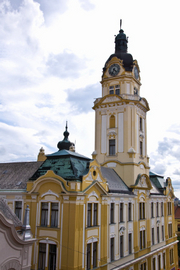
The pretty city of Pécs is a strong competitor to Hungary’s capital, Budapest, for attractiveness and cultural offerings. Surrounded by vine-covered mountain slopes, and blessed with a mild climate and beautiful architecture, the city is a gem of a destination waiting to be discovered. Being named European Capital of Culture 2010 has led to Pécs refurbishing its central squares and museums, as well as converting parts of the old Zsolnay Factory to house a new exhibition hall, arts and crafts centre and theatre, one of the largest such projects in Europe. Here is just a sample of some of the delights Pécs has to offer…
Top 5 sights and attractions
See the remarkable Roman remains at the Cella Septichora Visitor Centre, a Unesco World Heritage Site. The centre displays sepulchral monuments such as the wine pitcher chamber, with rich wall-paintings; and the 4th-century Peter-Paul burial chamber, a two-storey construction with a chapel.
Add your token of enduring love to the hundreds of love-locks covering two iron railings on Janus Pannonius Street.
Art Nouveau fans can’t miss the Zsolnay Museum with its impressive collection of porcelain in the lustrous eosin glaze.
Wonder at the ornate interior of the city cathedral, which dates back to the 11th century and was rebuilt in the present neo-Romanesque style during the late 1800s.
Hang out in the lovely Jókai Square, trimmed with beautiful houses and pavement cafes, and dotted with sculptures, this is the place to spend a sunny afternoon.
Top entertainment
 Get tickets for Pécs’ renowned opera company or the Sophianae Ballet at Pécs National Theatre.
Keep the whole family entertained at the Bóbita Puppet Theatre.
Spend the evening hanging out in the homely cafés and tea houses of the city.
Join the student vibe at one of Pécs’ pulsating nightclubs.
Events
The Pécs Spring Festival, from the end of March, sees a month of diverse events and activities, from jazz to contemporary dance, and from harmonic choirs to theatre.
Pécs Days Heritage Festival is a 10-day festival of dance, music and wine, in late September.
Did you know..?
Hungarians are extremely polite and courteous in conversation – a standard greeting from a man to a woman is “Csokolom” (“I kiss it” – “it” being the hand).
In 1998 Pécs was given the Unesco Cities for Peace prize for maintaining the cultures of the minorities, and also for its tolerant and helping attitude toward refugees of the Balkan Wars.
The University of Pécs was founded by Louis I of Hungary in 1367; it is the oldest university in Hungary, and is among the first European universities.
Where to stay
There is a broad range of accommodation options in the city, from budget guesthouses and hostels to top end hotels.
How to get there
Frequent buses and trains travel every day between Pécs and Budapest, where Hungary’s main international airport – Ferihegy – is located.
Resources
The Pécs Guidebook is a pocket guide published to coincide with the city becoming European Capital of Culture 2010. Written by a local expert, Piroska Gölcz, the guide offers an insider’s view of Pécs and the surrounding countryside. For the full picture on the country, read Bradt’s guide to Hungary.
The Pécs street plan has an enlargement for the city centre at 1:10,000; a list of over 200 places of interest, services and facilities; a road map of the Baranya province at 1:200,000.
Pécs European Capital of Culture 2010 website: www.pecs2010.hu.
Author: Rachel Ricks