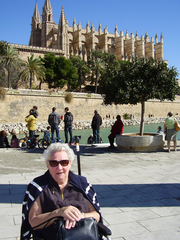
 I recently took my grandmother, who is unable to walk unaided and who is heavily dependent on her wheelchair, to Palma, Mallorca. A friend had advised me that Palma was a suitably wheelchair-friendly destination. Unfortunately, my friend had no experience of pushing and navigating a grandmother and a wheelchair around and her advice proved to be ill-informed.
Mallorca, particularly in the north of the island, is quite mountainous, but the Bay of Palma is a comparably flat terrain. The difficulty was that this flatter terrain seemed to consist of two disparate layers – a higher one for the historic centre of the city and a lower one for the coastal road and newer parts of the city. Navigating between the two was very difficult, particularly as the old roads with anything other than negligible gradient were very slippery after even the briefest of rain showers, surfaces were uneven and curbs had haphazard and infrequent accessibility. As anyone with any wheelchair pushing experience will tell you, it’s impossible to cope with a combination of a steep gradient, a cobbled street, slipperiness and a wellfed relative on wheels.
 The greatest disappointment for both of us was that there did not seem to be disabled access into the Palau de l’Almundaina, with their resplendent Arab baths. The Palau March Museu had made an effort to install and advertise its disabled access, which we appreciated, particularly as it was in a different place entirely from the standard entrance.
Once we had eventually heaved our way up to the height of the cathedral, it looked as though we might be defeated because the access consisted of two old stone steps and no sign of a ramp to hand. I managed to heave my grandmother and the chair over the steps because an English language notice just inside the entrance indicated that the cathedral was fully accessible to wheelchairs. I dare say, had I asked for a ramp, the attendant would have had one in storage, but having got us inside of my own exertion, we were undoubtedly rewarded: not only was disabled entrance free, but the cathedral had a lift and strategically placed ramps which gave us a fully accessible route around the splendid Gothic and baroque buildings and artefacts, as well as Gaudi’s 1901 restoration work. We were in awe of the stained glass, with three tiers running the length of the structure and a rose window explosion of colour at either end of the cathedral, pouring down on the nave and illuminating the tourists and faithful.
One thing I cannot fault is the kindness of the people who work in the city’s tourist related places, who were always very considerate of us and our mobility problems. The staff/owners of cafés and restaurants also kindly and frequently let us use their toilet facilities without custom, coming to salve another knotty issue, which results from travelling with an elderly relative on water tablets. We found the staff on the city sightseeing tour buses very friendly and welcoming. The tour buses were wheelchair accessible, as were Palma’s normal buses, and gave us access to parts of the city that we would not have seen had we been solely dependent upon our own steam – such as the view from the hilltop with the Castell de Bellver. Unfortunately the castell’s (castle’s) disabled access was up a steep, uneven and tricky dirt path which defeated us.
 We stayed slightly out of the city centre, in a more migrant populated and “realistic” but laid back residential area, yet in a smart but affordable hotel – the Tryp Bosque – which was patronised by Air Berlin staff. The hotel had considerately placed us on the ground floor, with easy access of the main door, the bar/restaurant, the lift and the breakfast room. All of the staff were helpful and friendly and the breakfast buffet was particularly good value for money. At one end of the Camilo Jose Sera, where the hotel was situated, was the entrance road up the hill to the Castell and at the other end was a useful taxi rank, where the drivers, with whom one felt very safe, were always on hand to transport us further afield, and assist with folding up the wheelchair.
I could not, in all honesty, say that I would recommend a wheelchair user to visit Palma unless they had long wanted to go there and had reconciled themselves in advance to not seeing a sufficient amount of the city. Undoubtedly, prior to the season starting, when we went in March, Palma has much to offer an able-bodied tourist in search of a warm, relaxed city break; unfortunately we did not get to see the best of it.
My recommended pre-departure reading is Mallorca Directions, Mallorca Eyewitness Top 10.
Author: Sam Golding
Disabled persons face many problems, so there should be strong actions for their accessible wheel chair services.