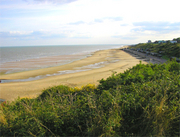
I know a place that’s the best spot in Britain to avoid the rain, find unspoilt sandy beaches, eat freshly caught oysters, and walk through scenery unchanged since the early 19th century. Why, it’s beautiful Essex of course.
For starters, believe it or not, Essex has one of the longest coastlines in England at no less than 300 miles. And in most places it’s actually rather attractive. You don’t get any of those nasty uncomfortable stones of Brighton beach, instead there is sand – yes, soft, golden, glorious sandy sand. You can sink your toes, build castles, dig out boats, bury dad…
And then there’s the sea. Yes, sometimes it looks brown, but no it’s not dirty – it just looks like it due to it being a shallow sea full of rich sediment from the mudflats of the Essex estuaries. Besides, it’s safe to swim in, and at least there are no sharks or other beasties lurking.
 There are some lovely quiet spots that I cannot pass a summer without visiting. Genteel Frinton-on-Sea is bound to prompt thoughts of raving pensioners protesting against pubs. But the clean and pleasant beach, the sweeping cliff-top greensward and 1920s tennis courts – all maintaining the elegance of a bygone era – are what it’s all about.
Mersea Island feels more rugged and isolated, with its only connection to the mainland the ‘strood’ – a narrow causeway which easily gets covered by high tides. The east side of the island is particularly where it has been left unspoilt thanks to a Cudmore Grove country park that has protected the precious saltmarsh vegetation and bright-white sand beaches. The lack of man-made amusements keeps the crowds at bay, meaning you could easily settle down with a picnic for the day and the closest another person will come is off-shore on one of the attractive sail-boats that glide past. In West Mersea town, you can sample the famous Mersea oysters washed down with wine from the local vineyards that flourish in the microclimate of the island – which happens to be one of the driest places in the whole of the UK.
There are plenty of appealing spots inland too. The eminent English Romantic landscape painter John Constable would back me up. He spent many a sunny hour of the 1800s capturing on canvas the cumuli lingering above pastoral meadows around the villages of Dedham, in the very north of Essex, and Flatford and East Bergholt, just over the border into Suffolk.
 Essex is modest about the oldest recorded town in Britain – Colchester – the first Roman capital before London became the preferred spot. It’s also the birth town of your favourite web editor – yours truly.
Colchester is certainly the most attractive of the Essex towns. The centre is full of timber-framed houses and Roman remains, while independent shops and cafes compete valiantly with the ubiquitous high-street chains. The star attraction of the town is found in the park and is the well-preserved castle keep. It started life in Roman times as a temple, then the Normans built a keep on top of it (the biggest in Europe), which now houses an impressive museum packed with historical finds from the district such as an almost complete mosaic floor recovered from the remains of a Roman villa.
And that desirable spot in Britain that receives the least rainfall? The seaside town of St Osyth – in Essex, naturally.
The OS map for Colchester covers the area, across to the coastline, and the OS map for Sudbury, Hadleigh and Dedham Valecovers Constable country. Find some other Hidden Places of East Anglia with this fascinating guide book.
Essex is ideal walking country – use guidebooks such as the Pathfinder Guide to Essex Walks or AA’s 50 Walks in Essex.
Many great authors praise Essex’s scenery – see Christopher Somerville’s Best Wild Places, and The Wild Places by Robert Macfarlane, while Jay Griffiths, author of Wild, lives in a shed on the edge of Epping Forest, Essex.
View all our maps and guides to Essex
- Browse our collection of maps & guides:
- > England travel guides
- > England road maps and atlases
- > Travel literature inspired by England
Author: Rachel Ricks