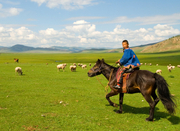
 A rather unexpected intermezzo occurred in our camp in the Gobi desert when my assistance was required for the slaughtering of a large goat. Goats, incidentally, live a happy life on the Mongolian steppes as they are freely herded around the countryside (there are no fences anywhere!) by happy shepherds and are at liberty to frolic and tumble around. But more importantly have been grass-fed all their happy lives with juicy, succulent pasture, and not administered any hormones or antibiotics habitual in the West. But I digress, a butchering was at hand and help was needed.
None of the Mongolians were available in the camp and since I was moping around, nursing a hangover, I was asked to hold the doomed animal’s hind legs while the carving up of the carcass took place. First, however, the sorry beast had to be put down: this entailed cutting a little slit into its chest below the ribcage, through which my Mongolian colleague, a young history student from Ulanbaator, put his hand and reached right round the lungs to the main artery that supplies the heart. This was then squeezed so as to stop the flow of blood. The animal simply passed out, silently and without pain. Rest assured, this is a centuries-old tradition perfected by the nomads to cause the animals the least discomfort and a species-appropriate death. But it is also a very economical slaughtering and here is where I was made to step in.
The goat is carved up in such a way that it remains laying on its back with all four hooves pointing straight to the ‘blue heavens’, as the Mongolians would say. A large cut all down the full length of the middle of the torso and all four legs was performed. In this way the animal’s pelt could be skinned of in one piece (the resulting skins are dried and used as down payment towards the next goat).
In the meantime, the skin is spread out on the dusty floor, fur side down obviously, and used as an ideal work surface to begin the dismembering of the body. All along I was sitting on a stool while this happened and continued to do so, my only job being to hold the goat’s hind legs to ensure that the body didn’t fall to one side. All the innards were removed and put into a bucket; even the blood that pooled itself in the abdominal cavity of the up-side-down carcass was scooped up and put into a further bucket.
Finally the main sections of the carcass were dissected and one by one hung up in the main camp tent to bleed. The Mongolians’ every move was swift and confident, clearly demonstrating competence and years of practice. Nothing was thrown away, much to my displeasure; as a little treat, the liver was consumed by the Mongolians immediately and raw! With mouth-watering relish they poured loads of salt over the slimy organ and cut it into strips. Not wishing to cause offence I also ate my slither and was surprised I was able to stomach it, usually being very averse to any types of offal, especially liver. The Mongolians in general had a soft spot for the innards and sheepishly hid them away for themselves, believing that they might offend the Westerners by not sharing. Little did they know we were quite glad about that and also for sparing us from goats’ heads which they cook with some sort of blow torch and then pick the bits of meat from the skull. (Also for the not so faint hearted is ayrag, fermented mares milk and Mongolian curd. However, on visiting a ger you probably won’t be able to avoid it.)
Lo and behold, the stupendous Mongolian barbeque that night that resulted from the earlier slaughtering more than compensated for any obscure culinary experiments. And after a few bottles of vodka drunk in Mongolian style, sitting in a circle and the bottle and a cup going around (but no camp fire), and after a few bouts of wrestling, you certainly do feel at one with the immensity of the steppe expanse.
When one has imbedded enough, one can lay back under the stars that seem within reach and fall asleep in the open, counting the shooting stars, or goats.
Blue heaven may bless you.
The Mongolia GiziMap is a great geographical map of the country, and has an inset of Ulan Bator. The best guide is the Mongolia Bradt Guide, which also contains a guide to staying in a ger camp. And I recommend reading Genghis Khan by John Man.
Author: Aaron Glover