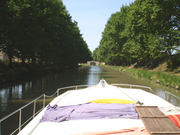
 “It’s just a floating caravan!”
That was my wife’s first unhappy reaction to the sight of Beauregard, the French canal boat that we were about to spend the next seven days living on. In our family the holiday from hell has always been to endure the discomforts of camping or caravanning – why do people voluntarily make do with less than the comforts of home? So I could tell as we were shown around the compact layout of Beauregard by the local boat technician that my wife’s sunny vision of the next seven days was rapidly clouding over. When we got to the lesson on pumping out the miniature toilet, I confess that my enthusiasm began to waver too.
Our plan was a relaxing week’s cruise up the Canal du Midi in southwest France, from Argens-Minervois near Narbonne to Negra just short of Toulouse. The Canal is a marvel of engineering built in the late 17th century to link the Mediterranean to the Garonne River at Toulouse, and thereby via the Gironde to connect the Med to the Atlantic. The route passes through the historic city of Carcassonne, as well as the wine regions of Minervois and Cabardes, and is renowned for its peaceful and picturesque scenery.
Having completed the guided tour of our floating caravan, our technician, Eric, took us out into the canal for a crash course in boat handling. This included talking me through a 180-degree turn between the banks of the narrow canal, a trick I proudly accomplished but hoped never to have to repeat without Eric. And that was it – we and Beauregard were sent on our way.
In fact, keeping a boat on a mainly straight-line course through a canal is not too difficult – the children happily took turns at the wheel. Navigating our first lock was another matter. The principle of the thing is simple enough, particularly on the Midi where all 65 of the locks are manned by resident keepers who direct traffic and operate the gates and sluices. We managed to steer Beauregard neatly enough through the narrow opening into the belly of our first lock – the Midi locks are shapely ellipses built for strength and to accommodate several craft – but our first attempt to hurl our line fifteen feet up the lock wall to our daughter on top fell short. As the boat drifted helplessly out from the wall the failed tosses became even longer. Our confidence quickly turned to dismay and embarrassment as we floundered to secure ourselves. The more locks we notched up, however, the more slick our teamwork became. By the second, or maybe third, day, we even basked in our mastery of the process, looking askance at others who failed to execute a perfectly elegant passage.
 One of the first lessons we learned on the canal was that everything is best done slowly. The maximum cruising speed is 8km an hour – we only covered 120km in total in the whole week. The locks do not open until 9 in the morning and close at 7 in the evening, with an extra hour’s rest in the middle of the day to allow the keeper to have his lunch. You couldn’t get anywhere fast even if you wanted to. And the leisurely routine of life on the water is the whole point. A slow wakening and breakfast on board before the first lock opened, when we would be ready to navigate a few miles. Mid-morning we’d stop for re-fuelling; topping up our water supplies and cycling along the tow paths to the local villages in search of provisions. We lunched and read while the lockkeepers did the same, and then cruised through the afternoon. My favourite time of day was the last hour’s cruising in the early evening, when the rich sunlight softens the landscape and the milky waters of the canal are peacefully still.
From my detailed maps and guidebooks I was aware that we were passing tantalisingly close to the vineyards of the Minervois and I was keen to search out the local chateaux on our bicycles. By a stroke of good fortune, and much to the relief of my crew who were not so enthusiastic about a lengthy wine tasting expedition, I stumbled upon a wonderful Maison du Vins right beside the canal at the little village of Homps. After an enjoyable hour chatting to the helpful and expert staff about the local grapes and growers, I staggered out laden with enough samples for the week onboard and for the rack at home.
It is true to say that we spent less time than we usually do on this holiday “seeing the sights”. We were too busy going slowly up the Midi to have time for anything else. One of the exceptions was a lunch stop in “must-see” Carcassonne. We first glimpsed the famed turrets and towers of the walled city from the boat, the view sliding past like a medieval mural. Having moored near the train station we cycled through the lively streets of the lower town and ascended the steep hill to the Porte Narbonnaise, the impressive fortified entrance to the citadel. The hilltop cite is a Unesco World Heritage Site: it was here in 1209 that the Albigensian crusade besieged the Cathar heretics and when the city fell, the feared crusader leader, Simon de Montfort, made it the capital for his ruthless campaign.
 We enjoyed a pleasant lunch in one of the myriad tourist restaurants that now line the narrow streets of the cite, and wandered around the cobbled lanes and battlements, browsing in the souvenir shops. My son was captivated by the countless medieval knights for sale, but I confess that – overwhelmed by the crush of summer tourists and knowing that much of what you see today is a fanciful 19th-century reconstruction – I found it difficult to conjure up the city’s dramatic history. We were pleased to return to the quiet of our boat and the unpopulated canal.
Our next stop of note was another landmark in Cathar history, the busy pleasure port of Castelnaudary. Its expansive Grand Bassin reservoir once served as a turning point for large grain barges in the Midi’s industrial past, where today pleasure craft of all shapes and sizes moor up and their owners flood the town in search of the classic local speciality, cassoulet. Legend has it that the dish made of white beans, garlic and bits of pork and sausage was invented here in the mid-14th century during one of the many crusader sieges when the locals were forced to make do with their last scraps of food. The putative original recipe is safeguarded to this day by a committee of local chefs known grandly as the Confraternity of the Grand Cassoulet. We promised our eight-year-old son a “stew” for dinner, which he heartily enjoyed, although we were careful not to identify all of its mysterious ingredients too explicitly!
As for further sightseeing, we felt little urgency to adjust our leisurely daily routine. Chugging slowly through the landscape gives you time to enjoy the scenery: the canal is typically lined by rows of regularly spaced plane trees that protect its solitude and provide welcome shade. In several memorable places they edge both sides of the channel, their tall straight columns and the arch of their branches creating a soaring nave over the water. The heads of sunflowers peak over the bank, and beyond, rows and rows of green vines stretch across the wide plains to the slopes of the black hills to the north. To the south, on a clear day, the hazy peaks of the Pyrenees are faintly visible.
Of course, one of the key selling points of camping or caravanning is that you can stop where you like. And so it is on the canal. Once the locks closed for the day, we moored our travelling home in a peaceful place, usually with only a local fisherman or two for company. We assembled dinner in our compact kitchen, played endless games of cards around the table, and sat out on the deck sipping the local rose and watching the stars gradually multiply overhead. When we reached our journey’s end and had to give Beauregard back, even my wife admitted that she would miss her.
The Navicarte guide to the Canal du Midi was indispensible for navigation on the canal. The strip maps show every bend in the river, and essential information on locks and cruising facilities and supplies. The Rough Guide to Languedoc and Rousillon was excellent for local cultural information. I also took the IGN Top 100 maps for the area for general reference a (Toulouse/Albi and Beziers/Perpignan).
A version of this article first appeared in the travel section of The Independent, 7 June 2008.
- Browse our collection of maps, guides and travel literature:
- > France travel guides
- > France road maps and atlases
- > Travel literature inspired by France
Author: Douglas Schatz
Douglas Schatz worked at Stanfords for more than 20 years, and was the company’s managing director until April 2009. He is now pursuing several exciting ideas in the world of books and digital publishing.