I don’t like Warsaw, the city where I was born just three months before the most calamitous event in its history, the Warsaw Uprising, and where I lived until I came to London in 1965. To me Warsaw is ugly and characterless, but then what else can you expect from a city with such a horrendous past.
For my generation, and that of my parents, that uprising and the preceding years of wartime occupation still dominate the city, not just in the shrines and plaques on buildings, always well looked after and often decorated with fresh flowers, or in the numerous monuments, big and small, many of which have been erected since the political changes of the early 1990s, but in the very fabric of the city. The uprising, ruthlessly suppressed, gave rise to an order, equally ruthlessly executed in the central parts of the city, to have Warsaw wiped off the map, and the post-war decades have not been kind to it. Left with so many buildings destroyed and so many empty spaces to fill, urban planners and architects could exercise their meagre talents just as unsuccessfully as they did everywhere else worldwide, but simply on a greater scale.
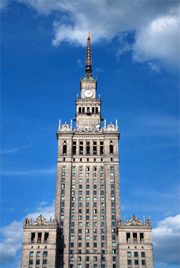
The Old Town, rebuilt through an enormous popular effort as soon as the war had ended to give the devastated city some focal point, still raw and all too new when I left in 1965, has by now acquired a suitable patina of an old historic district, but its main square can never be the heart of the city, like in Kraków or in Wroclaw. That honour belongs to the most disliked building in Warsaw’s entire history, the Palace of Culture, or, to give it its full original name, the Joseph Stalin Palace of Culture and Science. Built in the early 1950s as a gift from the people and the government of the Soviet Union, this gigantic monster (I wonder what Prince Charles would call it – surely a carbuncle would not suffice) and the vast open spaces around it, several blocks wide, dominate the city and constantly remind it of its past.
The then president of Poland, Boleslaw Bierut, had been offered a choice of a housing estate for the city’s homeless population or a Soviet-style skyscraper, and if you wonder what the city centre would have looked like had he opted for the more sensible gift, a couple of tram stops away Plac Konstytucji (Constitution Square) provides the most likely example. Not exactly great architecture, heavy and pompous, but to many eyes somehow still preferable to what followed it in the 1960 and ’70s.
Left with the Palace dominating the views from everywhere and making the skyline look like some oversized village with a gigantic parish church, the city’s authorities at first could not decide what to do, leaving wartime ruins on the eastern side of the square, and then gave up altogether and did what their colleagues the world over would do – erected a whole lot of boring, mundane buildings, by now already looking dilapidated, which, if anything, make its larger neighbour if not acceptable then at least different.
And even now no one knows what to do with it all. Part of the square in front of the Palace is covered by a temporary prefabricated bazaar, selling jeans, trainers, and other symbols of capitalist decadence, while the centre, with the podium from which members of the Central Committee of the Polish United Workers Party once viewed “spontaneous” parades of grateful citizens every 1st May and 22nd July, is now a parking space for still more symbols of that bourgeois acquisitiveness.
Many would like to see the Palace demolished, and not always purely on architectural grounds. There were even some not very tasteful 9/11 jokes about it five years go. But the city cannot afford it, neither financially, nor, I think, emotionally. Too much had already been destroyed and it is better to come to terms with the past, whatever its shape. Warsaw has already acquired some interesting new buildings, particularly the High Court (with the main monument to the Uprising just next to it). Like every respectable metropolis it has a Norman Foster. Daniel Liebeskind, who as a child in 1955 was taken by his mother to see the newly opened Palace of Culture, is contributing towards making it less dominant in the city’s skyline.
If you find yourself in Warsaw and want to understand more about the city and its past, don’t bother with the picturesque houses and the winding streets of the Old Town, full of souvenir stalls selling “folk art”, but head out of the centre, across the area of the wartime Ghetto, now filled with endless monotonous housing blocks, to the Powazki Cemetery. Not the big one, but beyond it, to the slightly smaller Military Cemetery.
There, in a simple grave right by the main entrance, lies one of the greatest Poles of the post-war era, Jacek Kuron. Less well known outside Poland than Lech Walesa or Karol Wojtyla, he was one of the country’s leading dissidents in its fight for social justice. Ironically, as almost everything always is in Poland, when in the 1990s he finally became the Minister of Labour, he had to preside over the dismantling of much of the country’s heavy industry and his surname was used to create a new word in the Polish language, kuroniówka, the unemployment benefit. At the other end of a long avenue, much like the one from the closing scenes of The Third Man, lies the communist aristocracy: Boleslaw Bierut, the president who left to the city such a prominent reminder of his rule, Wladyslaw Gomulka who in 1956 raised so many hopes only to dash them during the moribund ’60s, and endless dukes and counts of the Politburo and the Central Committee. And in between those two extremes of Poland’s post-war history, in the central part of the cemetery, lies Warsaw’s lost generation – rows upon rows of the 1944 insurgents: the teenagers, the twenty-somethings, the thirty-somethings. It’s not the most pleasant way to spend an afternoon, but it will tell you much more about that not very pretty city than its museums, the marble halls of the Palace of Culture, or the bars and souvenir stalls of the Old Town.
For the trip to the cemetry, use the excellent PPWK street plan for Warsaw. For sightseeing in the city centre, nothing beats the waterproof Daunpol map of Warsaw which features an enlargement of the historical area. For background reading on the city’s post-war development and architechture, read Warsaw by David Crowley.
Browse our collection of travel guides and maps to Warsaw >
Author: Malgorzata Ross