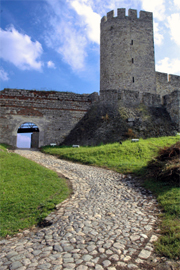
It is a very typically Balkan thing that the centre of Belgrade should still bear a Turkish toponym: Kalemegdan. It is today the most beautiful and largest park in Belgrade and it is where the most important cultural and historical complex of the city, the Belgrade Fortress, stands high above the Sava and Danube confluence. The view is breathtaking: both the rivers are very wide and from the high position of the Kalemegdan lookout you can see them arrive from afar, proceeding with great majesty, the Sava from the West and the Danube from the North. When their waters finally meet below the rocky cliff of Kalemegdan, theirs is a peaceful embrace. Beyond the rivers are Novi Beograd (New Belgrade), Zemun and the wide plains of Pannonia.
The name Kalemegdan actually applies only to the spacious plateau surrounding the Fortress, which was turned into a park in the 1880s. When the Fortress served as Belgrade’s chief military stronghold, the plateau was a place from which the enemy was kept under observation and where preparations were made for battles. Its name derives from the Turkish words kale (field) and megdan (battle). The Turks also called it Fichir-bair, which means “the contemplation hill”. The latter name better fits the state of mind the place inspired in me.
I spent three weeks in Belgrade on a language course and I thoroughly liked the place and its people. The student scene is lively, it organises gigs, events and it is politically very active. Three days after my arrival I went to a free concert night in the Kalemegdan Park and it was a magic experience: a great big stage had been set up at the border of one of the largest green spaces in the Park, people just sat on the grass having picnics, drinking and generally having a really good time, local indie bands played all night long and in the background – the silent meeting of the rivers.
All around Belgrade there are constant reminders of the troubled history of the city and of the Balkans. It is probably because the population has lived through new wars in the last ten years that every war and in particular the Second World War can still be felt as a memory more recent than in other cities of Europe that were equally affected by it, as if history were more difficult to dismiss in this city. The National Library, which hosts some of the oldest manuscripts in Cyrillic, was severely damaged during the Second World War so the new Library was built underground in a bunker. Memories of the Soviet block era are alive in the Museum of Ethnography, with its attention to folklore and traditional crafts.
But it is Kalemegdan that best conjures up the history of the place with the traces it bears of all the historical eras, dominations and battles the city has seen: sections of Roman walls stand below the Serbian which in turn stand below the Turkish and Austrian fortifications. Each era saw the addition of new towers, military ports onto the rivers and gates. Near the Dizdar Gate, by the road leading to what is known as the Fortress’s Lower Town lies the Fountain of Mehmed-pasha Sokolovic. Mehmed-pasha Sokolovic was a famous Bosnian-born Turkish Grand Vizier. He was one of the Serb children that were taken from their families to become Turks for what was called the Blood Tribute. His was an exemplary carrier and he became Vizier. He gave the fountain as an endowment to Belgrade. Sokolovic’s other famous endowment is the bridge on the Drina in Višegrad, at the centre of Ivo Andric’s great novel The Bridge Over the Drina.
Anybody interested in history should visit Belgrade, walk their way up through the layers of history of Kalemegdan and stop at the top of “contemplation hill” to admire the silent witnesses to the flowing of time, the Sava and the Danube.
The Belgrade Gizi Map is very good, as is the Gizi Map of Serbia. The only dedicated travel guide to the country is the Bradt guide to Serbia, who also produce the Bradt pocket guide to Belgrade. For more history, Tim Judah’s The Serbs (now sadly out of print) is extremely readable and well informed.
Browse our collection of travel guides and maps to Belgrade
Author: Marina De Santis