Christchurch: Top 5 Tips

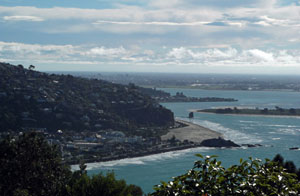
Christchurch coast

After experiencing Christchurch‘s earthquake first-hand in 2011, Chloe McInnes, who spent two years living and working in New Zealand, uncovers a rebuilt city that’s beginning to welcome back visitors.

Whenever I mention living in Christchurch, the most commonly-asked questions are “Wasn’t there an earthquake there?” and “Was it scary?” Well, yes, and (obviously) yes. And I’m beginning to find this discouraging, because it’s almost two years since the quake, and the people of Christchurch have worked tirelessly to rebuild the city and its surrounding suburbs.

Continue reading Christchurch: Top 5 Tips

The Top 5 Lake District Walks

The Lake District offers some of the UK’s most spectacular walking routes. How to narrow down so many? We asked local expert Ian John to reveal his top five.

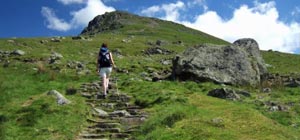
One of the great joys of a trip to the Lakes is a chance to slip on a pair of comfortable boots and a rucksack and head out into the hills to experience the timeless rugged beauty of the landscape. Walking remains a hugely popular activity for all ages in Cumbria and there are hundreds of different walks, ranging from those anyone can enjoy through to those suited only for experienced or advanced hikers.

Here’s a selection of five of my favourite ambles in the Lake District:

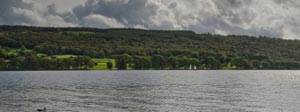
Coniston Lake1. Coniston Hall & Park Coppice (3 miles)

If you’re with younger children or people with mobility issues, this gentle amble on wide, safe pathways is an ideal starting point for walking in the Lakes. Starting in the beautiful village of Coniston, you head down the Cumbria Way eventually reaching the atmospheric Coniston Hall. From here you continue walking along the lake then turn back through the pretty Park Coppice before heading back to Coniston for a well-earned coffee.

> Map your Coniston walk with The English Lakes: South Western area OS map

Grizedale Forest

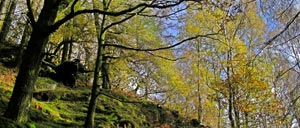
2. Grizedale Forest Walk (3.5 miles)

While the lakes and mountains of Cumbria are undeniably its biggest attraction, it’s easy to forget that the county also offers different types of walks – and the finest example of this in my view is the Grizedale Forest Walk. This is a fabulous route again for the beginner or family group as the paths are well-maintained and easy to follow, and you can round your trip off at the visitor centre.

You have a choice of eight well-signed walking routes, each through a lush verdant and varied woodland, with plenty to keep children entertained too. If you want to begin your Lake District trip with a flat, easy and enjoyable short walk, then this is an ideal starting point.

> Map your Grizedale walk with Footprint’s Walks Around Coniston

Langdale Pikes

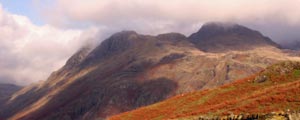
3. The Langdale Pikes and Dungeon Ghyll (6 miles)

For experienced walkers, this is one of the most popular climbs in the Lake District and as such, it is advisable to head to the New Dungeon Ghyll car park early to guarantee yourself a parking space. The effort of an early start though is worth it on this six-mile hike around Stickle Tarn, Pavey Ark, Harrison Stickle and Pike O’ Stickle.

You’ll need stout boots and not be afraid to scramble up and down steep faces to enjoy all this walk has to offer but the rewards are immense, with stunning views of the beautiful southern Lakeland hills and breathtaking landscapes at every turn.

> Discover more with HandiHikes’ Walk the Langdale Pikes

Scafell Pike

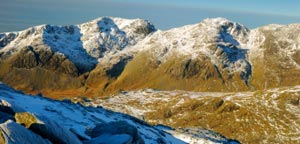
4. Scafell and Scafell Pike from Wasdale (6.5 miles)

Starting in the picturesque village of Wasdale (probably with many other hikers attempting the highest peak in England), make sure you’re wearing sensible footwear for this classic trek up Scafell. There are a variety of routes and paths available, ranging from the main tourist track up the mountain to much quieter side paths and tracks that offer more solitude. The scenery is splendid, offering fabulous views over Wasdale and the chance to reach the summit of both Scafell and the larger Scafell Pike.

> Ascend Scafell Pike with The National 3 Peaks Walk Official Challenge Guide

Lake District walking

5. Helvellyn from Glenridding (7.5 miles)

This is without doubt my favourite walk in the Lakes and one I first completed as a young boy on our first ever trip. For sure, it’s one of the best known and there are many different ways you can tackle the route. The easiest and most suited for families is on large wide paths for most of the lower part of the hike, leading onto narrower ridges for the 810m climb up Helvellyn and around Red Tarn, while more experienced climbers can scramble around Striding Edge and head up Swirral Edge taking in the peak of Catsycam.

At the summit, you’ll have spectacular views of the local area and without doubt the finest views of the majestic Lake Ullswater, glistening in the valley below.

> Walk from Helvellyn from Glenridding with the HandiHikes guide

> Learn more about the Lake District with our range of travel guides and maps.

Win One of the New Marco Polo Travel Guides!

Marco Polo travel guides

This competition is now closed.

With holiday planning season firmly underway, we’ve teamed up with Marco Polo to offer 20 lucky holidaymakers a guidebook of their choice to one of the publisher’s 20 new destinations!

According to a Marco Polo survey, 92 per cent of us are planning a trip abroad this year, while almost three quarters say a holiday is one of their 2013 priorities.

So whether you’re thinking of two weeks on the Costa del Sol, seeing the Northern Lights in Iceland or a backpacking adventure in Cambodia, let Marco Polo show you the way!

To be in with a chance of winning, simply correctly answer the travel trivia question below and submit your details below by Friday 1st March. Good luck! Continue reading Win One of the New Marco Polo Travel Guides!

Kolkata: The Nostalgic Indian Megacity

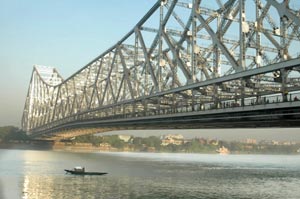
Howrah Bridge Calcutta

Travel blogger Aditya Akhauri explains the appeal of Kolkata, a city he believes is defined by its appetite for nostalgia.

Every Indian metropolis has its own distinct character. The style and pace of Mumbai, the sights and smells of all-powerful Delhi, the culture and traditionalist attitude of Chennai and the nostalgia that is the very air of Kolkata. Yes, nostalgia is what makes Kolkata great.

It is a city of the past, where the old meets the new, but unlike other places it’s the old that’s powerful. Things change slowly in Kolkata. One can see the remnants of the British Raj everywhere in the city – from the trams that crawl the streets like giant rats to the architecture in the old quarters, everything strikes of modern Indian history.

Kolkata – perhaps still better known as Calcutta – is the only Indian metropolis where the ideologies of Marx are still taken seriously and beyond textbooks. In fact, the hundreds of closed factories on the Howrah side of the city are testament to its relationship with socialism. Political graffiti, monuments and heritage buildings coupled with the fact that all the city’s landmarks were constructed during the Raj make this the ultimate place to experience the history of colonialism and Kolkata’s fraught relationship with it, one that pushed the city into the arms of Marxism.

Kolkata’s culture is perhaps its most vibrant attribute. It has its uniqueness still intact. Here, folk still take pride in selecting a fish from the bazaar rather than buying from a supermarket, which is fast becoming the trend elsewhere. It is a city of people who are as yet undaunted by the modern emphasis on looks and adhere to the view that what matters is what’s in your head. In Kolkata people like to take things slowly – they don’t chase money with the madness of Delhi nor are they in a perpetual rush like the hordes of Mumbai. Office lunch hours are often an extended affair (indeed, cab drivers working the commercial areas often refuse passengers during lunch) and evenings are spent on tea stalls chatting with neighbours. Perhaps no other metropolis in the world has such a leisurely pace of life – be it rich or poor, seemingly everybody indulges in keeping things slow.

As the strides of capitalism try to shake things up, Kolkata as we know it is changing. The pace of life is picking up and many things are no longer as they were. Marxist parties have given way to pseudo capitalism and high rises are cropping up – structures that are fast becoming new landmarks. Old mansions adorned with dates like 1821 or 1835 are crumbling and people are finding it increasingly difficult to find time to sit down and chat. There is a struggle that is going on; one that will change the city forever.

Perhaps today we are in a position to see the city in all its historical glory for the last time. It is changing and straddles a precarious position between the new and the old. What paths it will take no-one knows. What we do know is that all Kolkata’s fans are praying that some things don’t change – the awesome cuisine, the warmth of the people, the beautiful buildings from the colonial era and its deep affection for past – arguably this Indian megacity’s defining attribute.

Ahmedabad-based travel writer Aditya Akhauri writes for the Lonelyronin blog.

> Discover more of Kolkata with our range of travel guides and maps.

Our Top 7 Reads for 2013

Stanfords staff reveal which books they’re looking forward to reading in 2013:

Alone on the Ice

David Mantero

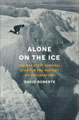
Alone on the Ice: The Greatest Survival Story in the History of Exploration, David Roberts

David, our travel guides specialist, is looking forward to the release of David Roberts’ Alone on the Ice: The Greatest Survival Story in the History of Exploration – a confident title for a story that, at first glance, is scarcely believable. In January 1913, the Australasian Antarctic Expedition was pulling a sledge towards base camp, 100 miles away. Suddenly, the dogs at the front were gone, and not long after, Douglas Mawson, the expedition’s leader, fell through the same snow bridge. An extraordinary tale of survival followed. Despite crawling for much of the way and the soles of his feet detaching from the rest of his body, a skeletal Mawson arrived at base camp, against all odds, just over three weeks later. With the release of this book, David believes Mawson may become one of polar exploration’s legendary figures. Continue reading Our Top 7 Reads for 2013

A Long Walk to Freedom: One Man's 15,000km Hike Home

On Foot To FreedomTravelling the world: the preserve of freedom-seeking gap year students, rat race escapees and millionaires. And now, a 28-year-old Mancunian by the name of Michael Lee Johnson. Like many, Michael’s adventure of a lifetime will be travelled alone and involve thousands of kilometres. But unlike others, Michael will cover the kilometres – all 15,000 of them – on foot, unaided, and potentially through some of the most dangerous countries on Earth.

Fed up of being a slave to his computer, in July Michael will fly to Beijing and spend three years walking back to London (though he’s set aside another two in case it takes him a bit longer) in a journey dubbed On Foot to Freedom. But with a background in web design rather than adventure travel, why has Michael set himself a challenge many feel is impossible? And why China, an unfamiliar country whose language Michael does not speak?

“London’s the place that’s free, whereas in China such freedom isn’t enjoyed,” he explains. “My entire journey’s ‘on foot to freedom’, so it makes sense to walk from China to London because of the political reasons – you are actually walking to freedom.”

So is this mammoth walk – a term that hardly seems adequate for the epic journey Michael is planning – really a political statement, an extreme way of raising awareness of China’s questionable human rights record? Well, not really – and if it was, China wouldn’t be the most sensible place to do it. Rather, Michael will focus on exploiting the potential of social media to raise awareness of himself and On Foot to Freedom as brands.

‘Freedom’, he explains, has a double meaning. Yes, there may be well-intentioned abstract political motives, but this will be a journey primarily undertaken for personal rather than professional reasons. “I’ve been sat at a computer for the last 20 years so I think it’s time to leave the monitor and walk from one side of the world to the other,” Michael says. “I’ve been sat at a computer for so long – it’s not a life. I’m not scared of dying, I’m scared of not living. Some family members think I’m going to find myself, but I’ve already found myself – life is about creating yourself, not finding yourself.”

Michael Lee JohnsonHis determination is admirable, but does Michael understand the risks of walking alone from one continent to another, through one of the most volatile regions on Earth? After a year and a half of intense planning and training, he firmly believes so.

“I’m working between 16 and 18 hours every day, spread between training, marketing, eating and sleeping,” Michael explains. “I’ve been training on Ben Nevis and Snowdon for the last seven months in different weather conditions, but the journey is planned in such a way that I should arrive in each country at the right time, so there shouldn’t be any real extremes of temperature. The only thing I’m really concerned about is not being able to get food and water, as at times I’ll be away from civilisation for seven to 14 days. I’m doing it alone, but it would be great if I got some kind of Forrest Gump following along the way.”

It’s this isolation and the gaps between destinations causing the greatest concern – not just among family members, but those who’ve completed similar journeys using more practical means. During one stage in the Gobi Desert, for example, Michael is likely to walk for 15 days without seeing another human being. Motorists who’ve completed the same journey have warned Michael it’s impossible on foot, but he has a little trick up his sleeve – or rather, one being pulled by his shoulders. “I’ve spoken to a guy who walked from the bottom of South America to the top of North America. He used a trolley to carry all his supplies, and he’s taught me how to build one.”

Central to Michael’s preparations is the route, which will be loosely based on the old Silk Road trodden by Marco Polo. The first confirmed stage is a 4,500km hike from Beijing to Kashgar, a western Chinese town close to the Tajikistan and Kyrgyzstan borders. Via Xian and the Beijing Wall, it will take approximately one year and three months to complete. “Once I’m in Kashgar I’ve got three possible routes in mind,” Michael says, “but because of the problems in Afghanistan, Iran and Pakistan I won’t be able to confirm which I’ll be taking until the time.

“A lot can change in three years; one route I have in mind would be simply impossible at the moment. I know it won’t be a walk in the park whichever I choose, but the premise stays the same: I just need to put one foot in front of the other for three to five years. I’m loaded with maps and a GPS system, so I shouldn’t get lost.”

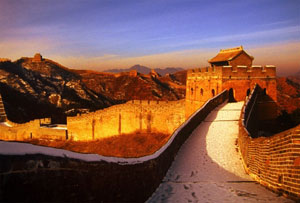
Great Wall of ChinaMichael is obviously limited in terms of how much equipment he can take, but his 22 sponsors will be providing all the gadgetry he needs en route – a lightweight laptop, phone and camping equipment: tools that will allow him to plot his route online in real time. Other necessities will be packed into boxes and wait for Michael at various city storage locations.

With the bulk of preparation work completed, Michael is looking forward to finally beginning a challenge he first mooted at the tender age of eight. Amid the frenetic media attention the clock is slowly ticking down to 21st July – the date he will board a plane at Heathrow and fly to Beijing, the Chinese capital.

“I’ll spend a week there on an intense Mandarin course,” Michael says, “and then it’s a case of getting going. I’m planning to walk over 25km each day at 4mph, though some days I’ll have to walk between 40 and 50km. Luckily China’s quite flat, so it shouldn’t be too much of a problem until I get to the mountains and the desert.”

We’ll be keeping tabs on Michael’s progress, but for regular updates you can follow the man himself on Twitter.

> Want to find out more about China? Browse our China travel information page or catch up with China-based Stanfords blogger Tim Neesham’s recent posts.

An Adventure in Bolivia's Salt and Sand Deserts

Rachel Ricks UyuniRachel Ricks travels to south-west Bolivia to take in Salar de Uyuni – at 4,086 sq mi, the world’s largest salt flat.

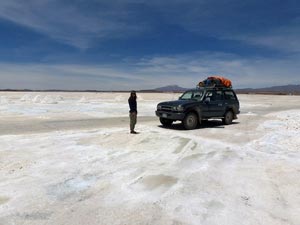
I strode out into the abyss of white. The ground was snow white as far as the eye could see in every direction. Silhouettes of mountains hovered in the far horizons, but otherwise nothing interrupted the white. I kept walking until the last voice of a tourist had faded out. I sat down on the ground and stared out across the salt flats of Uyuni. Then the silence hit my ears so hard they began to ring. I picked up a pinch of salt and let it crumble through my fingers. I could hear every grain hit the ground.

This surreal and stunning experience was just the beginning of a three-day tour I took in a 4×4 jeep from Uyuni in south-west Bolivia through to the border of Chile.

We’d booked the tour in La Paz after asking round several different agencies to get an idea of the price and what sort of service to expect. We also chose to fly from La Paz to Uyuni after hearing nightmare tales of the overnight bus journey. The flight with TAM (the Bolivian air force which operates commercial flights) was reasonably cheap, pleasant and efficient, and had the added bonus of offering spectacular views over the salt flats from the air.

Our flight arrived in Uyuni at 8:30 in the morning, so we were able to book onto a tour that started that day – most set off at around 10:30-11am.
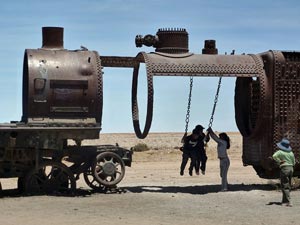
Uyuni train cemeteryWe joined the jeep with our companions for the next couple of days – a German father and daughter, two Israeli girls and Luis, our driver/guide/chef. First stop was the ‘train cemetery’ just outside of town, where engines that once ran through to Chile have been left to rust after the days of silver and mineral mining in the region ended. Now a bizarre tourist attraction-cum-playground for local kids, I wasn’t quite sure what the appeal was.

After that, the tour began in earnest – until we pulled up 10 minutes later at a row of souvenir and ‘handicraft’ shops where we were given more time than any site we visited on the whole trip. I didn’t even get out of the car to look at the same alpaca jumpers and flappy hats I’d seen for the past three months in Peru.

Luckily it wasn’t far from here until we hit the salt flats. Luis stopped for two photo opportunities before roaring us onwards to the Isla Incahuasi – literally an island of rocks and cactuses in the middle of the salt flats. Here, we along with 20 or so other jeep tours parked up for lunch.
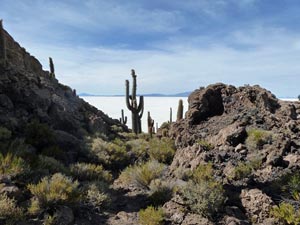
Isla IncahuasiLuis brought us plates of llama meat, rice and salad. Afterwards, we clambered along a signposted path over the rocks to the summit of the island where everyone gathered to take photos. Carlos and I veered off from the masses and the signposted path, instead descending a much more exciting-looking side of the island to the salty ‘beach’, where we were at last alone and took our photographs.

Luis was waiting impatiently for us by the car when we returned, and this was how it continued for the next two days – we didn’t realise until afterwards that the drivers have a system of leaving in order so they constantly have two other cars in their sight. You wouldn’t want to be stuck alone out here considering the distance we travelled from civilisation, and there is certainly no chance of phone reception.

We drove for a good couple of hours over the salt flats until Luis told us to say adios to the salar, and suddenly we were driving along a desert road instead to shortly pull up to our hostel for the night – built entirely of salt. The walls were constructed of salt bricks, the beds, tables and chairs were all made of large blocks of salt, the floor was granules of salt, and even the lights were decorated with salt chandeliers. I found it interesting that there was no salt on the table for dinner.
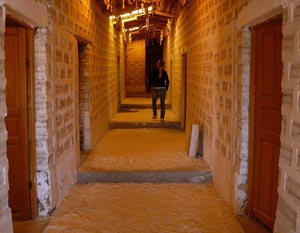
Salt HotelBefore dinner was served, I went for a stroll along the sandy road. I turned a bend round a mountain and saw it had hand-painted signposts pointing out a trail up its rocky side, so I followed it up and discovered a petrified sea of corals and large cactuses. I stopped on the rocks to watch a beautiful glowing sunset over the never-ending desert landscape.

The next day Luis got us up at the crack of dawn to set off on a long morning of driving through vast deserts with volcanoes looming in the distance. By lunchtime we reached the first of several flamingo-filled lakes of the Eduardo Avaroa Andean Nature Reserve. As we drove off, a herd of vicuñas ran in front of the car and down to the lakeshore, making yet another impossibly stunning picture.

I was left astounded by this otherworldly scenery with these ethereal lagoons thousands of feet above sea level and miles from anywhere, with the only signs of life being the graceful vicuñas and the pink flamingos. I thought I’d seen all the different landscapes our planet has to offer, but here I kept being surprised. Luis rounded this long day off with a stop by the immense Red Lake – so called as unique micro-organisms that thrive here rise up towards the sunlight during the day, turning the water crimson.
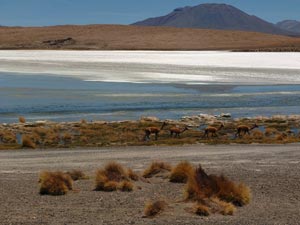
VicunasThat night we stayed in a basic hostel in the middle of nowhere again, to rise even earlier the next morning in the freezing cold to go and see some steaming geysers at their best. Seeing these jets of steam in front of the rising sun was indeed worth getting up in the dark with teeth chattering.

Luis rewarded us with a stop at thermal baths, formed by the side of the volcanic Lake Challviri, where we gladly wallowed in the warmth for a while.

Carlos and I were to be dropped off at the border to cross into Chile, so there was a quick stop at a green lake this time before we drove on. The border post is just a simple house in the middle of the desert where the tour jeeps drop off or pick up travellers exchanging with Chilean mini-buses. As we drove off down the road into Chile, I turned round for a last glimpse of Bolivia and spotted an ancient burnt-out bus abandoned in the desert. As beautiful as it had all been, somehow I couldn’t wait to get to Chile.

How to do it

Shop around tour agencies in La Paz, Tupiza or Uyuni for prices and get a feel of what they’re offering. As far as we could see, all follow the same route, stay in the same types of accommodation and serve the same meals (we were always joined by at least six other groups), so don’t be so sure that paying more means you get more. The drivers are mostly freelance and simply booked up by agencies as the tourists come.

I paid Bs.720 for my tour with El Desierto, booked through El Solario Travel Agency in La Paz. I could complain about certain aspects of the tour, but I won’t bother because it was all pretty good for the price and for Bolivia.

The basics you should expect for 700-800 bolivianos (Bs.):

A driver/guide/chef who most likely will be Spanish-speaking only; a 4×4 jeep in decent working order, normally accommodating six tourists – your backpacks can be taken on the roof if you’re going on to Chile. Extra costs to expect include entrance to the island on the salt lake (Bs.35) and the nature reserve (Bs.150, although this was being reassessed at the time of my visit). You should be advised on these by your tour agency.

Day one

  • Tour starts at 10:30/11am.
  • Visit train cemetery. 
  • Drive across Salar de Uyuni, taking in old Salt Hotel, now museum, and the island for a walk. 
  • Lunch (cold meat, rice or pasta and salad, fruit, cold drinks). 
  • Tea and biscuits. 
  • Dinner (soup, meat and rice, fruit, water). 
  • Night’s accommodation in dormitory in salt-built hostel (expect solar or generator-powered electricity and to pay extra for a hot shower).

Day two

  • An early rise for breakfast (cereal, yoghurt, tea/coffee, bread).
  • Driving all day with stops at various scenic points including Ollague Volcano, rock formations in the desert and flamingo lakes and the Red Lake in the Eduardo Avaroa Andean Nature Reserve (expect to pay as extra the park’s entrance fee). 
  • Lunch (similar as before). 
  • Dinner (similar as before). 
  • Night’s accommodation in dormitory in basic hostel (again expect solar power and to pay extra for a hot shower).

Day three

  • Breakfast (as before).
  • Early rise to visit geysers. 
  • Green Lake. 
  • Thermal baths.
  • Drive back to Uyuni, or if transferring to Chile you will be dropped off at the border and shown your connection with a mini-bus to San Pedro de Atacama in Chile. 

NB – If taking the latter option, you will pay when you book the tour an additional Bs.50 for the transfer. You get your stamp for Bolivia here, while the Chilean immigration office is some 40 minutes’ drive away on the outskirts of San Pedro de Atacama. Try and ensure your driver gets you to the Bolivian border post early to be prudent; there have also been reports of Bolivian border staff charging unknowing tourists unsolicited fees.

All details and prices I provide here were correct at the time of my visit in late November 2012.

You can read more about Rachel’s travels on her blog.

> Discover the best of Bolivia with our range of travel guides and maps.

All photos © Rachel Ricks 2012
His and Hers Guide to the Globe – Part 1: Singapore

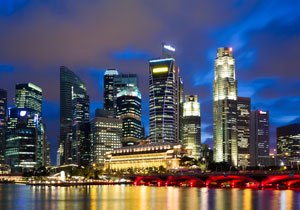
Singapore skylineGlobe-trotting couple Matt and Sharon Ward spent the second leg of their worldwide journey discovering the best of Singapore from a his and hers perspective. Here’s what they had to say about the south-east Asian city state…

We landed in Singapore and caught a taxi to the place of a friend of a friend, who’d kindly allowed us to stay at his beautiful 11th floor apartment on Parkway Parade. For the cost of a duty-free bottle of Bombay Sapphire, our first few nights’ accommodation were sorted. I had a few well-earned bottles of Tiger and Sharon a glass of wine on the balcony as we got to know our temporary landlord. We stumbled to bed around 02:30. Continue reading His and Hers Guide to the Globe – Part 1: Singapore

The Blue Whales of Sri Lanka

Sri Lanka Blue Whale

Venetia Rainey travels to Sri Lanka and gets up close and personal with the largest animal to have ever existed: the blue whale.

In the age of David Attenborough, you don’t need to go far from your sofa to marvel at nature’s awesomeness. From the really small to the really smart, TV has given us the chance to sit front row at the greatest show on Earth.

What David doesn’t tell you though is what these experiences are like in real life.

The largest animals to have ever roamed the planet, blue whales reach up to 30 metres long and rarely come close enough to land for tourists to see them in a day trip. For most, they will only ever be seen through the eyes of another.

But where there’s a whale there’s a way (sorry), and visitors to Sri Lanka will be pleased to learn that between December and April, the island’s southern coast has officially been established as a haven for seeing the beasts as they migrate.

Mirissa

Getting to Sri Lanka’s self-proclaimed whale hotspot is easy: from Colombo, pick from either a regular bus or an irregular train heading south. Both take around four to five hours.

Although Mirissa looks scruffy upon first inspection, the action, as far as tourists are concerned, is on the beach; a pale curve of sand connecting two dramatic, rocky headlands. Mirissa comes into its own at night, with candlelit tables spilling onto the sand from every establishment and stall after stall of freshly-caught seafood to tuck into.

Mirissa Sri Lanka

Picking a boat

The one thing you won’t find on the menu (hopefully) is whale. Regardless, every bar, restaurant, hotel and guesthouse will offer to take you whale watching.

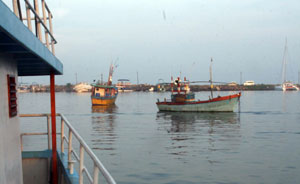
The cheaper options (Rs 3,000 – 3,500) put you on a big boat with between 20 and 30 people sat on both the lower and upper deck. This can be crowded but is also more sociable. The more expensive options (Rs 4,000 – 8,000) mean a smaller boat (still with two levels), fewer people and more space.

Either way, remember that you’ll be out there for a while (at least five hours) and that tours start at the crack of dawn, so sleeping space can be invaluable. All boat operators give you breakfast, a life jacket and insurance (whatever that means).

Crucially, however, all the boats follow each other, so when it comes to the whales, everyone sees the same thing. A final thing to check is how long the boat will stay out if you don’t see anything. I heard tails (sorry, sorry) of people sticking around all day – not ideal if you have travel plans/aren’t that keen on boats.

The main event

First off, a packing list: camera/video-camera, sun cream, sunglasses, hat, waterproof bag, water, snacks. Wear flip-flops and bring a warm layer for the early morning. The boat’s crew should have seasickness pills if you need them.

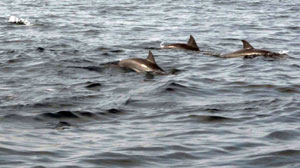
It takes an hour or two to get to the whales’ migratory passage, so if you’re awake watch the sea carefully for jellyfish and ghostly shapes darting below the boat’s prow – pods of dolphins should be easy to spot throughout your trip.

Dolphins Sri Lanka

You’ll know it’s time to wake up and get your camera in sports mode when the crew’s voices get louder, the engine’s growl takes on a new note of determination and your fellow passengers are clinging impatiently to the boat’s sides. It’s time.

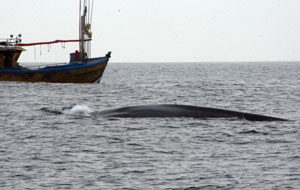
Nothing can prepare you for your first sighting. A flash of greyish-blue blubbery back and then it’s gone, hidden once more beneath the glinting waves. Underwhelming? Perhaps a little, but not for long.

After that first glimpse, your eyes will be glued to the sea. It’s easiest to spot any sea action in cloudy weather, but your eyes begin to play tricks on you whatever the weather.

By this time you’ll be travelling in convoy. The journey out might have given you the impression that it’s going to be just you and nature, but it won’t be, so get used to the pack mentality with which the boats operate.

Eventually, there’ll be another sighting. This time it’s the real deal.

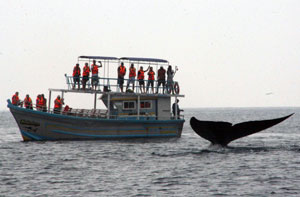
For photos, the money shot is the tail, so don’t worry if you or your camera is slow off the mark. Hopefully you’ll see the entire thing (not all at once) as it comes up for air, announces its arrival through its blowhole, and then sinks back underwater, the full length of its body slowly arcing above surface as it does. The performance ends with the tail, a two-finned behemoth that is flicked into the air with a final flourish before the whale plunges back into the sea’s depths. You’ll probably have a boat or five in your photos, perfect for giving a sense of scale.

Sri Lanka Blue Whale

If you’re lucky your leviathan will hang around to see what all the fuss is about; they can be curious creatures and are not afraid to pop up right next to you. If not, expect to spend a few more hours chasing them around. If you feel your driver is getting too close or harassing them, don’t be shy of making your feelings clear. This is a fairly new industry and needs all the checks it can get to stop it from becoming detrimental to the animals on which it relies.

The journey back is a good chance to do some more dolphin-spotting and check out other people’s photos. Pat yourself on the back, David would be proud.

> Learn more about blue whales and whale watching with Whales: Giants of the Seas and Oceans.

> See more of Sri Lanka with our range of travel guides and maps.