Caroline Sandes continues her trip around Iran travelling from Kashan to Eshafan stopping off at a nuclear facility along the way….
Thanks to the persuasions of a guide, Hossein, who had been at the one of the lovely houses of Kashan I’d visited the previous day, I had decided on the option of him driving me from Kashan to Esfahan so as to take in a few sites I wouldn’t be able to get to otherwise. Thanks to the exchange rate of the rial, this particular luxury was not just affordable but positively cheap. I also knew it would involve going right past one of the most supposedly notorious places of Iran – the nuclear facility at Natanz.
 He collected me from my hotel at 8am – a friend of his, an artist, was doing the driving so I was able to sit in the back and admire the scenery without worrying about coming up with intelligent conversation. The first stop was an archaeological site that was a last minute addition to the trip because a teacher I’d met the day before said I must visit it. Tepe Sialk is, archaeologists are almost sure, a ziggurat that was built around 3000 BC, which would make it one of the oldest ziggurats in the Middle East. It looks mostly like a large hillock but the shape, blurred as it is by weathering and caked mud, is suspiciously unnatural. Excavations that have happened sporadically over many decades, have uncovered all sorts of things, some of which are displayed in a small museum on the site. Hossein had in fact worked there on a couple of the excavation seasons, and was keen for me to talk to the aged museum supervisor, who spoke French, thanks to working for many years with French excavation teams. Regrettably my spoken French is hopeless; Hossein was clearly disappointed that I couldn’t talk with the supervisor, as was I.
From there it was on to the famous Bagh-e Fin gardens. Built for Shah Abbas I, in the late sixteenth century and the oldest surviving gardens in Iran, they are now part of Iran’s World Heritage gardens. The entrance to them is door in a high wall, but inside is a paradise of tinkling water, trees, greenery and the same graceful architecture with its beautiful wall paintings as seen in the houses in Kashan. It was late February so still somewhat wintery but the gardens must be lovely when the roses and other flowers are in bloom. The gardens were also the scene of the assassination of the popular Mirza Taqi Khan, a moderniser and prime minister between 1848 and 1851. Rather bizarrely, the murder is carefully depicted using Madam Tussaud-type wax models in one of the bathhouses… Continue reading Kashan to Esfahan
 Travel Photographer and author Steve Davey will be speaking at the Destinations Show at Earls Court this weekend. We have a signed copy of Steve’s latest book Around the World in 500 Festivals to give away to one lucky winner.
  Let me start by saying that I never really understood the obsession surrounding the historic U.S. Route 66. It is well known all around the world as one of the America’s icons. You can buy countless books, posters, calendars, magnets and whatever else you can imagine branded with the Route 66 shield. Somehow I never got too fascinated by it. A couple of years ago I did manage to see and drive some bits of it in Texas and Oklahoma but, to be honest, those stretches didn’t blow my mind away. As I already wrote on this blog, there are so many more interesting and scenic roads in the US. For me the only truly fascinating aspect of this famous route were the small ghost towns along it. One of them was the town of Texola located on the border of (where else) Texas and Oklahoma which I visited in 2011. With only 36 inhabitants (according to a 2010 census) it was practically a ghost town. Many buildings (including a gas station which once served Route 66) were falling apart or were completely overgrown; usually both. A great photo opportunity, but I seriously wondered where these 36 people lived. It was a fascinating little place but scarcely a reason to specifically follow the Route 66.
 by Kasia Nowicka
 With the short days of winter upon us there might be fewer daylight hours, but it’s more important than ever to enjoy them outside! The skies are full of birdlife and walking is great for keeping you warm so get off the sofa and try one of these
 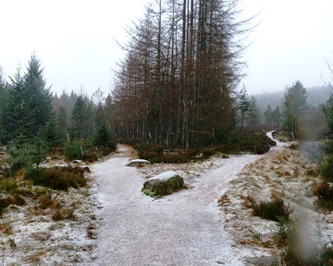 The most loved hill in Britain?
 by Gregor Swiderek