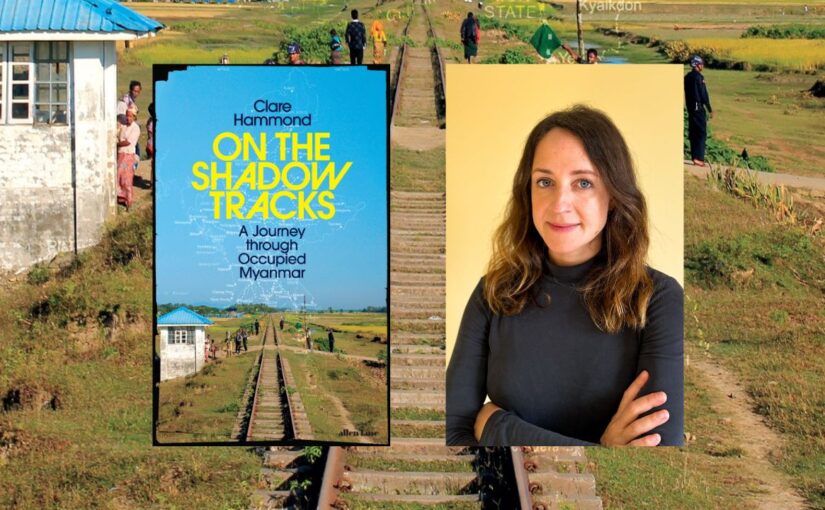
Being a map and travel bookshop, we are famous for showing people the world from the comfort of their armchairs. When we can’t travel somewhere, we really rely on maps, books and travel writers to help us learn about the history of a country and its people so we can keep ourselves informed. A perfect example of this is Clare Hammonds new book On the Shadow Tracks: A Journey Through Occupied Myanmar. Here she shares with us some things she has learnt while travelling by rail around Myanmar.
Tips for rail travel in Myanmar
By Clare Hammond
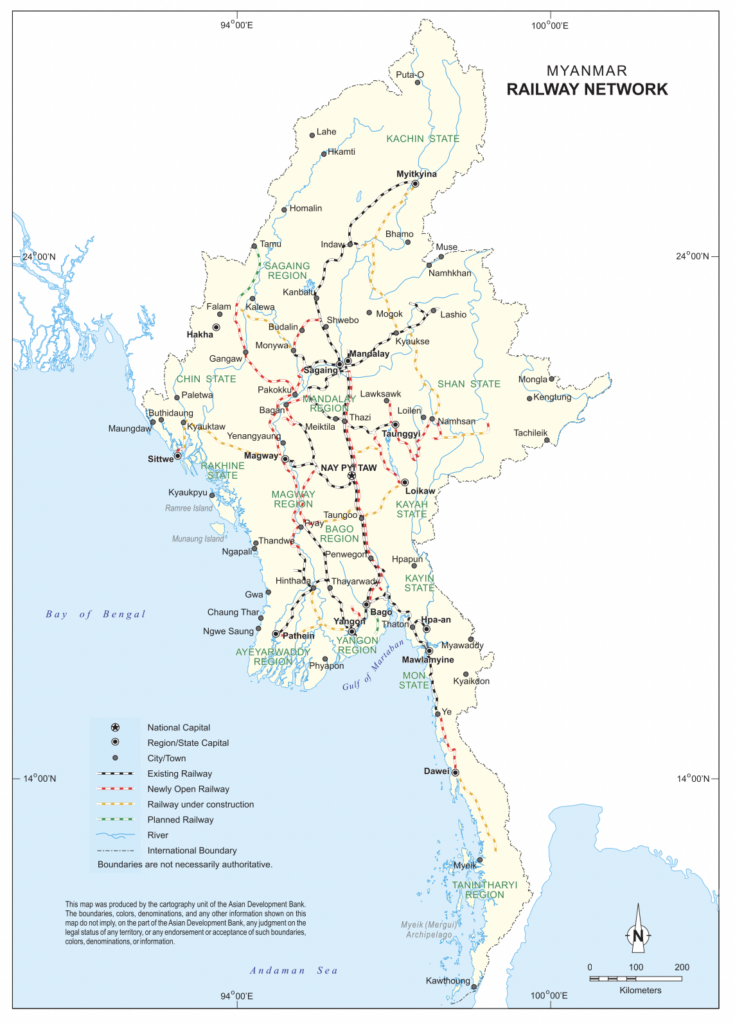
In 2016, while working as a journalist in Myanmar, I came across an obscure map that showed a web of new railways spanning the length and breadth of the country – railways not shown on any other publicly available maps at the time.
It inspired me to pack a small backpack and set out on a three-month journey to piece together the story of why these mysterious railways were built. This journey would transform my understanding not only of Myanmar’s modern history but also of Britain’s colonial past. I hope my new book, On the Shadow Tracks, will inspire others to discover more about this shared history, including by (one day) travelling to Myanmar. Which brings me to my first tip for rail travel…
Pick your moment. Since a military coup in 2021, conflict has broken out across the country and many of its railways have become battlegrounds – as they have been many times in the past. This means travel is very difficult, for now. But I’ve written this guide in a spirit of optimism, believing that the civilian-led resistance will prevail.
I hope it will soon be possible for outsiders to once again experience the slow, gentle magic of rail travel through this extraordinarily diverse country that is wedged between India, China and Southeast Asia.
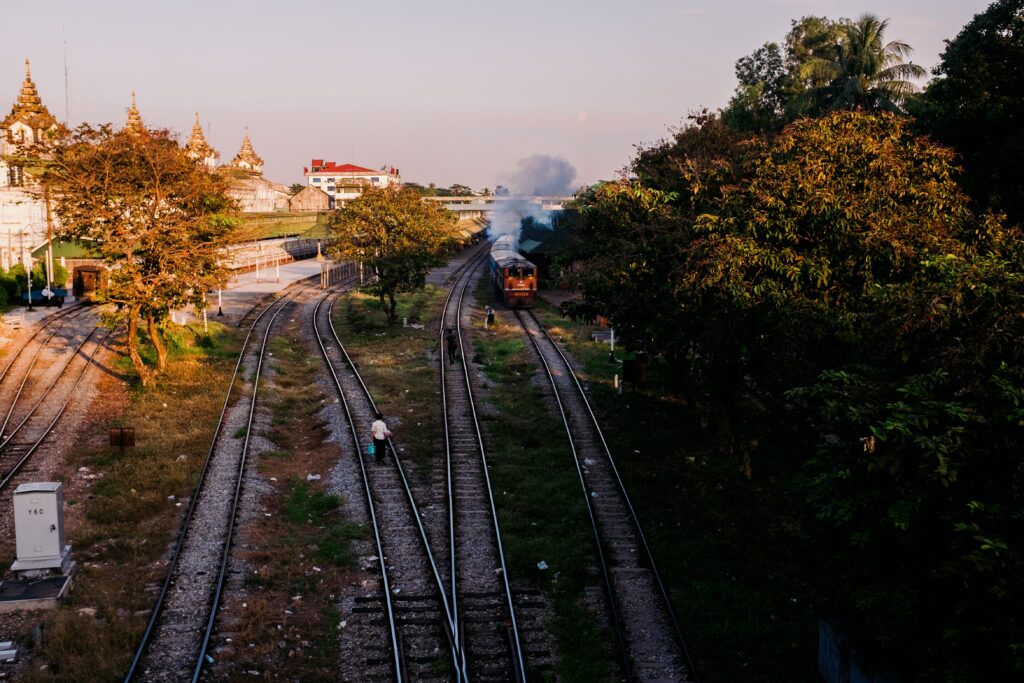
A train leaves Yangon Central Railway Station at dusk (Libby Burke Wilde)
Make sure your map is up to date. From the 1990s, Myanmar’s military regime expanded the colonial-era railway network to strengthen its grip on the country. But many of its railways are unfinished, abandoned by corrupt officials when the money ran out. Others are only partially open, having been washed away by floods, blocked by landslides, or blown up by non-state armed groups. The map I followed (see image below) was (relatively) accurate at the time. But when Myanmar opens to travel again, the landscape might look very different.
Pack light. Railway stations on the newer lines tend to be in the middle of nowhere, and you’ll need to jump on the back of a motorbike to get to the nearest village or town – very difficult if you’re carrying a large suitcase. But some items are non-negotiable. Bring your passport (your details will be written by hand onto every ticket), a torch (train lights often don’t work), a jumper or blanket to sit on (this will cushion the bumps – expect to be repeatedly thrown into the air), and a notepad and pen (many people in Myanmar read and write English better than they speak it).
Don’t forget to bring plenty of food. Sometimes there are vendors at stations and on the trains, selling excellent home-cooked snacks – everything from pickled roots and coconut jelly to quails’ eggs and strings of tamarind sweets. But often there are not, and most people travel with basket-loads of food just in case. Your companions will probably offer you some of theirs (expect a huge variety of dishes: Myanmar is home to more than 100 ethnic groups, each with its own cuisine), but it’s useful to have your own – and it means you can return the favour. Beer, whiskey, cheroots and betel quids to share around the carriage are staples too.
Don’t be in a rush. Basic tasks like finding your station (newer stations are often not marked on Google maps) and buying a ticket will take time. There are no public timetables for many railways and trains often leave before dawn (a legacy of the country’s long-running conflicts; it’s less dangerous to travel during daylight hours) – so your best bet is to arrive the night before.
You should also be prepared to insist that you really do want to take the train. When travelling into the delta, I was repeatedly advised to take the bus instead – the train service was no good, stationmasters said. Of course, they were right: 36 hours, four trains, two boats, one motorbike taxi and a night spent on a teashop floor later I finally reached my destination. The journey would have taken just four hours by road.
Accommodation can be eccentric. But you’ll always have somewhere to stay. When my train broke down on the way to Myitkyina, in Myanmar’s far north, the stationmaster marched me along the platform to what he called the ‘VIP room’ whose centrepiece was a large and heavily varnished teak table. In the corner was a single wooden bed. It had no mattress but was equipped with a filthy blanket and a crusty pillow. Spraying the entire contents of a bottle of air freshener into the room, he locked me in for the night. If all else fails, ask for directions to the nearest monastery.
Be prepared to hire your own train. I had to do this when travelling on a British-built mining railway in Shan State, near the Chinese border. Western railway enthusiasts in the past have paid thousands of dollars to commission steam trains. Luckily for me, a tiny, green diesel-powered trolley turned out to be a fraction of the price.
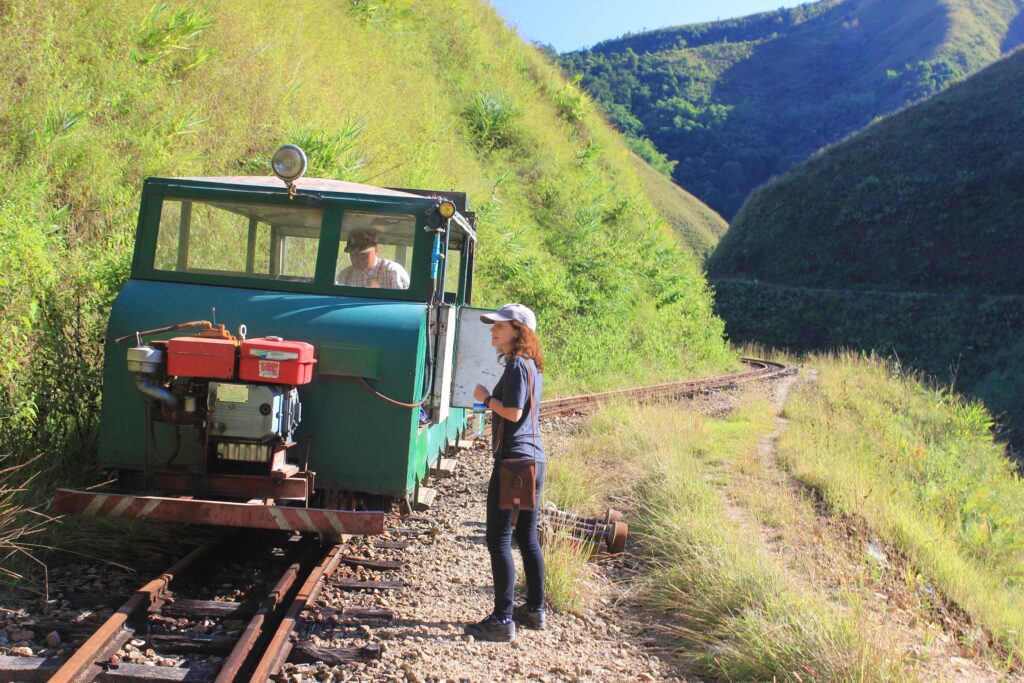
A condition of travelling on the abandoned railway to the Bawdwin mines in Shan State was that I hired my own train (Sai)
Brush up on your history. Railway building in Myanmar has always been contested. The British were the first to build new tracks into territory they barely controlled, shuttling troops to an advancing front line. Railways are fortified with barracks, police stations and prisons – colonial infrastructure that has been inherited and expanded by Myanmar’s armed forces. In the 1990s, new railways were built with mass forced labour, with millions of people forced at gunpoint to work. This history is not widely known about, even inside the country. But when military rule ends, I hope it will at last be possible to talk freely about the past. So, when you do go, ask questions! Pull up a plastic chair, accept the tea you’ll inevitably be offered, and settle in. People in Myanmar are exceptionally generous, including with their time.
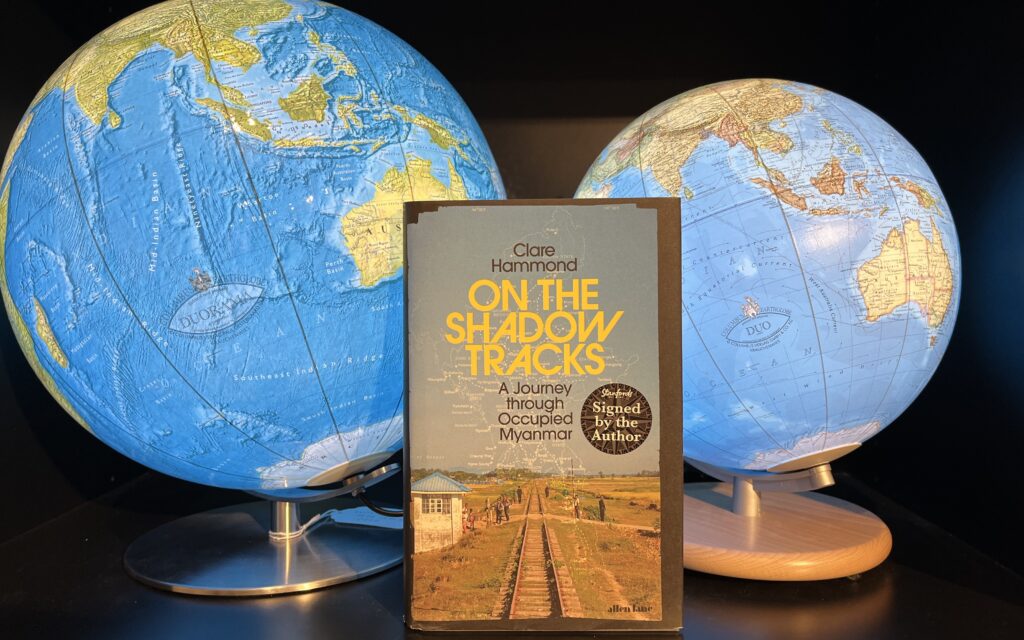
On the Shadow Tracks is available now from Stanfords for £25.
Watch Clare Hammond introduce On the Shadow Tracks: