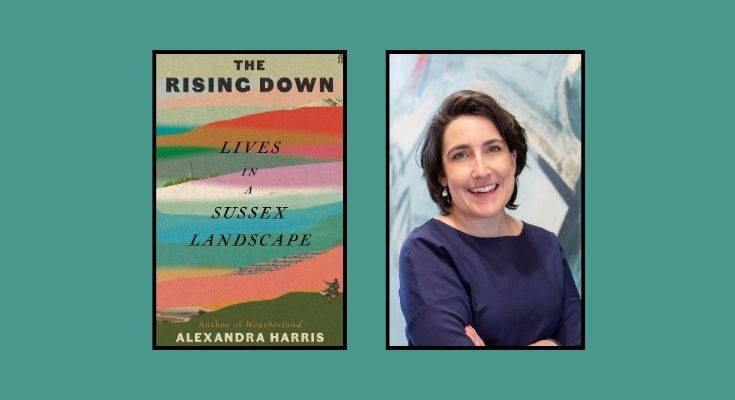
When the celebrated critic and cultural historian Alexandra Harris returned to her childhood home of West Sussex, she realised that she barely knew the place at all.
As she probed beneath the surface, excavating layers of archival records and everyday objects – bringing a lifetime’s reading to bear on the place where she started – hundreds of unexpected stories and hypnotic voices emerged from the area’s past. Who has stood here, she asks; what did they see?
From the painter John Constable and the modernist writer Ford Madox Ford to the lost local women who left little trace, these electrifying encounters – spanning the Downs, Poland, Australia, Canada – inspired her to imagine lives that seemed distant, yet were deeply connected through their shared landscape.
By focusing on one small patch of England, Harris finds ‘a World in a Grain of Sand’ and opens vast new horizons.
Here is an extract:
The Old English ‘dún’ meant simply a hill. It’s the dún that gave us sand dunes. In the Blickling Homilies, Christ preaches ‘on Oliuetes dúne’.[7] The Down of Olives is a marvellous thought – Christ delivering his sermon on a grassy slope with the chalk at his feet and rampion straining in the breeze – but clearly dúne was a generic word, used for all kinds of high places. The general meaning gradually acquired more specificity. A fourteenth-century encyclopaedist explained carefully that, ‘A downe is a lytyl swellynge or arerynge of erthe passynge the playne grounde . . . and not retchyng to hyghnesse of an hylle.’[8] This sounds like what we now call downs. Swelling is still a word much used to describe them; ‘arerynge’ is good too, a version of ‘a-rearing’, as in rearing up. By the sixteenth cen tury, ‘down’ was distinctly associated with chalk sheep pastures. The Tudor poet Barnabe Googe offered a vision of peace in his third eclogue: ‘I . . . thought it best to take my sheep / And dwell upon the down.’[9]
The western Sussex downs are more wooded than the hills to the east, and the tree cover has made the history round here more secretive. Earthworks disappear under depths of leaf mould; brushwood fills in former trenches.[10] Most of the villages are sheltered by land rising around them, which makes them different from villages in Norfolk, say, where you can see from one church to the next, or in Oxfordshire where if you find a hill, you can see tracts of the midlands. In the downs, you often come upon places by surprise. A friend lit a roadside beacon once on a November afternoon when he was expecting me, knowing that a visitor would be liable to miss the spot.
For most of its human history the Arun valley was isolated. Proximity to London, as the crow flies, meant little when an impassable band of Wealden clay was in the way. Well into the eighteenth century, overland travel was either onerous or impossible except for a few months in the summer. Goods coming into and out of the downs were transported by river, or by the seaborne ‘coasting trade’ round to London or west to Portsmouth. There are strong traditions of people living here without wanting to be easily observed. The area’s powerful Catholic families sustained recusant networks with necessary discretion through the post-Reformation centuries of intolerance.[11] Others have come – even in the twentieth century – to shake themselves free of networks, to be private. You could drive through Fittleworth regularly without noticing the lane up to the smallholding where in the 1920s Ford Madox Ford lived almost self-suffciently with his partner Stella Bowen, recovering himself from the double horrors of the war and his marriage; he raised pedigree black pigs and thought his way towards his novel Parade’s End. Laurie Lee left the Ministry of Information to live, under the radar, in a caravan outside Storrington. Ivon Hitchens had another caravan towed into the woods at Lavington Common and stayed for the next forty years, painting shadowed, secretive hollows and millponds.
The long, high path on the top of the downs stretches from above Winchester through Hampshire and Sussex and out to the white cliffs of Beachy Head. You can look across the Channel to where the same band of chalk continues, reappearing from under the sea. Sussex men who went to the Front in 1915 and 1916 were surprised to find them- selves among the familiar contours and flora of chalk country.[12] The path is almost as old as human life on the hills, long predating any notion of England or France. There is evidence for Mesolithic activity on the ridge, and by the time of the Iron Age the track was already very ancient. It has been a busy highway. It still is – on sunny Saturdays when off-road bikes weave around the groups of walkers.
I love to be up there pounding into the wind on the white road. But soon I drop down to a lower path. I would have been no good in the Iron Age. Unless you are a very hardy shepherd, it’s mostly in the foothills and valleys that life is lived. When I think of the downs, they are not falling beneath me but rising in the distance; I’ve always thought of them as rising. They rose beyond the playing field of my junior school in Storrington, so that when I came eleventh out of twelve in a running race there was still that rounded green wall, glimpsed beyond the football posts and the boundary trees, standing for something that was not to do with coming first or last. They rose in the seven o’clock dusk on Wednesday evenings when the window was open in the upper room at the village hall where children went for ‘ensemble’ class, or semi-controlled playing of all available musical instruments. I liked to tap the xylophone and hear its chimes answered by church bells from across the field. I was nine or ten, I suppose, and already conscious of turning from the brightly lit room, where someone was shaking maracas, to look out at the hills in the night. I think I was aware of something grand and in violable out there, but I didn’t understand much about the land around me and wouldn’t have known what to ask.
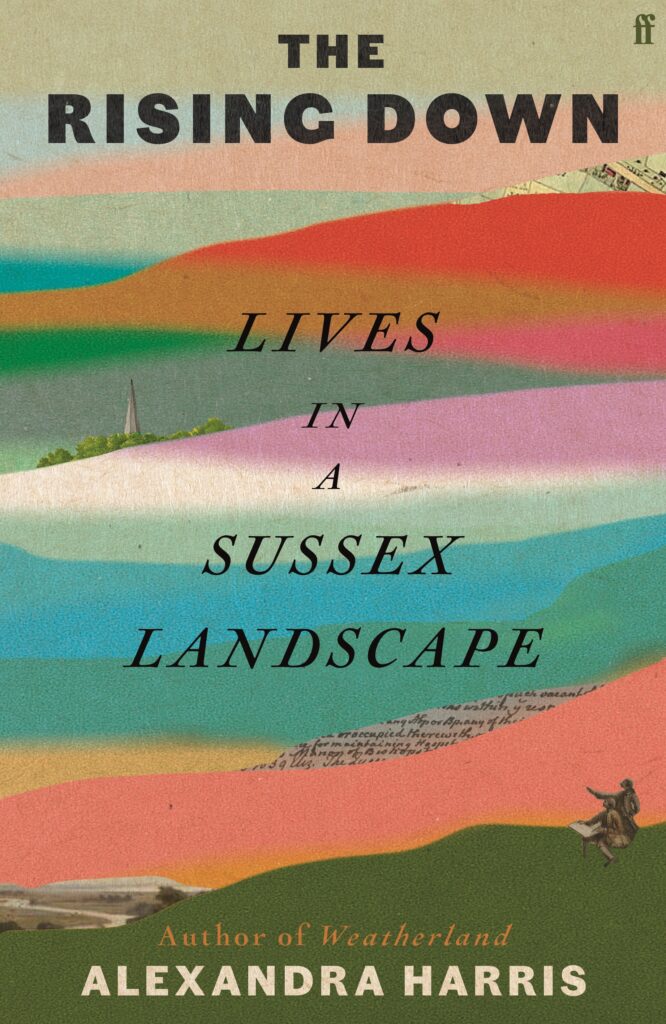
The Rising Down: Lives in a Sussex Landscape by Alexandra Harris is published by Faber (£25.00 hardback)
- [7] The Blickling Homilies (10th century), ed. Richard J. Kelly (London: Continuum, 2003), 48, 88.
- [8] Bartholomaeus Anglicus, De Proprietatibus Rerum, trans. John Trevisa (1398; Oxford: Clarendon, 1975), 717. Downs here include small foothills beneath higher hills; they are generally a middle ground between lowlands and highlands, and much favoured for living and farming.
- [9] Barnabe Googe, ‘Egloga Tertia’, lines 147–8, in Eclogues, Epitaphs and Sonnets (1563), ed. Judith M. Kennedy (Toronto: UTP, 2009).
- [10] LIDAR technology has recently made visible (by laser imaging) the archaeology of wooded areas. Secrets of the High Woods, ed. John Manley (Midhurst: SDNPA, 2016), presents research from a group of related studies in the area.
- [11] Matthew Dimmock, Andrew Hadfield and Paul Quinn assess the sixteenth- and seventeenth-century history of the county in Dimmock et al., eds, Art, Literature and Religion in Early Modern Sussex (2014; Abingdon: Routledge, 2016), 1–13. ‘Sussex was an anomaly: a southern county with a religious dynamic more in keeping with those of the north, connected to the Continent as much as to the rest of the country.’
- [12] A phenomenon widely discussed but see especially Keith Grieves, Sussex in the First World War, SRS 84 (2004), xxiv, and John Godfrey, ‘Landscapes of War and Peace: Sussex, the South Downs, and the Western Front’, SAC 152 (2014), 189–209, 204. See also chapter 26.