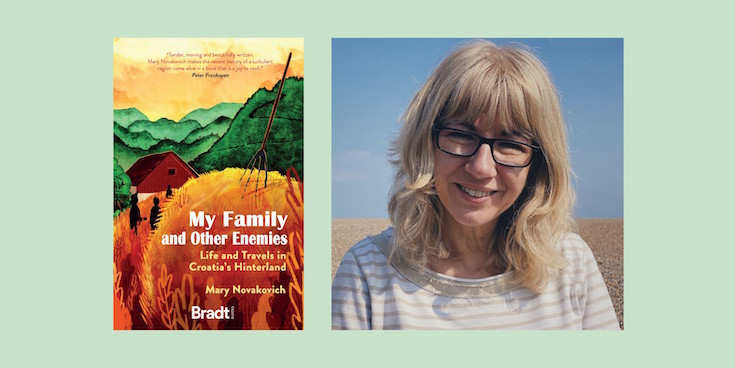
My Family and Other Enemies is part travelogue, part memoir that dives into the hinterland of Croatia. Mary Novakovich explores her ongoing relationship with the region of Lika in central Croatia, where her parents were born. In recounting her own family’s tumultuous history, Novakovich opens up a world that is little known outside the Balkans, telling the stories of people whose experiences weren’t widely reported at the time, when the devastation in Croatia was superseded by the Bosnian conflict and media attention moved elsewhere.
Here is an extract:
After taking another long look at the Una river, we headed back along the rough track through that glorious greenery again towards Štrbci, the village where Mum was born and where she hoped to track down some of her cousins. Eventually, we came across a group of houses and spotted an old couple in the lane. Boja, the elderly woman, had an endearing verbal tic as she chatted away, punctuating every phrase with ‘srećo moja’ – meaning ‘my darling’. She was adorable to listen to.

We were soon joined by one of Mum’s cousins, yet another Ilija to add to the vast family collection of Ilijas. He led us across the lane into his pleasant, tree-shaded garden backed by orchards and, just beyond, impenetrable forests. I immediately liked Ilija: he was warm, friendly and open, maybe in his late sixties. One of his neighbours had stopped by, and they were all cheerfully knocking back beers in this harmonious place. Well, it was harmonious on this particular day, but earlier I had spotted a building with ‘Ovo je Hrvatska’ – This is Croatia – spray-painted on it, and another had ‘BiH’ – Bosna i Hercegovina – in red letters, more reminders of the 1990s war.
Ilija proved to be helpful in filling some of the gaping holes in Mum’s family tree. We established that his grandfather and my mother’s grandmother were brother and sister. A few times, though, when someone tried to recall a missing family member, they would all chime: ‘Oh, Anđa will know. Ask her when you get back to Nebljusi.’
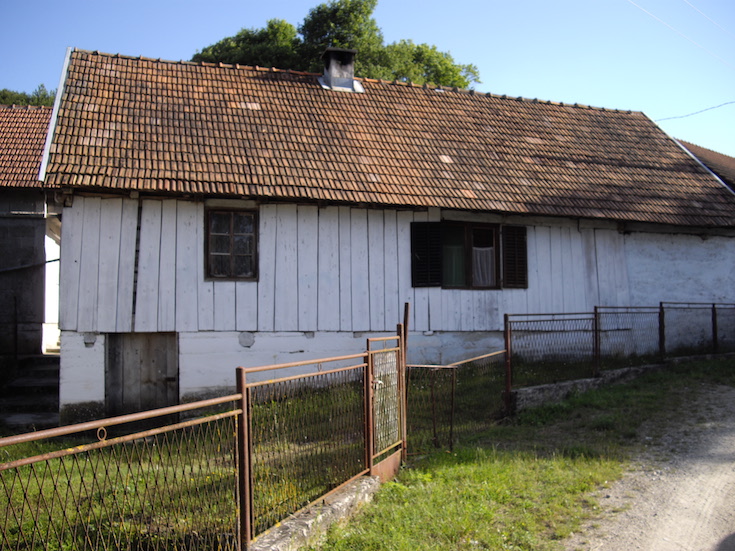
Unlike many of the more modern houses I had seen, Ilija’s seemed to be relatively old, perhaps late nineteenth century, built of thick whitewashed stone walls and terracotta roof tiles. ‘Your great-grandmother Deva was born here,’ Ilija told me, which made my jaw drop in astonishment.
My great-grandmother Deva was murdered by the Ustaše in 1941, and this was one of the stories I wanted to delve into while I was here. Both my parents’ houses had long fallen into ruin, as had both my grandmothers’ houses. And here was my great-grandmother’s house not just still standing, but lived in, and loved.
I sat back and marvelled at the news. Minutes earlier I had been sitting at that rickety table under the trees, not particularly with a sense of familiarity, but with utter ease. I wondered if some instinct was making me feel at home. Or was I being fanciful? Either way, I was thoroughly enjoying this little hamlet and its peaceful setting.
Ilija let me poke around inside the house, where beautiful solid oak beams were supporting a heavy oak ceiling. My mother, her brother and sister would have played here as small children before war broke out in 1941. This tangible, living link to my family’s past was such a rare thing to find, and it filled me with a quiet joy.
It also made me realise how, as the child of a refugee and a migrant, I had grown up with next to no physical reminders of my parents’ past lives – apart from a small handful of old photographs. And even many of these would have been sent to them by other family members once my parents were settled. My father would have carried nothing as he made the tortuous trek on foot from Lika to refugee camps in Italy and Germany before arriving in Britain. My mother would have had, at most, a small suitcase as she travelled by train from Trieste to Ostend to take the ferry to Britain’s east coast. We have no family heirlooms, humble as they would have been. Our strongest link to my parents’ past has always been
through food, even stronger than religion, although many of our rituals associated with the church usually revolve around food.
I left my great-grandmother’s house to find the garden empty Everyone was in an adjoining field, where I witnessed a scene that could have come out of the Middle Ages. Ilija had climbed up a makeshift ladder to stand on top of a giant haystack, while several helpers, including the woman Boja we had met earlier, were passing him clumps of hay using homemade pitchforks. The late-afternoon sun was casting a glow on the scene, which couldn’t have looked more bucolic if Constable had painted it. But only a city person like me would initially be swept away by the romanticism of it all, when, in reality, everyone here was either elderly or in late middle age, and it was extremely hard work.
My Family and Other Enemies by Mary Novakovich is available for £9.99.
STANFORDS LONDON IN STORE EVENT
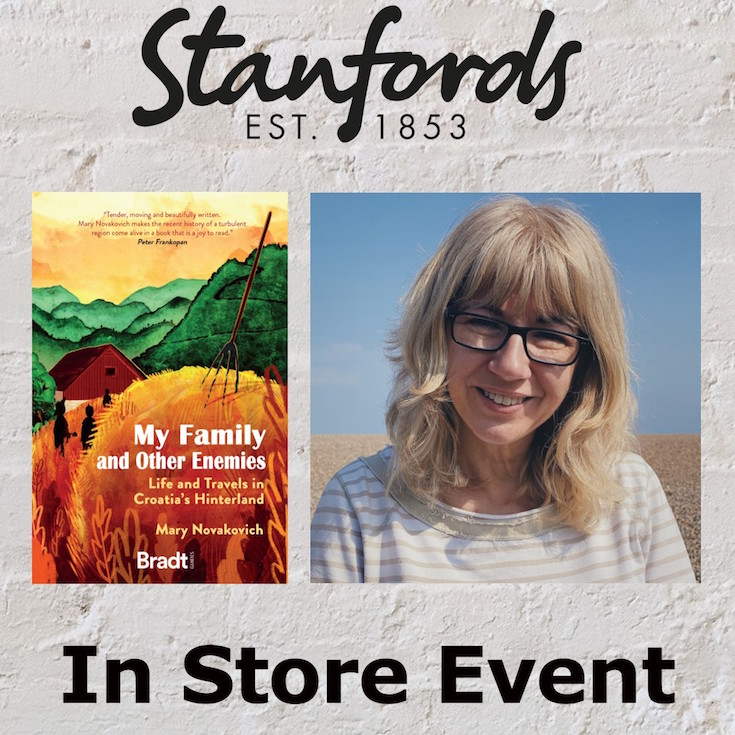
Join us on Thursday 1st September 19:00 as we welcome Mary Novakovich to Stanfords to talk about My Family and Other Enemies. Get your tickets here.
Fabulous Mary. Good luck with the talk and the book’s sales.