
Following on from the hugely successful, 2020 Edward Stanfords Travel Writing Awards shortlisted The Atlas of Unusual Borders, Zoran Nikolic is back with a new atlas all about discovering intriguing linguistic oddities and language islands.
We communicate through the spoken and written word and language has evolved over the centuries. Many languages have survived although only in small pockets throughout the world. The Atlas of Unusual Languages explores a selection of those languages and some that have now been lost forever.
Here, Zoran Nikolic tells Stanfords about his latest book:
The country I was born in no longer exists. However, in 1975, when its name was entered on my first birth certificate, the Socialist Federal Republic of Yugoslavia (SFRY) was a federation composed of 6 republics. A short-lived dream of the togetherness of many nations, it didn’t even have an official language on the federal level. Beside the main languages, Serbo-Croatian, Slovenian and Macedonian (all three from the family of South Slavic languages), all languages of national minorities had the status of an official language – Albanian, Hungarian, Italian, Turkish, Romanian, Slovak, Czech, Ruthenian, Bulgarian, Greek, Romani, Vlach… I hope I didn’t forget to mention any language!
My first encounter with languages that are unknown to me, but which are commonly spoken in my homeland, came through television. Namely, during my childhood, state TV stations used to broadcast news and some other shows in all official languages of the SFRY. For some reason, I liked to listen to all those completely incomprehensible reports about time, agriculture or conflicts in the world in languages that I absolutely did not understand. I was simply fascinated to learn that there are some people around me who live exactly the same as my family, but who speak a completely different language.
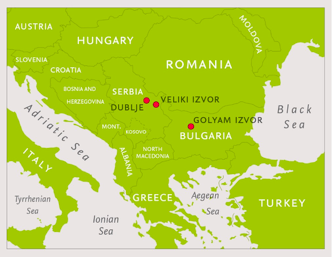
Growing up, from time to time I used to come across constantly new intriguing information about the myriad of languages spoken in my country. For instance, I learned that in two villages in Serbia, people speak a language (or perhaps a dialect, it has not yet been reliably determined) that is spoken in only one other village, in the center of Bulgaria. This language is close to the Bulgarian language, but differences are obvious. It is possible that the speech of this population was influenced by the medieval language of Kievan Rus, because a larger group of inhabitants of that area immigrated to Bulgaria after the Mongol invasion.
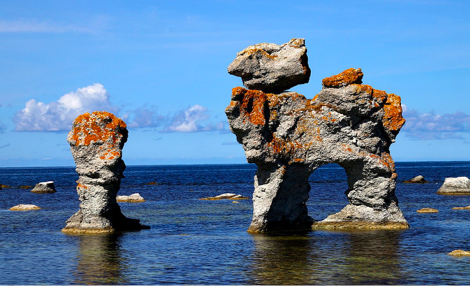
Even later, the Internet became an inexhaustible source of numerous interesting things related to geography and linguistics. That is how I learned that in the mountain ranges of the Crimean peninsula, one of the East Germanic languages, Crimean Gothic, may have survived the gloomy fate of its relatives deep in late 18th century. In the same way I also became aware that there are linguists who believe that Gutnish, the language spoken by part of the population of the Swedish islands of Gotland and Fårö, is in fact perhaps the last living descendant of the Gothic language. Although the probability for that is small, it is quite possible that in some ancient times the Gothic language participated in the creation of Old Gutnish, from which today’s Gutnish originated. As Gutnish continued to develop under the enormous influence of the Swedish language, it has today become a (slightly more difficult to understand) dialect of the Swedish language.
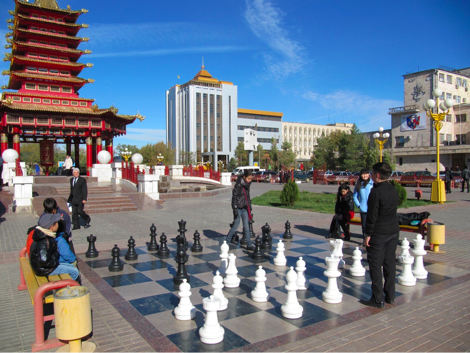
On the other hand, my path to new knowledge was sometimes quite unusual. An example was one of my business meetings, during which I learned that in Belgrade, the capital of Serbia, there was a Buddhist temple until the Second World War. A business partner, who was delighted with my interest in this topic, even gave me a book, whose publication was financially supported by his company. It was a book about the Kalmyks, a Mongolian people unknown to me until then, many of whom fled to Belgrade, then the capital of the Kingdom of Yugoslavia, after the defeat in the Soviet revolution. That is how I learned another incredible story, about the people who jealously guarded their language for centuries, carrying it from today’s Mongolia and northeast China, through Central Asia, all the way to the European shores of the Caspian Sea and the Balkan Peninsula. Today, there are no more Kalmyks in Belgrade, but they have survived in their autonomous region in Russia, the Republic of Kalmykia, which is the only political territory in Europe where the majority of the population speaks the Mongolian dialect and practices the Buddhist religion.
Little by little, those crumbs of knowledge accumulated over many years have become the driving force for writing a book about some lesser-known languages around the world. Actually, I wrote The Atlas of Unusual Languages as if I were writing it for myself – with as much interesting information, illustrative photos and comprehensible maps, all without going into too much detail (after all, it was never meant to be an encyclopedia or doctoral dissertation).
To list just a few more examples covered in the book:
– one language that has been spoken for an incredibly long time (10,000-15,000 years), has only recently officially gained the status of an indigenous language (it is the Ainu language in Japan)
– several peoples in southern and eastern Africa speak languages that are completely different from any other language in the world, with the exception of one ceremonial language on an island in northern Australia: these are click languages
– the famous Mutiny on the Bounty resulted in the creation of an unusual language, a mixture of English and Tahitian from the 18th century
– in North America there are several densely populated cities where today the inhabitants use almost exclusively Yiddish, one of the few languages spoken by Jews around the world today (certainly, Hebrew is the most represented, as the official language of Israel)
– in the small island nation of Singapore, there is an even smaller enclave of the Thai language, which actually comprises only one business-residential building
– in some parts of Scotland today neither English nor Scottish is spoken, but Scots, the sister language of English
– in one village in New Zealand there are still several people who speak an unusual dialect of German, known as Puhoi Egerländer dialect
The Atlas of Unusual Languages is the collection of similar examples from all around the globe. By celebrating the difference between the languages, I hope that my book will help bring better understanding between people, especially the ones living next to each other but not sharing the same language.
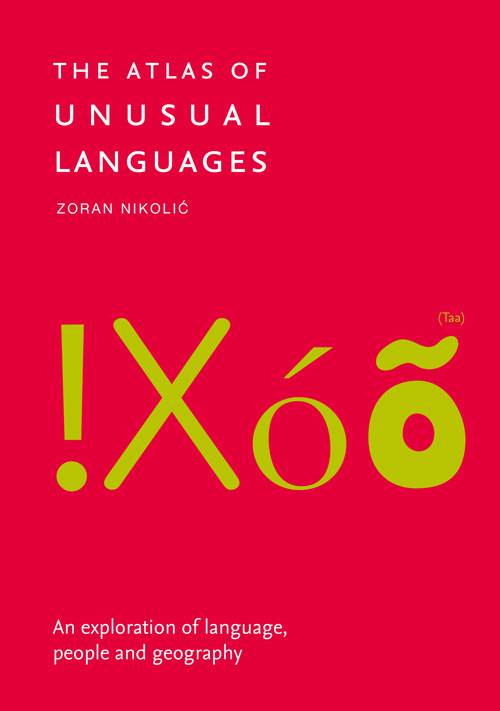
The Atlas of Unusual Languages is available for £14.99
Watch Zoran Nikolic introduce The Atlas of Unusual Languages: