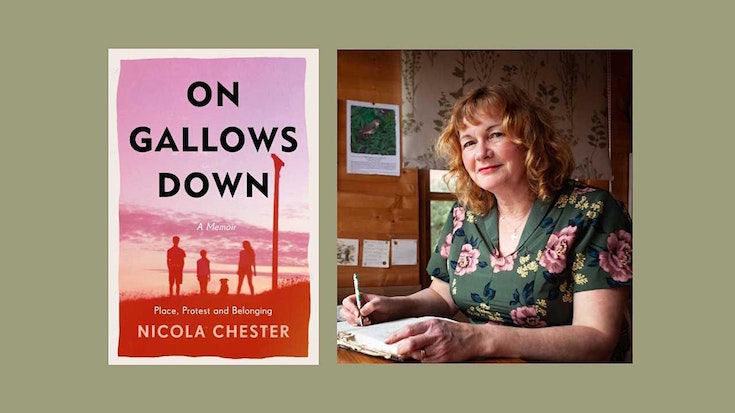
The following is an extract from On Gallows Down: Place, Protest and Belonging (Chelsea Green Publishing, October 2021) by Nicola Chester and is reprinted with permission from the publisher.
Bird in a Landscape
It is St George’s Day, late April, two days shy of my birthday. The sky is the colour of a pheasant’s egg and skylarks are singing against it at such a height I can’t see them. A just discernible shimmer of heat blurs the near horizon of orange gravel that marks the old runway of this former US airbase. I am sitting on my hands on top of an old American fire hydrant, its once-smooth sides speckled with rust and yellow and red paint curled and crusted like lichen. I can’t quite reach the ground and sit swinging my legs, a toe occasionally reaching a knobbly chunk of flint to kick away. I think I’ve been stood up.
The view to the southwest is all curves. The open-mouthed caves of the old cruise-missile bunkers replicate the smooth, lyrical, whaleback arc of the chalk hills beyond and their ancient procession of round and long barrows and hillforts. The striking green contours of bare, richly flowered and springy turf take in White Hill, Watership Down, Ladle Hill and Great Litchfield Down. On the other side of the hidden A34 are the ‘elephant graves’ of Seven Barrows on the Highclere Estate where British aviation pioneer Geoffrey de Havilland made his first flight in a homemade aeroplane in 1909. Above Seven Barrows is the graceful dome of Beacon Hill, crowned with its Iron Age hillfort. At its centre lie the railings and grave of the (reputedly mummified) 5th Earl of Carnarvon, co-discoverer of the tomb of the Egyptian boy pharaoh, Tutankhamun. Only from that hill can I see the old, isolated, flint-and-brick estate cottage at Highclere that was once my home. I still have the key to its blue-liveried front door on a piece of matching ribbon by the side of my bed. I like to weigh its cool heaviness in my hand and for my fingers to remember the satisfying grate it made when turned in a lock the size of a child’s shoebox. From there, the hills roll on to where I live now, within an afternoon’s walk along the ridgeway.
If I lower my gaze again to the foreground, the old bunkers, built to hold nuclear warheads as well as withstand a strike from one, are now long-haired, softened relics that have become a part of the narrative-landscape of this place. Steep-sided, flat-roofed, grassed all over, they seem part Neolithic long barrow, part natural chalk downland; half-built pyramids for a pharaoh or shallower versions of the prehistoric flat-topped cone of Silbury Hill not many miles from here. Their doorless entrances are wide mouths, open and raised obediently to the sky, all six singing the same long note: say ‘ahhh’. They are empty vessels, waiting for a spoonful of something.
I am sitting in the middle of what was formerly RAF Greenham Common, a military airbase in West Berkshire, Southern England, a few miles south of the town of Newbury. Now just Greenham Common, it is being restored to what it had been for thousands of years – a thousand acresof open heath on a gravel table, with wet, wooded, primeval gullies that run off it like creases in a tablecloth. Greenham Common, almost as I know it, was created millennia ago, when the little, benign chalk streams of the Kennet and the Enborne – which gave my schoolhouses two of their names– were mighty rivers that washed out the flints from chalky subsoil overlying sunset-coloured clays and sands.
Greenham Common is a place of big skies and wide, cloud-reflecting pools. The joyful sense of freedom and open space I felt 21 years ago when the fences came down is renewed every time I come back. Back then, that feeling had a lot to do with the Common’s military and social history, its place in local culture and how I remembered it before the fences as a child. Yet now, that sense has become permanent, emanating from the place itself like an excitable shiver of heat haze on the low horizon. A force of nature. This high, wild, gravelly plateau, romantically bleak one day and a riot of crackling warmth and colour on another, is our own wild moor. Richard Mabey, the father of modern writing on nature, wrote about Greenham Common in 1993 when it was decommissioned and up for sale: ‘It will be heartwarming if the place can become a common ground for humans as well as wildlife…a powerful symbol…complete with grazing animals, ponds and a few rusting relics to remind future generations of what this place once was.’ The sense of happy incredulity that this actually came to pass does not diminish.
Before then, the birds and plants were mostly nameless familiars. I knew their touch, sight, sound and smell – the memories they engendered, the feelings they inspired – but not always their names. They were there. They were abstract. But they were part of my personal history. We used to exercise the riding-school ponies bareback along the paths and tracks in the school holidays, over purple heather or in snow, until one day an eight-foot chain-link fence cut right across the path. Another path, presumably an attempt at compensation, was diverted and, bizarrely, concreted. The hoofprints we made that day in the fresh, almost-set cement registered a protest and are still there. But now the path ends nowhere again; itself having become a relic, like the old control tower, the fire hydrants and the ‘fire plane’, a rusty facsimile of an aeroplane that lies supported above a round, shallow pond which would have been filled with burning fuel for training purposes. The odd concrete post or angled section of rusted razor-wire fence seems innocuous, even naïve now. They wouldn’t keep a rabbit out. Yet I remember the very real threats of a ‘shoot to kill’ policy if the inner enclosure was breached.
Apart from the birdsong and the occasional popping of gorse and the patter of explosively ejected seeds falling, the Common is quiet now. I check my watch and decide to give it another ten minutes, shifting myself on my fire hydrant. The wood shakes itself of cherry blossom.
Greenham Common is an ancient place, never otherwise enclosed. It had remained under traditional common use, by local cottagers and smallholders, for grazing, fuel and other gathered materials, right up until it was requisitioned in 1941 for a wartime airfield. But instead of being returned to common land, as expected, after the war ended, the UK government overruled considerable local opposition and protest and it became a United States airbase for heavy bombers. By 1980, the government agreed for it to be a base for American nuclear-armed cruise missiles.
The Common expirates a largely undocumented historical aura of commoners and the rural poor as well as Romanies, travellers, thieves, picnickers, refugees and armies, but it has a more recent retro feel, too. For me, no doubt because it’s a childhood haunt full of touchstones and memories; but also because of its missile hangars with their 1980s mullet hairdos and other Cold War accoutrements, the 1950s-style American fire hydrants and 1940s ammunition stores hidden deep in a bluebell wood, with its abandoned, crumbling, concrete stalls. Silver-washed fritillaries the colour of strong tea float down to rest on the old brickwork and, sometimes, you can happen upon a lizard basking, curvy like the letter ‘S’, or a diamond-studded adder, and mistake them for an ornate hinge, a rusted bracket, the imprint of a mountain-bike tyre in grey earth or an old piece of heavy-duty rope. Sometimes little ringed plovers gather round the pools and there are woodlark, green-winged orchids and nightingales beyond the fire plane. And on a day when the clouds build and loose like billowy galleons over the downs and the ponies and commoners’ brindled, dappled cattle graze among the stands of gorse (or furze, depending on which side of the border you’re from), it’s a part of North Wessex that Thomas Hardy would recognise, as long as you keep the view to the southwest and the smells of the pickle factory to your east. It has a lived-in, handed-down, given-back feeling. Pre-worn, nostalgic but freshly aired. Like a faded piece of vintage cloth, washed and made into a new dress, it is quietly jubilant. It’s a landscape that connects, threads through and links my own narrative, intrinsically. In the year 2000, having been derequisitioned and reinstated as common land once more, Greenham Common was officially reopened to the public. I watched a short-eared owl cruise down the old runway where once there were Vulcan Bombers.
In ten minutes, I must leave to pick the children up from school. The one I’m waiting for has still not arrived. I am no lovelorn teenager in the all-consuming, hopeful, fearful flush of first love, but there is a growing, gnawing emptiness I can barely contemplate: that everything hinges on this moment and that I will break if it does not happen. The one I wait for always arrives within the two days either side of my birthday. I have been holding a candle for him all my known life, lighting it every spring, and each year the anxiety that he will not make it increases. The knowledge of what he – and generations of him – have to go through each time he comes and goes increases year on year, making our meeting seem all the more unlikely. That thought almost prostrates me with grief. I am waiting for a bird. I am waiting for the cuckoo.
It hasn’t always been the cuckoo I’ve waited so hard for. Once, for a while, there was another heartbreaker bird. I come here each year just to hear that too, now; over beyond the fire plane, because now that is the only place I can find it. And this is important. Because I need to know that the cuckoo I want so much to hear is – as near as possible – ‘my’ cuckoo; the cuckoo (or another generation of it) that belongs to this landscape as much as I do, that is still coming back, still returning. I need to know that the cuckoo is still coming home.
Between the fire hydrant and the fire plane lie the remnants of the old airstrip, the concrete cross of its middle all that remains of the longest runway in Europe. The rest of it has been broken up into rubble and is the reason I feel that having the Common back is only some sort of consolation. The rubble now lies, recycled, in a narrow, nine-mile stretch (the same length as the old, unravelled perimeter fence) three miles from here, dividing and curving between my old homes, under the Newbury Bypass.
Time was up for me on Greenham. It was another ten days before I finally heard the cuckoo. Carrying out washing to the line, I heard it call from the wood across the field. That two-syllable note that echoes down the centuries with the quality of a woodwind instrument. ‘Cuc-koo, Cuc-koo’. It stopped me in my tracks and before I could help it a sharp intake of breath became a sob. I felt as though my legs had been knocked from under me and I had fallen, winded, only to realise that I’m okay, that it’s okay. There is the hot sting of tears and I wonder, when did I get like this? About a bird? When did it ever begin to mean so much?

On Gallows Down: Place, Protest and Belonging by Nicola Chester is available at Stanfords for £20.00
Join us at Stanfords on Wednesday 17th November 2021 for an evening of passionate conversation as Nicola Chester talks about her new book. Tickets available here.
Here is a video of Nicola introducing On Gallows Down: