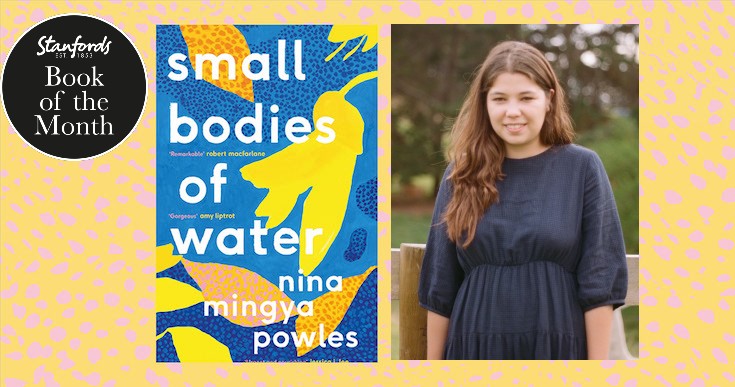
Our Book of the Month for August is Small Bodies of Water by Nina Mingya Powles, Taking us from London to New Zealand, Shanghai to Malaysia via a lyrical, poetic essay collection that blends memoir with powerful writing on the natural world. To give you an idea of what to expect from this book, here is an extract for you to read:
Extract from ‘Unpeel’, pages 117-121
I’d begun cataloguing the varying pinkness of the Shanghai sky with my phone. On days when my VPN app let me through, I posted square pictures of magenta clouds on Instagram and Facebook, watching the tiny red hearts of other people’s likes popping up from all the different time zones where my friends lived: mostly Aotearoa, but also Europe, Canada, America. I didn’t speak to anyone face to face for almost two months, while my phone buzzed and lit up with messages from far away.
Towards the end of summer I responded to a WeChat job posting from a Shanghainese mother looking for an English tutor for her daughter. I took two subway trains across the city to meet with her at a McDonald’s, where she bought me a raspberry-flavoured ice slushy and admired my tattoo. Her daughter was shy, though she liked telling me in careful English about her favourite manga comics. I took the job, and at their kitchen table every week their Scottish Fold cat sat wide-eyed on the table between us, purring at me. I’d stay for dinner, and both mother and daughter together taught me how to use my fingers, knuckles, teeth and tongue to unpeel and eat tiny Shanghai freshwater crayfish, 小龙虾 xiaˇo lóngxiaˉ, little dragon shrimp. It was a labour-intensive process of picking, peeling and sucking sweet flesh out of each crimson shell.
The long, achingly hot summer faded out with the promise of a trip to the picturesque southern city of Guilin with three of my classmates: Katrin, from Frankfurt, and Adi and Frances, also from Aotearoa. On the sixteenhour overnight train – far cheaper than the bullet train – the others played cards while I kept watch for the snack cart, which was piled high with vacuum-packed dried sausages, preserved eggs, fresh fruit and endless styrofoam cups of instant noodles. The two characters of Guilin, 桂林, together mean sweet osmanthus forest. In early autumn, the region lives up to its name: all the roads are coated in delicate white-and-yellow flowers. Guilin’s dramatic karst hills, and the Li River that curves between them, are depicted on the back of the Chinese twenty- yuan note. I had been to Guilin before, almost a decade earlier, on a school trip in eighth grade. I remember sitting with two of my best friends on the edge of a curved stone bridge, our feet dangling over the edge, watching dragonflies and drinking mango smoothies. At night the market streets were lined with fairy lights. The limestone hills fell away in darkness, then reappeared at sunrise like giants guarding the town, silhouetted against the blue dawn.
The others wanted to climb one of the smaller limestone mountains, Lao Zhai Shan. I reluctantly agreed, knowing I’d be trailing along behind them. After half an hour up the winding track my body was aching. I focused my senses on my surroundings in order to keep placing one foot in front of the other. In the shade of the bamboo forest we were kept cool from the strong sun, and through the gaps in the trees I could see graves and burial mounds set into the hillside, much like the hillside cemeteries in Kota Kinabalu. I could see that the concrete graves had once been painted in pastel colours, peachy pink and baby blue, now faded. Bowls of oranges and chains of plastic white and yellow chrysanthemums had been left as offerings. I relaxed into the soft silence punctuated by our deep breathing and rustling leaves, a particular blending of sounds I hadn’t heard since being back home, walking the bush track up the hill above the sea.
After an hour, the canopy of leaves began to clear. The sun warmed my face. The last section of the climb was too steep for any proper path. Instead, a series of rope and steel ladders were hammered into the side of the rock. I shut my eyes and followed my friends, not looking down but only straight in front of me, at the pale, scratched limestone rock.
At the summit, out of breath, I turned to see the view. The Li River in miniature, a luminescent blue ribbon curving between jagged limestone slopes that seemed to go on forever. Between the mountains, smaller valleys had been carved into terraced rice fields. A buzz of insects filled the air along with our breathless laughter: yellow and blue-winged butterflies flitted between us, and giant wasps. I cut a peach into quarters for the four of us and Katrin presented a plastic bag filled with mandarins, bought from a streetside seller at the foot of Lao Zhai Shan. We peeled and feasted under the small wooden pagoda, letting the juice run down our wrists.
Small Bodies of Water by Nina Mingya Powles is available for £14.99

All our copies are signed by the author.