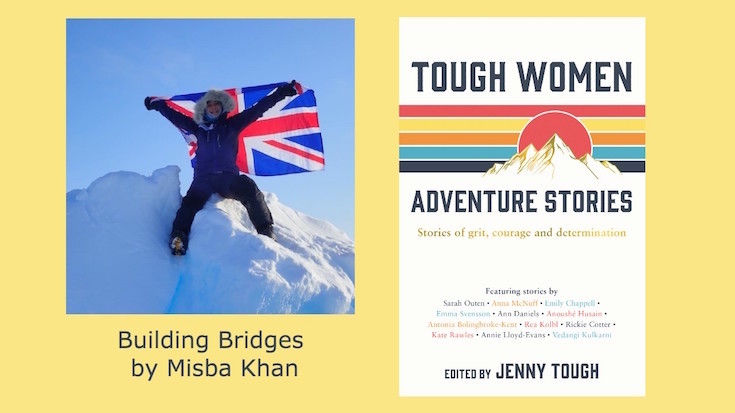
To celebrate International Women’s Day 2021 we are taking a closer look at Tough Women Adventure Stories: Stories of Grit, Courage and Determination an anthology edited by Jenny Tough. The adventurers in this collection are all fearless, intelligent, compassionate and curious about the world – and they all happen to be female. From endurance obstacle races to arctic expeditions, from mountain climbing to wingsuit flying, from horse trekking to swimming the English Channel, they have set the bar high for what women are capable of.
Here we have a story from the book Building Bridges by Misba Khan:
It’s the first time I’ve celebrated Pakistan Independence Day actually in Pakistan, my ancestral country. It happens to be a rest day and we’re staying in the charming mountain village of Hushe, in the Ghangche District of northern Pakistan. Our small, multinational group has been trekking through the Karakoram mountain range for two weeks now, from where we began in Skardu. We then ascended the Baltoro Glacier and spent a night at K2 base camp. We’re near the end of our journey now and some members of the group have chosen to go for a day hike. I’m revelling in the spirit of a rest day, exploring the village and absorbing the adventure of the past fortnight.
I find a quiet spot in the sun to sit and read my book in isolation. I’ve read The Magic Faraway Tree so many times now, but it’s different every time I go on an adventure of my own. I’m lost in the pages when the owner of the guesthouse we’re staying in approaches and invites me to follow him to the local school, where the Independence Day celebrations are about to commence. His children attend the school and are eager for me to come along.
We walk through the village, stopping to say hello and run errands as we do so. I feel like his daughter, following him somewhat cluelessly, yet curiously, as we visit what feels like every home in the village, greeting neighbours, while he tells me about this place in the gaps in between.
We enter the school to a remarkable reception of children singing in unison. The children are all neatly turned out in their uniforms, which are blue with the girls in white headscarves. The neatness of the children juxtaposes the school’s conditions, which are impossible to ignore. It’s an incredibly poor building, with no sanitation and limited resources for the children to learn. In a village where almost every adult is illiterate, this is perhaps no surprise, but I still inhale sharply at the sight of the eager youths contrasting against the limited promise offered to them.
Unable to leave Hushe without understanding more about life here, I return to the school after the celebrations to meet with the principal. I sit, once again feeling like a girl, in a low chair across the desk from the man who has charged himself with the task of raising educated children in a village where so few adults have been educated, or even respect education. I wonder if his suit has been donated, the way the sleeves fall down to his knuckles and he fails to fill out the shoulders, yet he is a determined man, passionate about the battle he has taken on. The principal states flatly that within five years of beginning school with him, at least half of the students will have already left and be in fields, working full time.
“It’s the older generation who are the problem here,” he sighs. “They don’t believe in education, because they don’t have any and so can’t accept any need for it. They’re the ones who hold the children back.”
After school, I notice him, in his oversized suit, making calls around the village, chatting to citizens about the importance of education, attempting to stoke an ember that could change the future of the local children. Watching him work – tirelessly and against winning odds – fills me with admiration.
I’ve spent the past decade trying to inspire others around me to get outside and be active, so I understand his hard work. He is trying to change behaviours and go against the grain in order to make the world a better place. I leave Hushe feeling utterly empowered and inspired to work harder when I return home. If this man can believe in a literate population in Hushe, I can grow the numbers of my walking group in northern England.
I grew up with Pakistani parents in England, enjoying all of the potential offered to a girl in a Western country, and yet what I’m doing now – an intense, high-altitude trek through the Karakoram range, some of the most formidable mountains in the world – was always beyond my scope and imagination. It wasn’t until my own teenage children began their Duke of Edinburgh’s Awards that this world appeared to me. I saw my children return from trips, dirty and smelling of campfire, filled with a new confidence, each time stronger than when they went out. I wanted some of that for myself. One weekend, I borrowed my daughter’s backpack and my son’s head torch and went out in Skipton with a walking group. It was a dark, rainy November day and I was outside in the miserable weather with a group of strangers. It was exhilarating.
Two weeks later, I went out with them again, and over the course of the following years began purchasing my own equipment and never missing a group walk if I could avoid it. I built up my confidence, learned how to read a map and realized there was so, so much more of this world that I wanted to see.
And I could see it, if I kept going.
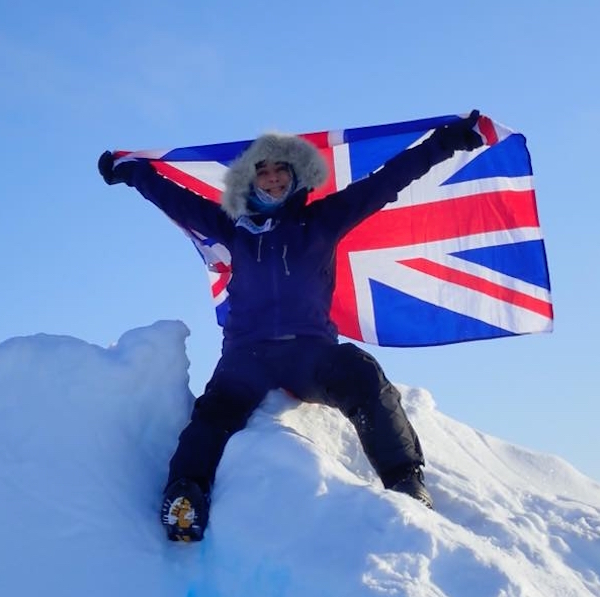
In 2017 I joined the first all-female expedition to the North Pole, a record-breaking achievement that had never even been on my radar just a few years prior. It seems almost inconceivable – no, almost irresponsible – to journey in such a short space of time from a simple walk following a group near Skipton to have my name on the Guinness World Records list for reaching the magnetic North Pole. But, like a long hill walk, it is made in single steps. I never missed an opportunity to go out with my walking group. I taught my family to expect nothing from me on Sunday – that was my time to go walking and I would be back later. They just had to do without me for a few hours. They learned to cope, and I expanded my abilities and my love for the outdoors. I gained confidence in navigation, slowly purchased my own equipment (giving my teenagers back their belongings) and showed myself that I could handle bigger challenges. Adventure came late in life for me, but I’ve grabbed it with both hands.
It was empowering to join that group of strong women on the North Pole expedition, and prove to the world – and ourselves – that women are tough and capable. In the months leading up to our departure, I trained and studied and filled all of my extra hours outside of work and rearing a family with preparing myself to join these women in one of the most hostile and unforgiving places on earth. At some point along this journey, the statement “you’ll get this out of your system” was mentioned to me. I felt confused. The truth is, this is now very much in my system. I returned home from our expedition with a hunger for more and the idea of my ancestral country loomed in my mind.
I’m heartbroken saying goodbye to my hosts in Hushe, promising that I’ll return as soon as I can – a promise I fully intend to keep. Through my ability to speak Urdu, a second language for the locals, I have been able to connect with so many people during my time in the village, and I leave with a list of phone numbers and Facebook profiles so that I can stay in touch when I return home. While the villagers had seen foreigners here before – so close to the infamous K2 – almost everyone I spoke to had never seen a foreign Muslim woman before, let alone a foreign trekker who could speak their language. I felt like I was building bridges between West and East. Through the common ground of a religion, I was able to connect on a meaningful level and share so much between two cultures. Maybe it’s not the strongest bridge to start building, maybe it’s just a small wooden bridge that only a single person can cross, but that’s where we start.
We climb out of the village, glittering white peaks flanking either side of us, rising perilously toward the clear blue sky. For nearly two weeks now, we have been on the awe-inspiring Baltoro Glacier. I can hardly grasp the scale of the form we are traversing and every day I pester the resident geologist in our group with new questions, trying to build my understanding. At night in our tents, the noise of the glacier is louder than ever, the constant cracking of ice coming from deep within sounds like the Earth itself is opening up. Adding to the noise, we even hear the incredible thunder of avalanches fall in the distance – which suddenly feels very close, lying on my mat with nothing but a sheet of nylon shielding me from the power of the mountains. The rumble and ultimate crash of the avalanches are so loud that it’s hard not to imagine they are bound to hit us, although they are actually on mountainsides across the chasm of the valley. I am inspired by the power of nature – inspired by how little I know and empowered by how much I am still able to learn. Two months ago, I had been scared to come on this trip, worried that I wouldn’t be able to keep up with the experienced group. Of course I can do this. Of course this is exactly where I’m meant to be.
I bond with our local guides and porters by speaking in Urdu, translating for the rest of the group what they tell me. While I’m eager to learn everything I can about their lives, the landscape here and life in Pakistan, they are equally eager to learn about my life back in the UK. We build more bridges between our two worlds, connecting us across the chasm. At first, they treated me like any other Westerner, but when I approached them to ask for a prayer mat (my luggage restrictions prevented me from bringing my own), they were astonished and delighted to be guiding a Muslim.
It seems hard to believe, at first, that no Muslim woman has trekked through this region, considering that Pakistan is an Islamic country. But the more I uncover about the country, the more I realize how much culture prevents women from exploring and adventuring outside of the bounds of their realm. Women have the hardest jobs in the world. Making and rearing a family is a never-ending task. It’s always demanding, there are no statutory holidays and we will always work overtime. We can easily lose our individual selves in this role. It sometimes seems impossible not to.
After 23 days – although I completely lose any grasp on the concept of time – I return to Islamabad and back to the house of my auntie, a PhD professor of geography at Islamabad University. I am stunned when, as I show her photos of my adventure and fill her in on all of the stories, she places her arms on my shoulders and sighs, “Wow, you’ve been to all of the wonderful places I’ve only ever heard of and never been.”
It’s as simple as uploading a few photos to Facebook and telling my friends and family about my trip, but a year later a few of them are planning their own trips around our ancestral country. A small bridge indeed, but it’s where we start.
Misba Khan is a British adventurer who was part of the 2018 all-female Euro-Arabian expedition team to reach the North Pole. An “ordinary mum” turned Rambler turned polar skier, Misba hopes to show people that those of all abilities and from all backgrounds can get involved in activities that may push themselves for their own self-development. For the past 15 years she has been working as part of the finance team at the North Manchester General Hospital. Aside from her professional role, she is also a trained chaplain,undertaking voluntary work with female patients in the mental health department. Although British born and bred she is of Pakistani origin. She sometimes finds that women in her community are reluctant to stretch their abilities and reach their full potential, and hopes that by sharing her achievements she can encourage others and break down barriers and stereotypes.
Find out more about Misba at: @MisbaNorthPole
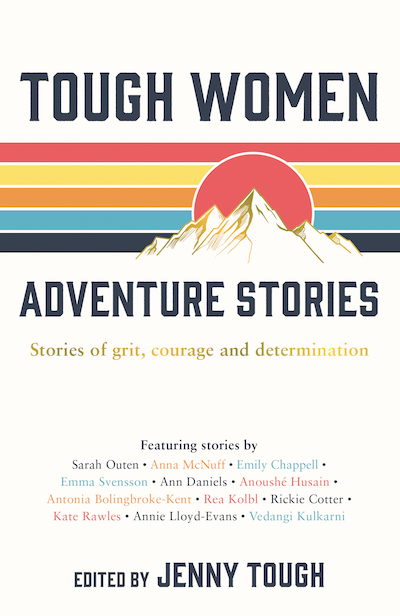
Tough Women Adventure Stories: Stories of Grit, Courage and Determination edited by Jenny Tough is available to buy for £9.99.