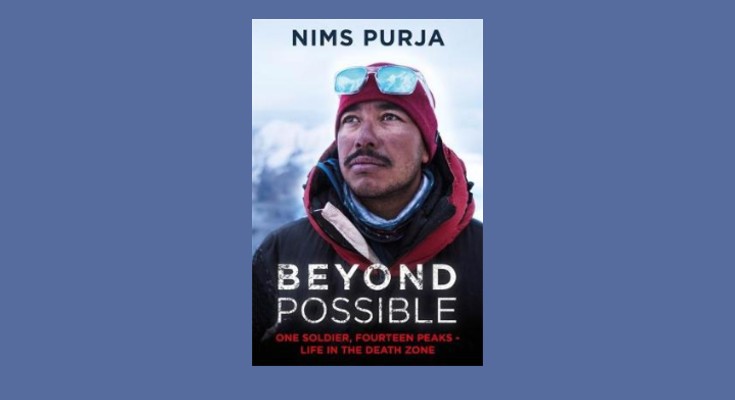
Nims Purja is a Nepalese mountaineer who has climbed all 14 of the world’s tallest mountains and recently made history by summiting K2 in winter.
We have signed copies of his book ‘Beyond Possible‘, here he shares some lessons he’s learned along the way:
Fourteen mountains on Earth tower over 8,000 metres above sea level, an altitude where the brain and body withers and dies. Until recently, the world record for climbing them all stood at nearly eight years.
So I announced I was summiting them in under seven months.
People laughed. They told me I was crazy, even though I’d sharpened my climbing skills on the brutal Himalayan peaks of Everest and Dhaulagiri. But I possessed more than enough belief, strength and resilience to nail the job, having taken down enemy gunmen and terrorist bomb makers while serving with the Gurkhas and the UK Special Forces.
Throughout 2019, I came alive in the death zone. Soon after, I was showing the world a new truth: that with bravery and enough heart and drive, the impossible was possible…
Here are some lessons learnt along the way:
1. Leadership isn’t always about what you want.
Having made it to Base Camp at Dhaulagiri during phase one of the mission, it was obvious that some of the lads in my team were struggling. Physically they were done; their morale was broken. Though I felt absolutely fine, having just climbed Annapurna and conducted a stressful search and rescue mission, I knew it wasn’t the smartest move to press on ahead regardless, pushing the others to their limits. Instead, I figured out what was best for the team. It’s easy to work to your own pace in a group setting, especially if you’re the fastest or strongest in the pack, but the people around you will soon lose faith. They’ll regard you as selfish and overly ambitious. The general consensus will be that you don’t care about anyone else and the efforts of the team will fade away. When you need your colleagues to step up again, they won’t bother. Rather than annoying everyone in that situation, put yourself in their shoes. Figure out how you can compromise: is it possible to work in a way that benefits everybody? In this case, I took the team for a little rest and recovery. Yeah, we had to work through some terrible conditions a few days later as a consequence, but that one action told the team that the mission wasn’t only about me. As a result, they broke their backs to work for the cause over the next six months.
2. Hope is God.
Brother, you’re not going to get to your dream by just fantasising about it. But if you make it your ultimate goal, or god, and give yourself to it entirely, there’s a good chance it might come your way. As a kid, I got so annoyed at being beaten by a runner from another school in the district champs that I started getting up in the middle of the night in secret training sessions. I took that same attitude into the Gurkhas. If we were required to run thirty kilometres in training, I’d tack another twenty kilometres on at the end to push myself even harder, because I knew I wanted to make it into the Special Forces. The job had become my church and I invested all my efforts into it. So rather than thinking, praying and waiting for your next project or challenge (and not doing it), commit to serious action instead.
3. A person’s true nature shows up in life-or-death situations.
A lot of soldiers talk the talk. On the base they act like big heroes, happy to gob-off about gunfights that they may, or may not, have been involved in. But the minute it kicks off for real, when bullets start flying and people are getting shot around them, they hide in the corner or panic. The same attitude can be found on the mountain. At Base Camp, when the weather is sunny and warm, climbers take selfies and mess around, talking about how they’re going to conquer the mountain. Once the bad weather whips in, and it becomes important to stay focused and super-disciplined, they freak out. Then their true personality emerges: they act selfishly, their work rate slacks off , and the safety of others is sometimes disregarded. It’s possible to learn a lot about someone when the chips are down.
4. Turn a nightmare situation into something positive.
During my first climbs of Everest, Lhotse and Makalu, my oxygen was stolen on the mountain. I’d asked for cylinders to be left at a number of camps, but as I arrived at each one, it became apparent that the lot of them had been swiped. At first I was furious, which was a very understandable reaction given the circumstances, but it was important to stay calm. Losing it would cause me to waste energy and maybe succumb to HACE in the process. As I explained in Lesson 2, the little things count most on the big mountains. A negative response, like a minor tantrum, would only cost me dearly later in the expedition. I calmed down and mentally turned the situation around. Rather than stewing in my own anger, I told myself that the air had gone to someone who needed it more than me. ‘Maybe someone had severe altitude sickness and needed my cylinders to save themselves,’ I told myself, knowing it probably wasn’t true. ‘In which case, fair enough.’ Yeah, this was a lie in some ways – however, it was a vital self-defence mechanism. If I’d sulked and moaned about the circumstances surrounding my missing air, I would have wasted vital energy, when I should have been concentrating on the mission ahead. Thinking positively is the only way to survive at 8,000 metres. Nobody cheats death by wallowing in self-pity.
5. Give 100 per cent to the now
. . . because it’s all you’ve got. There were moments on Selection when a programme of gruelling work was laid out ahead of me: weeks of drills, marches and exercises in unpleasant conditions, where I’d have to push myself to breaking point. It would have been easy to feel overwhelmed by the intimidating workload, or stressed that day one’s thirty-mile run might burn me out for an even longer run on day two. Instead I gave everything to the job in hand and dealt with tomorrow when tomorrow came around. It was the only way to handle an intimidating challenge.The same attitude applied to my mission to climb the fourteen Death Zone peaks. While working across a mountain, I tried my best not to think about the following expedition, because I knew I might not make it if I took my eye off the adversary ahead. To be focused on Broad Peak while scaling K2 would cause me to lose focus. And keeping energy in reserve was pointless. I had to give the day my all, because I knew the consequences if I didn’t.
Tomorrow might not happen.
Beyond Possible by Nimsdai Purja is available now (Hodder & Stoughton, Hardback)