Whilst travelling through northern India, Varanasi left me with the most vivid and exciting memories and also the most off-putting ones. The holiest city of India made the most impact on me but I am not sure I would like to go back there again.
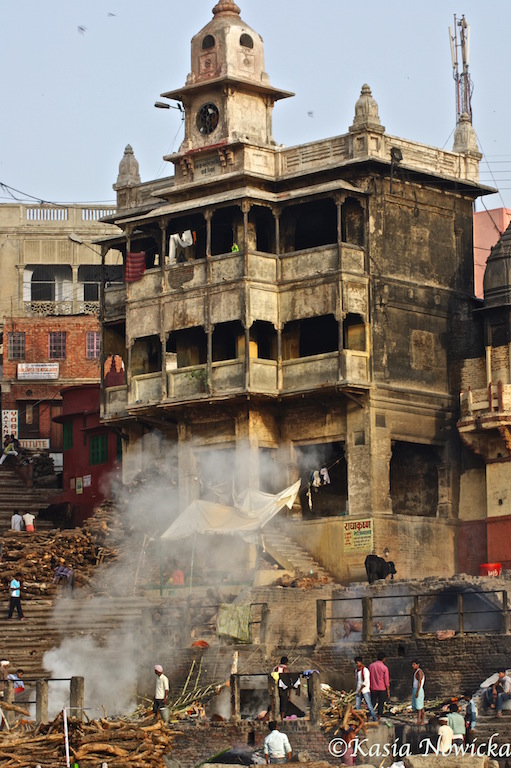
Off-putting are probably the usual: the dirt, the smell occasionally, the poverty. No matter how much you feel sorry for those people and no matter how much you would like to help, the ubiquity of it is just too much to stand unless you make yourself completely insensitive. But on top of that is the chase for money. Clearly everybody needs to make some money but the ruthlessness was a bit too much for me. If you are a western tourist everybody wants your money and they will not let go. Whether it’s the fruit seller who charged us probably 500% of the price, candle and trinket sellers at the bank of the river, little shops with cold drinks that almost always charged us more than the MRP (Maximum Retail Price), fake sadhus and agoras that want some baksheesh for being photographed, men grabbing your hand to give you an instant on-the-go massage, and so on and so forth. Even if you buy in regular shops you don’t know whether you are paying decent money for a silk scarf or they just rip you off with a stone face.
But Varanasi is wonderful! The colours, the commotion, the diversity are all attractive to visitors. Most of all though, it attracts Hindus who seek moksha – escape from reincarnation. Varanasi is the city of Shiva. Dying there, burnt and joined with the holy river Ganges guarantees you that you will never return to this earth in any form and be bound with God. Attracted by the novel approach to death, tourists arrive to Varanasi to see the burning ghats. My husband and I were no different. When we arrived at the city after sunset we embarked on the hunt for some food. Our hotel did not have a restaurant and we had to take to the streets to satisfy our hunger. Immediately after stepping out of the hotel, we were ensnared by a man who introduced himself as Babu. He must have easily sensed that we were completely new to the place and an easy target. With a lot of talking in pidgin English he managed to take us to the river. He wanted to show us the burning ghats. Hungry but at least equally excited by the whole ambience of the city we followed him.
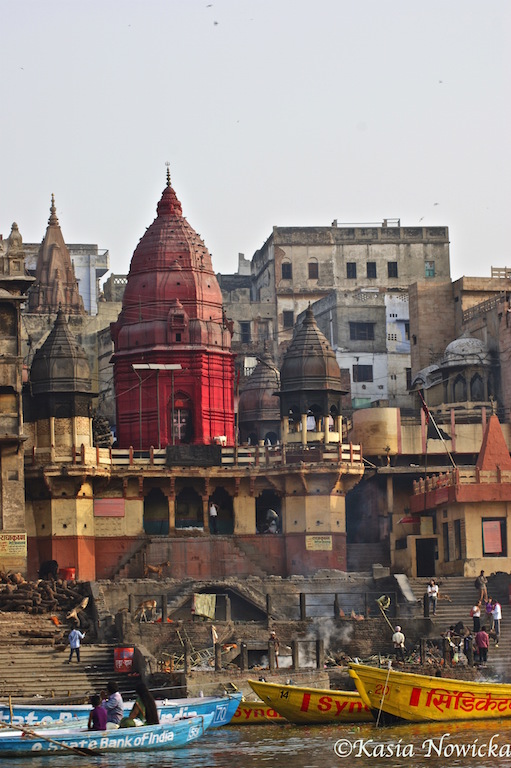
After meandering through narrow streets of the old town (Babu made sure we couldn’t easily find our way back) we emerged through a small gate that led us to the littered steps of one of the ghats. We slalomed among the sleeping goats and rushed after our guide. Babu was acting friendly and insisted that we should be not afraid. We were not but we suspected what was coming. Most of the ghats we saw were pretty well lit, except the one we just approached. It was glowing with fire and heat. Several people were rushing around helping with the fires, members of the families of the dead, and curious onlookers. Pitch dark and silent. Only crackling of the burning wood. We were taken over by another person who claimed to be a ghat worker, a brahmin. He spoke very quickly, as if from a script and he gazed away when my husband said he, via his grandfather, was a brahmin too. Our ‘brahmin’ guide wanted to take us through his introduction to the burial rituals and swiftly proceed to the next step – the alleged hospice.
According to our ‘guide’ people who have no families come here to die in the hospice – the three buildings that surrounded us. They looked burnt-out and completely abandoned. Our ‘brahmin guide’ gave us his phone to light up the path in front of us and asked us to follow him. Passing by some western onlookers, we heard “Do not give any money”. We were first taken to the holy fire that is said to have been burning there for 350 years without extinguishing and blessed with its ashes. Then our ‘guide’ took us to the rooftop of the middle ‘hospice’ building. Complete darkness, some people were sleeping on the concrete floors, some gathered between the flights of stairs, some looked out of the pillars. After reaching the top we were told about the lack of smell there. It was thanks to Shiva that the burning bodies didn’t smell (I read that it’s the oils of sandal wood and others that prevent the smell). We were also told that poor people could not afford wood for their funeral, therefore the ‘workers’ of the hospice, like our ‘guide’ collected donations for it. It takes three hours to burn a body and 300 kg of wood. One kilogram of wood costs 7000 rupees (just for comparison a bottle of coke costs 45 Rs). “How many kilograms would we like to sponsor?” we were asked.
Now an elderly lanky lady emerged from the darkness with two other men. They gathered around us. At that moment I thought to myself our trip was over and we would never be seen again. We were told to crouch to be given blessing by the lady. We abided. Now with vermilion on our foreheads we were asked again how many kilograms of wood we would like to sponsor. I did not enjoy the performance anymore, however my husband kept cool. He took out 500 Rs and firmly said: “What’s better – this or nothing for the show?”. Disappointed, they took the note and led us back down and through the convoluted paths lighting them up with their phones (honestly, I did not want to know what I was stepping on). Babu saw us off to the hotel and said he would see us next morning. I couldn’t wait.
I went to Varanasi 41 years ago – loved it. Nobody trying to get money from us although it was busy and a bit manic. On the ghats though there was a feeling of devoutness and spirituality. Heedless of pollution we dipped in the Ganges!