Our own Barbara Tognini visits Sarajevo – a city of beauty whose turbulent past is an ever-present shadow.
To people of my generation the name “Sarajevo” immediately gets associated with the Balkan war of the 1990s, and the terrible images of death and suffering we used to watch on the news. Regardless of knowing very well that the troubled history of this town goes well beyond the latest conflict, as Sarajevo played a major role in shaping the history and culture of the Balkan Peninsula, the image of the sieged town with its burden of religious and nationalistic tensions is the first one that comes to mind.
Still in the 1990s, the Irish band U2 and Luciano Pavarotti released the beautiful song “Miss Sarajevo” in the attempt of raising awareness of the conflict and to reach as many people as possible. For sure this commitment from such popular and independent voices played its part in turning the town into the symbol of the Balkan war.
In spite of all this, when I had the chance to visit Sarajevo in March 2014, just a few months away from the 100th anniversary of the start of WWI the core of my interest was spinning around the event which is regarded as the spark (or the pretext) that ignited the Great War, and which took place exactly in the centre of Sarajevo: the assassination of Austrian Archduke Franz Ferdinand and his wife Sophie by Gavrilo Princip.
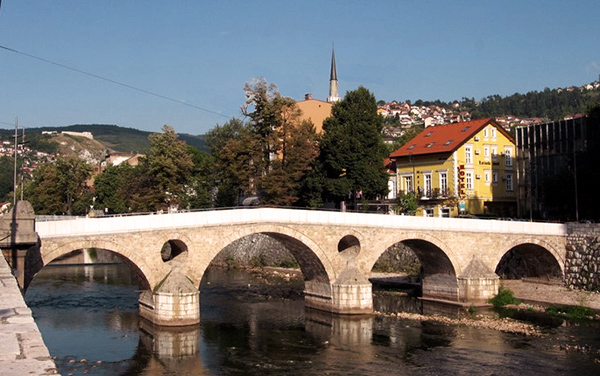
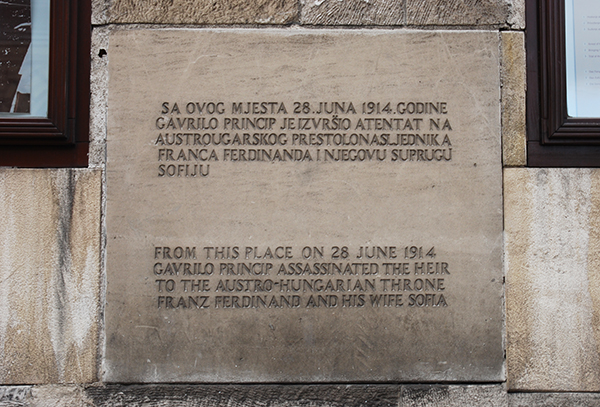
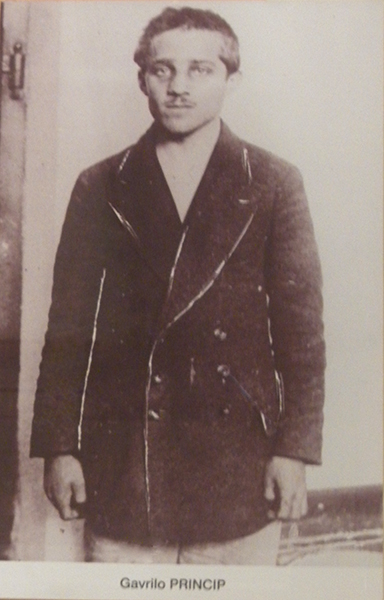
I couldn’t wait to see the spot of the assassination so, after dropping our bags at the hotel, we headed at once to the Latin Bridge, which was just around the corner from our hotel (a pure coincidence!). There was a group of people standing in front of the building opposite the bridge, taking pictures and looking at some photos shown in the windows. Getting closer, I noticed the plaque on the wall marking the place from which Gavrilo shot, and the picture of the young assassin.
I had already seen his picture in the past but staring at his face in this particular place, noticing his sad, nevertheless relaxed expression, was a poignant and haunting moment which raised a series of questions: who he was, why he decided to sacrifice his young life to the freedom of Bosnia, what happened to him after the shootings.
Another element in the life of Gavrilo Princip that intrigued me is the fact that he came from a tiny, remote mountain village in western Bosnia, and that he belonged to a poor peasant family. I got more and more fascinated with Princip’s personal history, wondering how a boy like him could have managed to organise the assassination and to start a process which ended up destroying the established world order, marking such a cornerstone in modern history.
 For some reason (and I know that it’s probably not appropriate) I couldn’t avoid to draw a parallel with a contemporary of Princip, the infamous Rasputin who, from a Siberian village in the middle of nowhere, reached power and succeeded in manipulating the Russian royal family.
Gavrilo was born in August 1894 in Obljaj, a little village not far from the Croatian border. His father was a postman and his mother a peasant: it seems that it was his mother who encouraged young Gavrilo to move to Sarajevo to continue his studies, given the excellent results that he had obtained at the local primary school. He moved to the Bosnian capital in 1907, where he proved to be a very good student, and where he familiarised with the revolutionary ideas of “Young Bosnia”, a movement particularly popular among students. The secret organisation included Bosnian Serbs, Muslims and Croatians, and the ultimate aim of their programme was to achieve a pan-South Slav unification of the Balkan nations into an independent Yugoslavian state.
In 1912, Gavrilo was expelled from school for taking part in a demonstration against the Austro-Hungarian annexation of Bosnia. He then moved to Belgrade where he continued his studies and got more and more involved in the resistance against the Austrian occupation, wishing to take active part in various terrorist groups.
When in March 1914 he read in the newspapers about the visit of Archduke Franz Ferdinand to Sarajevo, he decided that that was not the occasion to miss and mobilised to organise the assassination. With other six accomplices he went back to Sarajevo where they armed themselves with handguns and improvised grenades.
On the day of the official visit of the Archduke, the 28th June, as the cars of the Austrian delegation were driving along the river quay, the first assassination attempt missed its target: a grenade was thrown at the Archduke’s car but ended up exploding under the following car and injuring a few soldiers. However, on the way back from the Town Hall, the Archduke’s driver took a wrong turn (he hadn’t been informed about the change of route due to the assassination attempt) and stopped exactly next to the pavement where Princip was standing. Gavrilo fired twice, hitting the Archduke in the throat and, accidentally, his wife Sophie in the stomach.
He did not receive the death penalty because he was a minor at the time of the killings: under the Austro-Hungarian law the death penalty could not be applied to people younger than 20. He died in prison of tuberculosis in 1918.
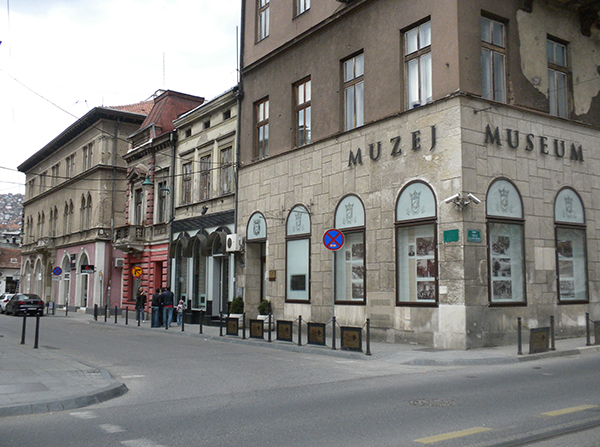
At the time of the shootings, the building in front of which Gavrilo waited for his victims was a café, the Moritz Schiller café, which was later converted into a museum, the Museum of Sarajevo 1878-1918.
We decided to leave the visit of the museum for the following day, and we went looking for Sarajevo’s brewery, because, after several hours driving up and down the Bosnian mountains, my partner Denis resolved that he needed a treat. The brewery is a short walk away from the centre, on the south side of the river Miljaca, so we set off in that direction crossing the Latin Bridge. The bridge is one of the most important town’s landmarks: it’s the oldest bridge, built by the Ottomans in the 16th century. It was renamed after Princip during the Yugoslavian era (“Principov Most”, Princip’s Bridge) and then renamed back to Latin Bridge after the break-up of Yugoslavia.
Yugoslavian authorities under Marshal Tito saw in Gavrilo Princip a hero of “Pan-Slavism”: he well fitted the political ideals of the communist regime because he was an atheist and an anarchist, who during his trial declared: “I am a Yugoslav nationalist and I believe in unification of all South Slavs in whatever form of state and that it be free of Austria”. In this way he became an important symbol of Yugoslav unity.
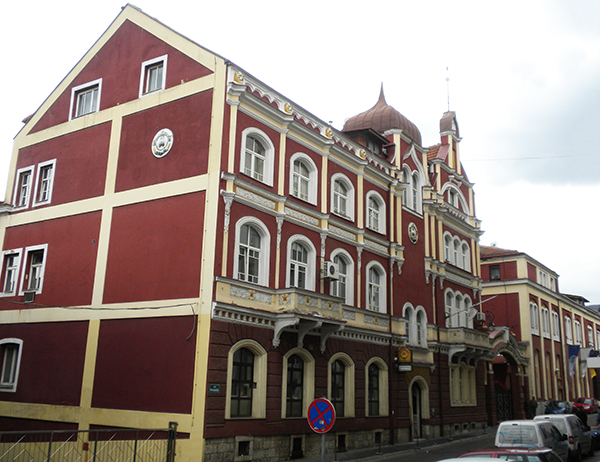
Once arrived at the brewery, I thought I could put aside the ghosts of WWI for a little bit and relax with a nice drink. But Sarajevo is not the place where one can avoid history, not even in a brewery. “Sarajevska Pivara” is located in a massive and beautiful red and cream building of the beginning of 19th century: its beer hall was probably furbished to recreate the atmosphere of Vienna’s elegant saloons at the turn of the century, and for sure it doesn’t fail to impress the newcomer. I like to think that during the years this hall must have been the place where Austrian, German and Yugoslav soldiers (probably even the UN Blue Helmets) gathered to have a pint. And just next to our table, an old image of Sarajevo was hanging from the wall: it was a rare picture of the monument to Franz Ferdinand and his wife that the Austrian authorities put by the Latin Bridge in 1917, to commemorate their murder. The monument was dismantled in 1918 when the Yugoslavian authorities took over.
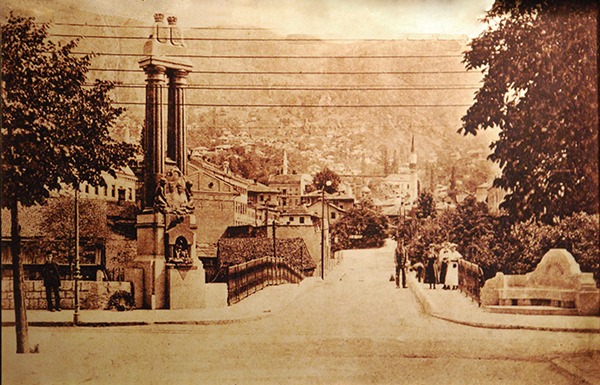
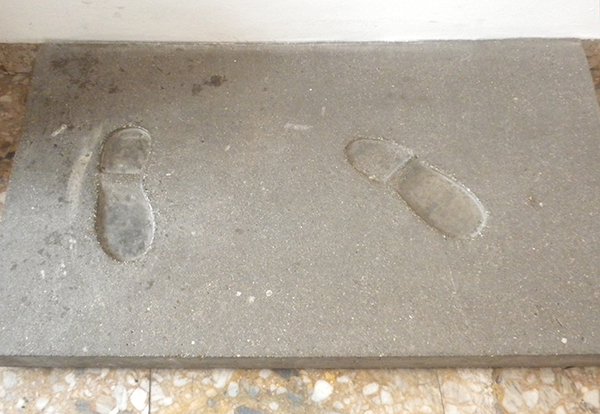
The following day we headed to the museum first thing in the morning: it’s very small, just a room, and presents the history of the Austrian-Hungarian rule from 1878 to the beginning of the Great War. 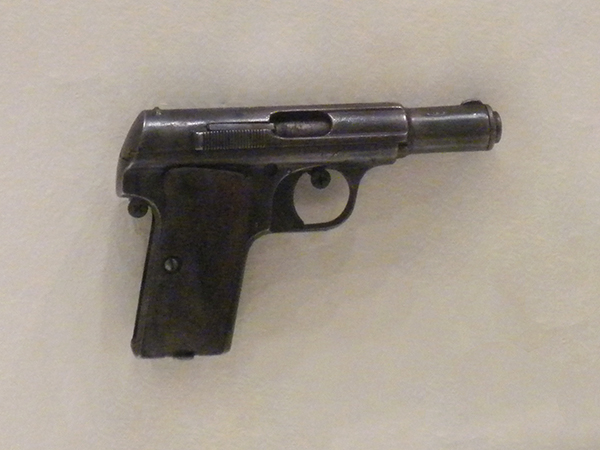 Obviously, a lot of attention is paid to Franz Ferdinand and his wife, with a video playing a fictionalised reconstruction of their assassination and a couple of mannequins wearing their clothes. A large window is dedicated to the assassins: their pictures, Gavrilo’s bag and trousers, and a couple of guns. The explanatory panel says that the larger one is the pistol used in the killing, but I’m not entirely sure that this is accurate, because from other sources I found out that the original gun should be in Vienna, at the Museum of Military History. And by the entrance, just next of the ticket office, there’s the famous cement cast with Gavrilo’s footprints; it used to be located on the pavement outside, marking the point from which Gavrilo fired, but it was removed after the break-up of Yugoslavia.
While visiting with little museum, I started reflecting on the fact that this young man’s name is not exactly very well known, and I don’t think it would sound a bell to everybody, despite the domino effect he provoked and that led to WWI. This is because the concatenation of events, which started with his pulling the trigger, has been so enormous that has almost wiped away the memory the individual that started it.
In addition to that, scholars’ interest has been focussed mostly on the reactions of Austria and the other Great Powers, on the reasons why they took this accident as the pretext to start a war, rather than considering the motivations of Gavrilo and the other Yugoslav nationalists.
From his trial deposition, it emerges that two are the main motives that inspired his actions: first of all, the will to remove an obstacle to the unification of the southern Slavs, and to avenge the oppression of the peasants carried out by the Austrian rule. To put it in Princip’s own words: “Still another principal motive was revenge for all torments which Austria imposed upon the people… They are completely impoverished; they are treated like cattle. I am the son of peasants and I know how it is in the villages. Therefore I wanted to take revenge, and I am not sorry.”
Nowadays in the countries of former Yugoslavia he is portrayed either as a Serbian terrorist or a hero, accordingly to political stances and ethnicity: mostly a villain for the Bosnian Muslims and Croats, and a hero for the Serbs. It’s interesting to notice that since the collapse of Yugoslavia, he stopped to be considered a fighter for Yugoslav unity (the definition that he gave of himself) and became simply a Serbian terrorist/hero.
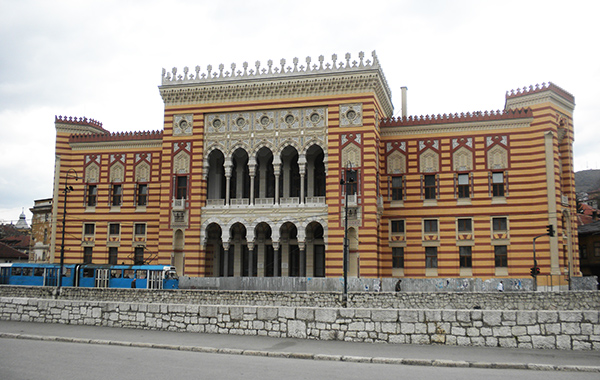
After the visit of the museum, we moved towards the former Town Hall (converted into the National Library of Bosnia and Herzegovina in 1949, which re-opened on the 9th May 2014 after years of restoration). This is a stunning Moorish building originally built in the 1890s, and almost completely destroyed during the latest conflict. It was restored thanks to EU funds, as we found out from a panel on its wall; I don’t think the money of EU taxpayers could have been spent in a better way!
From this building, on a nice summer day of 1914, Franz Ferdinand and Sophie set off on their last journey; a journey that was leading to the destruction not only of their lives and of their entire world, but also of the lives of other 18 million people.
Barbara Tognini
Discover guides to Sarajevo, Bosnia and Herzegovina
Great article I was in Sarajevo about 8 years ago and there was plenty of war damage then.I rode the train there from Zagreb. As I understand it the arch duke was shot with a browning revolver,but may be wrong, the gun in the picture is some kind of early semi automatic pistol probably 7.65mm/.32acp?so if he was shot with a revolver then this can’t be the gun!