By Caroline Sandes
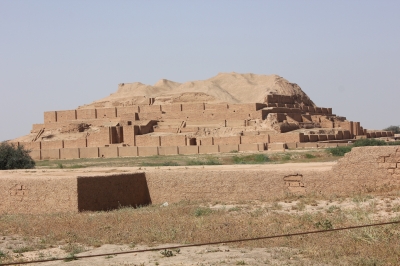
Chogha Zanbil is, according to the UNESCO World Heritage list, the largest and best preserved ziggurat in Mesopotamia. It now stands alone in the semi-desert landscape, its well-preserved red brick construction somewhat at odds with its wild surroundings. It was built around 1250 BC and was part of a flourishing temple complex with the town of Dur Untash until Ashurbanipal, who was also responsible for destroying Susa, sacked it in about 640 BC. It was only rediscovered in 1935.
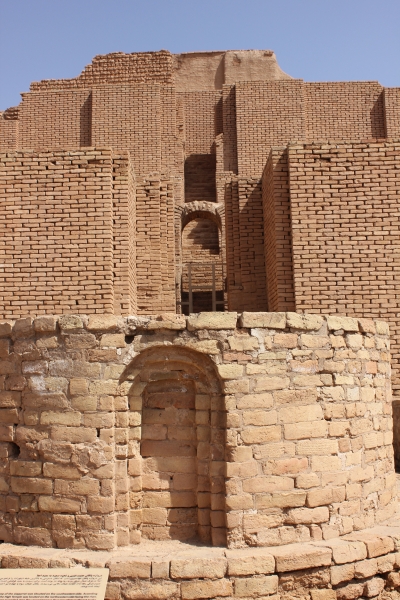
I’d had to hire a taxi for the day to take me from Shush, to Haft Tepe and to Chogha Zanbil, and then to deposit me in Shushtar. Both Haft Tepe and Chogha Zanbil are out in the countryside and not reachable otherwise. The ziggurat is impressive. You can’t go into it, or climb up it, which is just as well given its great age, but this is in keeping with its history as it was only ever accessible to the Elamite elite. It stands at about 25 metres high but originally would have been about 60 metres. The uppermost two sections including a temple have gone. If you look carefully, running around the temple at approximately eye level is an inscription in cuneiform. From the leaflet for the site, some has been translated and one section reads: “I Untash Napirisha with golden coloured bricks, silver coloured, [with brick colour of] green and black have built this temple and have gifted it to Napirisha and Inshushinak the gods of this sacred place”.
There are low ruins of various temples around the ziggurat, along with those of palace and housing complexes, though nothing as well-preserved as the ziggurat itself. Embedded in some baked clay near the base of the ziggurat is a child’s footprint; one of those curious archaeological survivors that, like a potter’s thumb-print on a piece of ancient pottery, seems incredibly personal and to collapse the hundreds, or in this case thousands, of years between then and now.
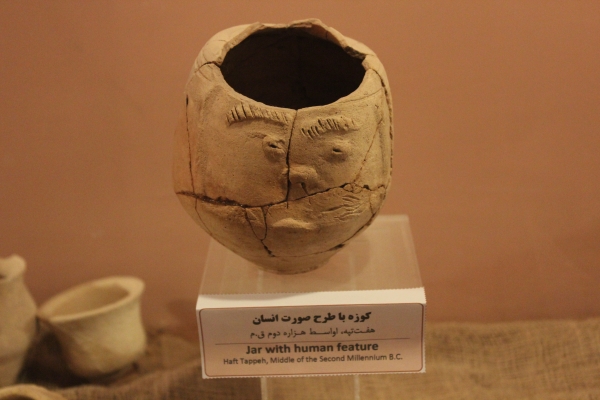
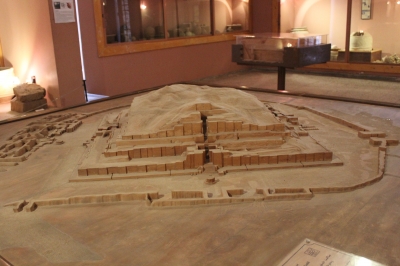
Before getting to Chogha Zanbil, I had stopped off at the site of Haft Tepe. Haft Tepe is an Elamite site and dates to around 1400 BC. It was the site of the ancient city of Kabnak and reputedly important during the reign of Tepti-Ahar. Now it is just a series of mounds, but beside the site is a small UNESCO-sponsored museum. It has finds from both sites, and a model of Chogha Zanbil which is worth seeing. As the Lonely Planet recommends, it is best to go to Haft Tepe first. getting to Chogha Zanbil, I had stopped off at the site of Haft Tepe.
Then it was onto Shushtar. Shushtar is a marginally larger town than Shush but the one hotel listed in my guide book was closed, leaving only one other option – a rather dodgy place in a building that looked only partly built. I climbed the cement stairs up to the first floor; it was clearly one of those places where young guys away from home working tend to stay. I hummed and hawed about whether I should stay there or not but taking comfort from the fact that it was listed in the Lonely Planet, I decided to risk it. It was only for one night and I really did want to spend some time in Shushtar. The young guy running the place looked somewhat surprised but took my money and showed me to a small, barely clean, room down a dark narrow corridor. It did at least have its own shower and loo.
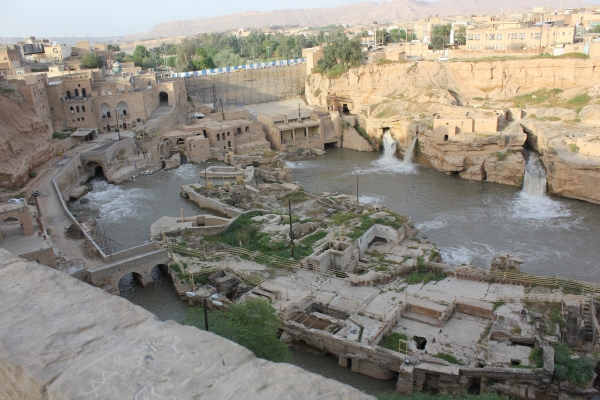
Shushtar is all about water and irrigation. The broad Karun River winds its way through the town, and Shustar is famous for an ancient water system that dates from at least the third century AD. It is probably based on a system developed during the fifth century BC. It is also a World Heritage Site and its man-made tunnels still send water cascading into a central reservoir, surrounded by sand coloured cliffs, along which the town has expanded. A school tour was there when I arrived – little girls running around in their hejabs and little boys behaving as little boys will. Some resident geese were honking with excitement at the prospect of bread, and all the time the roar of water charging out of the tunnels giving the place a rather contradictory sense of peace.
Prior to visiting the watermills, I’d gone in search of Mostofi House –a small museum supposedly with tourist information. It certainly had a small museum in the basement but in its courtyard it also had a restaurant. A waiter, realising I would not be able to understand the menu, kindly gave me a brief run down of what I could have: ‘kebab’, ‘local dish’ or ‘fish’. I opted for ‘local dish’ which turned out to be a delicious combination of lamb and plums with rice. I ate it sitting on a day bed in the shade in the courtyard, trying not to feel too scruffy as it was a rather smart place and I had been traipsing round dusty archaeological sites all morning.

From there I went to admire the sadly ruined but once impressive bridge cum weir, the Band-e or Pol-e Shandravan, meaning dam or bridge of Shandravan. It is also sometimes referred to as Band-e Kaiser or Caesar’s Dam. It was built in the third century AD by the Romans, though under orders from the ruling Sassinids. King Shapur I had succeeded in capturing Valarian, the only Roman emperor ever to become a prisoner of war, after the Battle of Edessa in 260 AD. Wars and floods, and possibly being blown up by the British, has taken its toll and it is now just a series of ruined arches stretching into the quiet waters of the river.
Shushtar also has, of course, a covered bazaar and in the evening I wandered round it, buying some oranges and some mixed nuts. It was busy with people shopping, and children darting about. There were mountains of carefully piled carrots (carrots are everywhere in Iran – you can even get carrot jam), lots of other fruit and vegetables, fish and, sitting on a tin plate outside a butcher’s, a recently decapitated goat’s head. I’m not vegetarian but it was one of the moments when I thought I should be. Outside along the street were more household goods, clothes and so forth. Goldfish seem to be popular as they were on sale everywhere; the poor unfortunates gaping out of their glass tanks and looking even more forlorn than usual. It was just as busy along the pavement as inside. As with Tehran, many women seemed to be pushing the limits on what constituted covering your hair, though I did pass a couple of women with Bedouin-type face coverings.
All in all it was a lively evening and I was keen to make the most of it. The following day I was returning to Tehran on the last Iranian part of my trip.
love your account of your trip to the archaeological sites of Iran. I’m going there in October and trying to propare for all the utterly amazing places I’ll see. Your photos took my breath away. Thank you