By Richard Slater, photographer and author of People in London: One Photographer. Five Years. The Life of a City.
You don’t have to go to India to see a Murugan Hindu kavadi ceremony.
As I discovered, all you have to do is hop on the Tube to Archway and go up the hill to the Murugan Hindu Temple in Highgate.
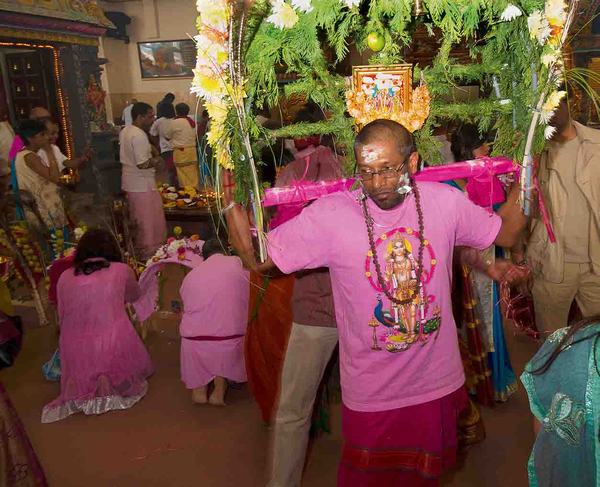
A kavadi is an object which consists of two semi-circular pieces of wood or metal attached to a cross structure which can be balanced on the shoulders of the devotee. It’s decorated with lots of flowers, foliage and peacock feathers – they’re the symbol of the Hindu God of War and Victory, Murugan – and can be very heavy indeed.
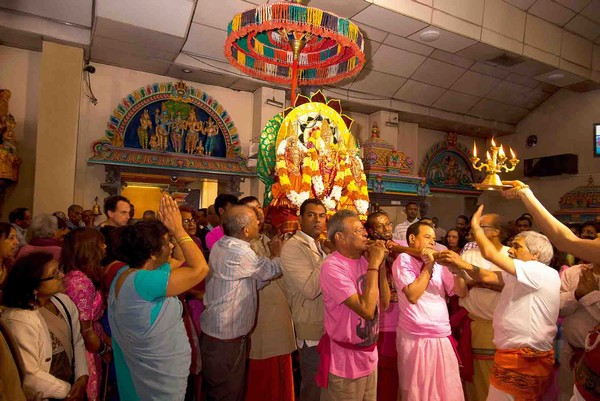
Devotees get ready for a kavadi ceremony by fasting – for 48 or 72 hours or more – and then, on the actual day of the ceremony, there are rituals, prayers and chants at the temple. All this puts them into a trance-like state. Then they hoist the kavadi onto their shoulders and circle round and round the temple until they’re close to collapsing. When I was at the Highgate Temple, some of them were not only staggering under the weight of the kavadi but shrieking and moaning as they went. All my senses were bombarded because there were cymbals and drums and of course a pervasive scent in the temple from all the candles everywhere. It was a very dramatic scene.
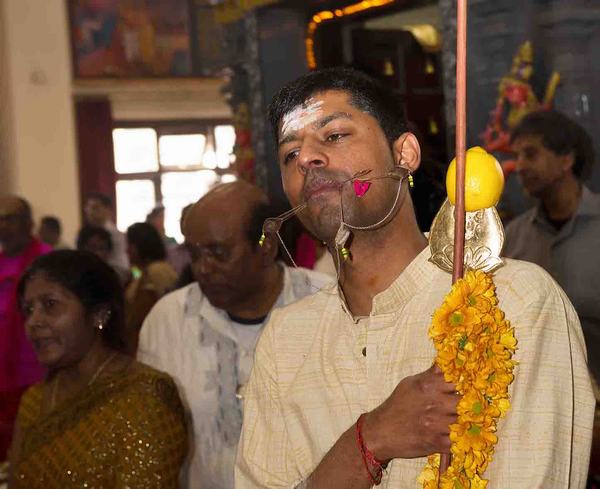
Some of the people carrying the kavadis had followed the tradition of piercing their cheeks, lips and tongues with fine gold skewers, which were drawn out at the end of the ceremony. I wouldn’t have believed this if I hadn’t seen it with my own eyes but, when they’re taken out, these skewers don’t produce any blood and don’t seem to cause any pain at all. This has never been scientifically explained.
What’s this ceremony all about? It stems from an ancient Hindu myth in which Lord Shiva gave an old man called Agastya the task of moving two hillocks from the holy mountain, Mount Kailas, in Tibet all the way to South India. You don’t need to be familiar with the geography of Tibet and India to know that this is a very long way.
So you can’t really blame Agastya for giving up after a short distance and delegating the job to one of his followers called Idumban. Idumban did very well. He’d got pretty close to his destination when he decided that he was entitled to a break. You can see his point. He put the hillocks down to have a rest.
It was when he decided to carry on that things started to go wrong. When he tried to pick the hillocks up again, he found that he just couldn’t lift them. He was trying to work out what to do next when a man happened to come by. He looked young and strong and so Idumban stopped him and asked him to help. But – to Idumban’s astonishment – instead of helping, the young man claimed that the hillocks belonged to him. I imagine that Idumban told him to get lost. But the young man wouldn’t back down and they got into a fight. Poor old Idumban was killed.
He hadn’t stood a chance, really, because the young man was Murugan in disguise. And it was Murugan, of course, who’d stopped Idumban from lifting the hillocks in the first place. What Murugan decided to do then, though, was to restore Idumban to life and tell him who he was.
It was Idumban’s next move which resulted in today’s kavadi ceremony that’s practised by certain Hindus, mainly in the Tamil areas of south of India but also in outposts where Indian immigrants are to be found. One of these is Mauritius, where many of the people that I saw that day in the Highgate Temple originated. Idumban asked Murugan to ensure that whoever carried a kavadi – a structure symbolising the two hillocks – on his shoulders to the temple would be blessed.