by Tim Cleary
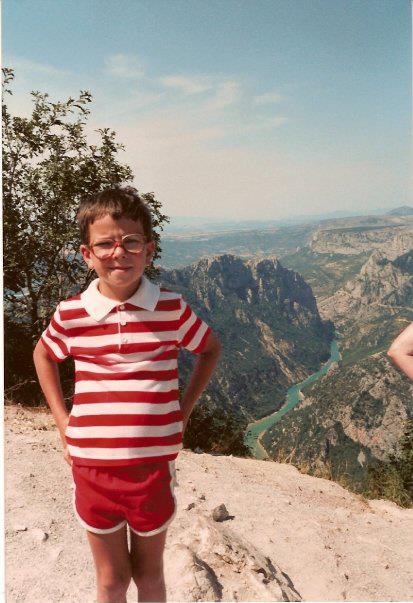 The late 80s were my formative years in terms of travel and holidays. In late July, six weeks of school holidays would begin and – like many other fortunate British families who had the opportunity to do such things – we would pack the boot of the car, load the roof rack and set out on a voyage of discovery to the Continent.
“Are we there yet?”
Although this was over 25 years ago, I remember quite distinctly what was involved with our annual camping holidays in France. First, there was an early-morning wake-up call for a quick breakfast and a drive to Dover for the ferry to Calais, where car sickness or the ferry’s swaying from side to side might result in said breakfast rising again to where it came from. My siblings and I would irk our parents by repeating the inevitable “Are we there yet?” at various points along the way, ad nauseum.
My father would then attempt to drive us as far as possible along the French autoroutes before tiredness got the better of him somewhere in central France. Here, we would pitch our tent for the night, usually on a municipal campsite, and hunt for the nearest Géant Casino supermarket restaurant for its cheap, Gallic equivalent of Little Chef fare. My favourite was steak haché – cooked rare – with frites, an assortment of vegetables to make it seem slightly more healthy than it actually was, and some sort of chocolate mousse for pudding. My parents would also have a glass or two of French red table wine.
Songs for the middle of the road
No road trip would be worth it if you didn’t have some tunes to keep the wheels turning. Thus began one of my enduring passions: music. During several hundred miles of travel through France, some time around 1988 or 1989, we would listen to French radio or the latest cassette albums purchased at home in England. The Gipsy Kings, Chris Rea (my favourite and most appropriate being On The Beach, the Travelling Wilburys supergroup, and the late-80s reincarnations of The Moody Blues (the Sur La Mer album in particular) and Fleetwood Mac became the soundtrack of these summer holidays. Middle-of-the-road music, in more ways than one. Occasionally, my more clued-up older teenage sister would get her way and my parents would reluctantly allow her to play albums by Morrissey, The Cure and other British alternative artists of the time. My tastes have changed, however, but my interest in music still remains. Whenever I travel now, I always try to use it as an opportunity to learn a bit more about the musical traditions around the world.
Out on the road, another, admittedly less rock ‘n’ roll, passion emerged. I would scour my parents’ road atlas and learn place names by heart, believing that a knowledge of these names would serve a useful purpose in years to come. Reims and Roye, Montluçon and Montélimar were etched onto my brain forever, as were the symbols used in the Michelin cartography, which would fire my imagination like no other stimulus for a 10-year-old boy. The long journey and this obsessive devotion to maps would be as important a part of the holiday as the beaches and swimming pools of the Côte d’Azur upon arrival. My passion for maps and place names did, eventually, serve a purpose when I started working for Stanfords as many an hour at work is now spent poring over these things.
Schoolboy French
I also have these family holidays abroad to thank for allowing me to develop my passion for languages. As the water would boil on the camping stove in preparation for morning coffee, my mother would send me out to buy croissants and baguettes from the local boulangerie. Armed with a handful of French francs and a few French phrases taught to me by my sister and parents, I would ask for “dix croissants et deux baguettes, s’il vous plaît”, say “merci” and bid “au revoir” to the kind baker who somehow managed to understand my attempts at his language. As a result of these beginnings, I would always be keen to learn at least a few words of the local languages of the places we were passing through. This has continued into my adult life, where my faltering attempts at Spanish, Hungarian, Arabic, Berber and Mauritian Creole have allowed me to get closer to the people and cultures of the countries I have visited. With French, I took this further and my first lessons – out in the field of the campsite – eventually helped me to delve deeper and learn this language more thoroughly than any of the others.
While in the south of France, we would camp, five to tent, on sites close to the sea. I remember sleeping under the shelter of sweet-smelling pine trees, swimming in warm swimming pools in the morning and visiting local beaches in the afternoon. My parents would sometimes take us to local tourist sites like the Verdon Gorges and Monte Carlo, and visit caves to stock up on local wines to take home with us to England. I would stock up in French chocolate-filled biscuits and local sweets that we couldn’t find in England. These were holidays that my parents could never have even dreamed of when they were growing up in the 1950s and 60s in South Wales and County Durham. The Gower Peninsula or Whitley Bay – exotic in their own right – were, for them, what Fréjus and St Tropez would become for me and my siblings. Times change, as do the ideals and the practicalities of a family holiday, but many of these early experiences form the basis of what a young child takes with them into adult life.