by Barbara Tognini
After spending a few days in Bosnia and Montenegro, it was time to go back to Serbia, this time to visit those parts of the country which are a bit off the beaten track.
We set off from Mojkovac in Montenegro early in the morning and after driving for about three hours along the Serbian border with Kosovo, we left the main road to climb up a mountain to Studenica.
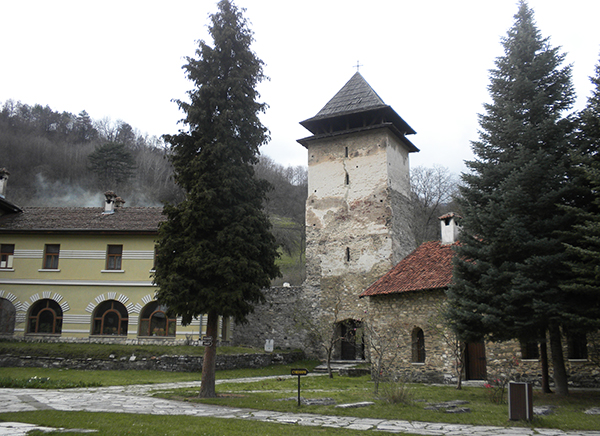
Studenica is the country’s oldest and holiest monastery, and it is still in use, with a small group of monks living within its walls.
The monastery was founded in the 12th century and consists of three churches and other two building enclosed by a defensive wall and a tower.
You notice straight away from the lawn around it that this place is special: the monks take good care of it, everything is clean and tidy, not a leaf of grass out of place. The setting is picturesque, on top of a mountain surrounded by other taller and forested mountains.
 The Church of the Virgin Mary is the largest and presents some beautiful frescos from the beginning of the 13th century. Unfortunately, the frescos have been damaged by the chisels of the 19th century restorations: they laid a new layer of plaster on top of the old masterpieces, so the interior of the church appears covered in large white scratches.
After lighting candles and spending some time in the peaceful atmosphere of the monastery, we hit the road again towards Arandjelovac, which is a three hour drive away.
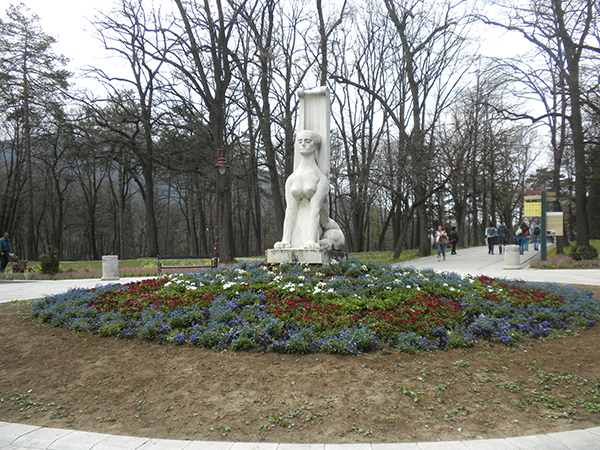
Arandjelovac (which literally means “the city of the Archangel”) is one of the most important Serbian spa towns: it’s a small, quiet and very pretty place to visit. It was developed into a resort by Prince Milos Obrenovic, who discovered the thermal springs by chance, when he visited the area for a celebration of St. Michael the Archangel. He bought the land and laid the foundation of the spa, which opened in 1836. It was named Bukovicka Banja and soon became a fashionable healing and wellness centre like the more famous spas in Western Europe, with thermal water of about 25 degrees Celsius. It is encircled by a beautiful park, which is also an open-air exhibition centre for contemporary sculpture collections, made of the white marble from the nearby mountain Vencac.
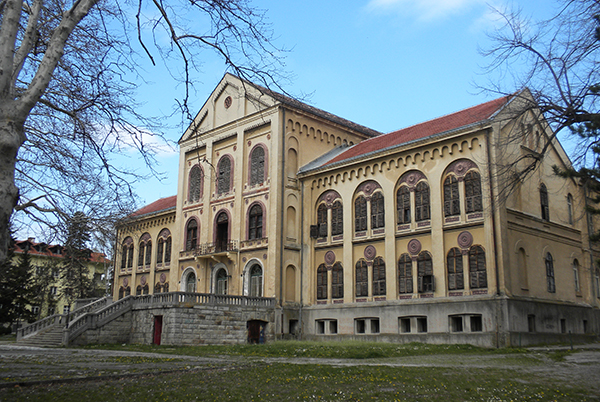 The spa is still in use today but exclusively as a rehabilitation clinic so we stayed at Hotel Izvor, a large and modern hotel facing the park with a modern spa. It’s a luxurious five star hotel but good value as half board and spa are included in the price of a standard room. On the other side of the park, there’s another large hotel, probably the equivalent of Izvor in the 19th century: it’s “Staro Zdanje” (old building) and it is Arandjelovac’s most famous building, almost the symbol of the town.
Built in Romantic style, it was supposed to be the residence of Prince Milos, but since he died before the palace was finished, it was converted into a hotel. During the following years, it played an important part in launching Arandjelovac as a holiday and spa resort, attracting the Serbian elites.
It was looted during WWII and then abandoned. Nowadays, an informative panel in front of the building in Bukovicka Banja park tells the visitor that the hotel was restored in 1969 and it’s now the “heart of the city’s cultural life”… well, it’s not: it’s actually derelict (the panel must have been very old!). Given the importance and the part that this hotel seems to have played in the history of the town, it is very surprising (and depressing) to find it in such a state of abandonment.
 The park, which is lovingly look after and surrounded by elegant buildings, definitely gives the town a classy touch and differentiates it from other provincial small towns.
About 15 km south-east of Arandjelovac, is the small town of Topola. In spite of its size, this town has played a very important part in the history of Serbia, marking one of the defining moments for the country’s national identity: from here one of the greatest national heroes, Djordje Petrovic or “Karadjordje”, led the First Serbian Uprising against the Turks.
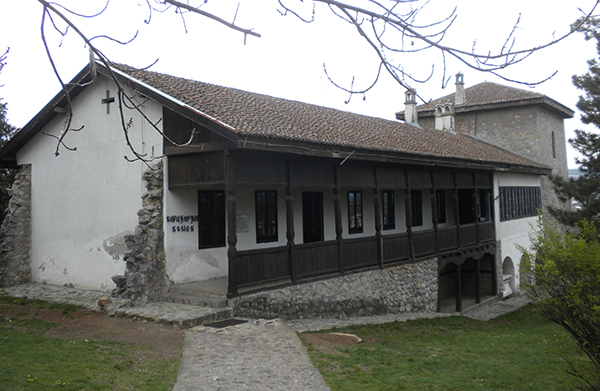
His fortified house in Topola has been converted into a museum and it’s surrounded by a beautiful park also containing a monument to the hero and an old church constructed at the time of the insurrection.
The museum exhibits the life of Karadjordje and the events of the Uprising, denouncing the brutal and oppressing policies of the Ottoman Empire and celebrating the bravery of the Serbian rebels.
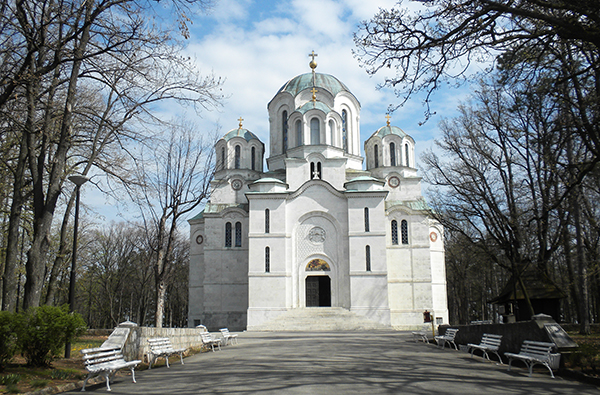
The person in charge of the museum gave us a good tour and then recommended to visit the Karadjordjevic dynasty mausoleum. This is a large church on top a forested hill, and it’s probably one of the most famous monuments in Serbia.
 It was built in 1911 and the exterior is covered in white marble, while the interiors are decorated with beautiful mosaics. Above the entrance there’s a mosaic representing St. George and the dragon, and the saint has the face of Karadjordje. The crypt, containing the tombs of the Karadjordjevic family, is remarkable, because of its atmosphere and the exquisite golden mosaics.
After the visit of Topola, we went back to Arandjelovac to make the most of our last day in Serbia: we bought some local products, like honey and Medovaca, a honey flavoured liquor.
At the end of my trip my impressions of the country and its people were all very positive; everywhere you go you are met with genuine friendliness, which is perhaps unexpected since the country has only recently started to recover from yet another period of troubles – another one of so many that the Balkans have gone through the centuries.
Browse our Serbia Maps and Guides>