 by Barbara Tognini
I’ve always found the Balkans and the history of the region extremely fascinating: it was particularly interesting to me how a region geographically situated in the centre of Europe, managed to become isolated – politically and culturally – for centuries, up to the point to be considered almost not completely European, and for sure remote and exotic. Even Prime Minister Tony Blair, talking about Kosovo, described it as “on the doorstep of Europe”!
As soon as we arrived at Belgrade Airport we headed to Smederevo, a small town along the Danube famous for its medieval fortress. My travel guides (Lonely Planet Western Balkans and Bradt Serbia) presented a captivating description of the town and its fortress; it seemed a place not to miss since it’s not too far from Belgrade (about 70km).
We decided to take country roads rather than the motorway to enjoy the landscape which I’m not sure was a wise decision, because apart from many blossoming cherry groves, the countryside wasn’t particularly attractive and the road was all bumps!
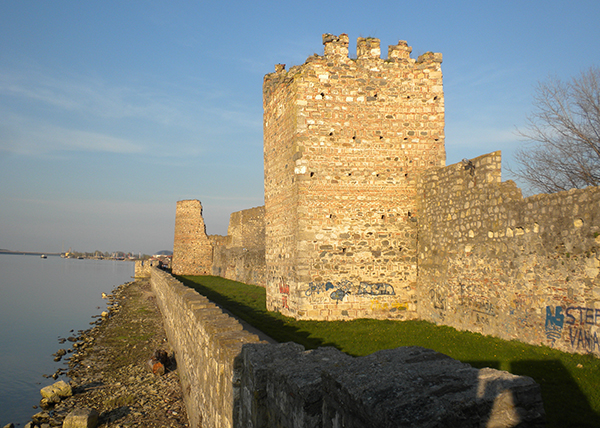
 As soon as we reached the town we headed to the fortress. It is indeed very large (it’s the largest inSerbia) and very photogenic; its construction was completed in 1430 and resisted the Turks’ siege for 20 years. From an informative panel attached to the wall at the entrance of the fortress, one learns that it was heavily damaged in 1941, when a German train loaded with ammunition exploded killing about 2,000 people.
Unfortunately, it’s poorly maintained and would need some serious restoration: there are graffiti everywhere and some parts are used as open-air public toilets. My guess (or rather my hope) is that they clean it before summer…
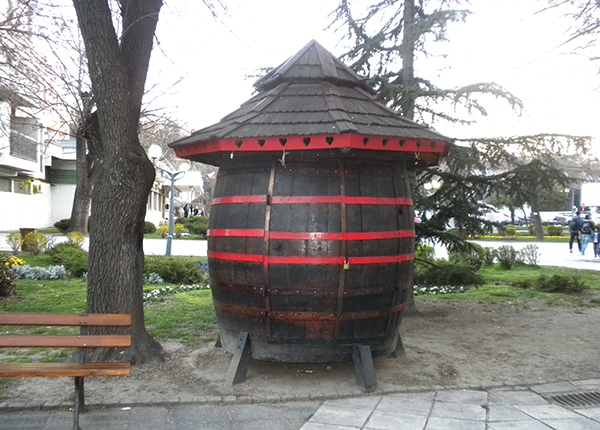
We continued the visit of Smederevo with a walk through the centre, where we came across a little square containing a circle of “stalls” made of huge wine barrels: most of them had local products like jams and honey for sale; it was definitely an unusual sight and such a brilliant idea!
After a snack in a bakery, we set off towards Belgrade, this time taking the motorway.
Our hotel was very central and it took us ages to find a parking place, since the centre is divided in zones which are strictly regulated. Fortunately, the receptionist told us of a suitable place near the zoo where we left the car for two days.
Once the parking was sorted, we went for a walk along “Knez Mihailova”, the main pedestrian street and the vibrant heart of the city, always busy with people of all ages and street artists. In one the narrow streets parallel to Knez Mihailova we came across a nice and cosy restaurant, Mikan Inn, so we decided to stop for dinner. The service was efficient and friendly, the food was very good and the portions so large that we were already stuffed half-way through the starters. The final bill was very cheap compared to London standards (about £35.00 for two with one litre of house wine and some liquor).
 At this point I have to spare a few words about the great food of this country: it is really fresh and genuine, always cooked with great expertise and so tasty! Since the Serbian cuisine (and the Balkan cuisine in general) is not well known, I didn’t know what to expect, so I was pleasantly surprised at the quality and the variety that it offers, even for vegetarians! The only problem is that the portions are too big and because it’s so good it’s a shame not finish it, so I stuffed myself as much as I could!
However, it has to be noted that smoking is still allowed inside (almost everywhere) in Serbia, and sometimes it got quite annoying, especially when someone was smoking next to our table.
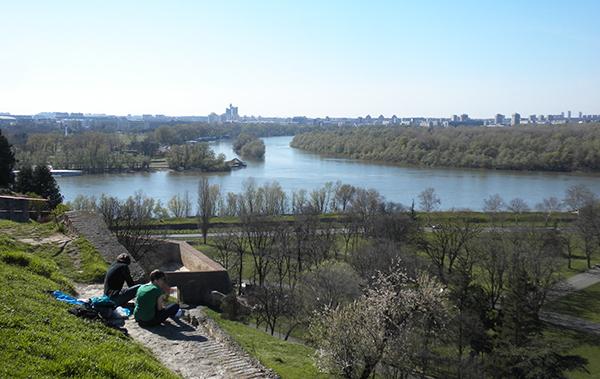
The day after we set off to visit the Fortress and its Military Museum: it’s Belgrade main sight and its location is superb, overlooking the confluence of the rivers Danube and Sava. There have always been fortifications on this location since Roman times, but the current appearance is due to 18th century alterations by the Turks and then the Austro-Hungarians. The fortress is surrounded by a large and pleasant park, and also the inner part of the citadel was turned into a park which offers a great view on the rivers.
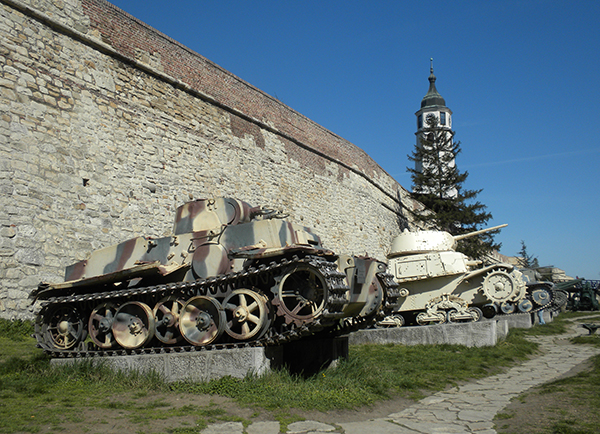 After the first fortified wall and just before the entrance of the citadel, in what used to be a moat, there’s now an exhibition of tanks and cannons from WWI and WWII belonging to the German, Allied and Red Armies. The exhibition belongs to the excellent Military Museum, which presents a military history of the Yugoslav peoples from the Middle Age up to the 1999 Nato bombings. A lot of room is given to the 1941 Uprising, the partisan resistance during WWII and Tito’s army.
On our way back to the pedestrian area, I noticed a few older women sitting on a side of the street busy lacing beautiful cloths; they had lined their works on the ground in the hope of attracting tourists. That worked perfectly on me, who I couldn’t possibly ignore them and I ended up haggling the price of a couple of tablecloths. Needless to say that it was a bargain, and I also had the certainty that the products are handmade; plus the lady was so happy she gave me another small cloth for free!
We continued our visit of the city centre with a stroll along Knez Mihailova street, where I noticed lots of small independent bookshops; sometimes they’re even one next to the other, or separated by a small café or a boutique. Considering that nowadays independent bookshops are disappearing from the centres of European capitals, it was such a nice surprise to find so many of them in Belgrade!
Keep walking along Knez Mihailova (from the fortress towards St Sava Church) we reached Belgrade’s main square, Republic Square, where the National Museum and the National Theatre are located. The façade of the museum has been covered by scaffoldings for a few years and unfortunately we didn’t have the chance to visit it. We only took a good look at the monument in front of it, representing Prince Mihailo Obrenovic, son of Prince Milos, leader of the Second Serbian Uprising and first ruler of the independent Serbia. In 1867, Prince Mihailo managed to remove the Turks from the last six fortresses they occupied and started an enlighten rule of the country, laying the basis for the development of modern Serbia.
 After a walk along the busy streets of the centre, we made it to St Sava Church: this is the largest church in Serbia and shaped on the model of St Sophia in Istanbul. The church is located on the site that saw the burning of St Sava relics (Serbia’s most important saint) at the hands of the Turks in the 16th century, in an attempt of humiliating the Christian Serbs. The exterior of the church was finished in 1989 and it’s covered in white marble, which delivers a magnificent effect. The interior still looks like a building site and it will probably take a long time before the church is completed.
On our way back to the confluence of the rivers Sava and Danube – where we had dinner in one the pretty restaurants along the river banks, we were hoping to stop for a drink at the famous “?” café. It may look bizarre but a question mark is the name of the place, no jokes! It was built at beginning of the 19th century and the owner named it “At the cathedral” because it’s just opposite the Orthodox Cathedral. However, the church authorities got offended and insisted for the name to be changed. Since they couldn’t find any other good names, they called it “?”! Its exterior is really sweet and the interior is cosy, but unfortunately we could stop for a drink as planed, because as we entered we met a thick cloud of cigarettes’ smoke…
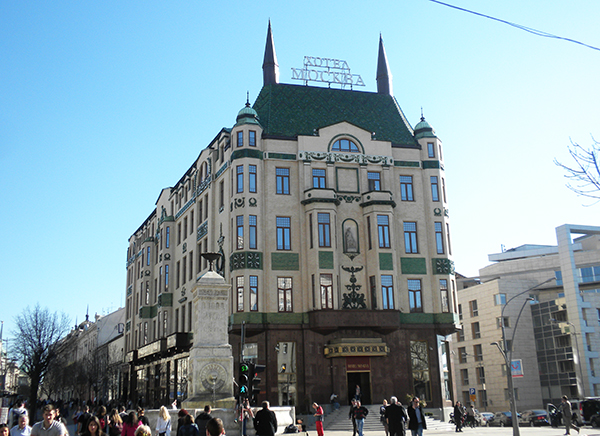
I would say that the rest of the Belgrade’s centre is characterised by neoclassic and art nouveaux buildings, of which the most famous is Hotel Moscow, build in 1906. The city has definitely its charm, but overall I wouldn’t describe it as beautiful, because the great part of its old monuments has been destroyed during his turbulent past. Recently it has gained some reputation as a nightlife hub, but I think that this little capital is vibrant and full of good looking people at any time of the day.
After a few days in Belgrade, it was time to move to our next destination,Sarajevo. But this was not a goodbye to Serbia: actually, the most interesting part was still to come!