by Charles Davis
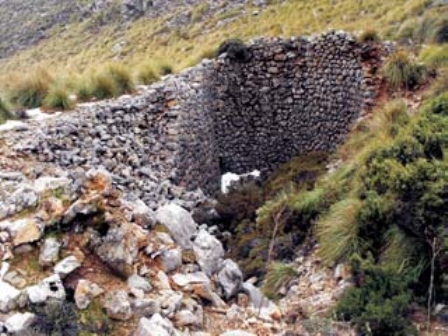 In a previous blog, I spoke about the charcoal-burning and lime-firing that furnished many of the paths still in use in Mallorca, but these cottage industries were far from being the only activities opening up what has since become the leisure walking landscape in Spain.
Snow gathering for the purposes of preparing medicines and for refrigeration was still in operation as late as the 1920s. Trampled into ice and packed between protective layers of diss grass or straw, the snow was stored in deep pits variously known as casas or pozos de nieve in Spanish and casa neu in Catalan (literally snow ‘houses’ or ‘wells’), then transported down to the lowlands piecemeal on mules during the summer nights. Like the activities of charcoal-burning and lime-firing, the trails left by snow gatherers provide some great walking experiences, and some of the surrounding cabins are still used for shelter. The trade in ice was so definitive of the mountain environment that the culminating point of the Axarquia, which was originally called Tejeda because of the surrounding forests of yew (tejos), is now uniformly known as ‘La Maroma’ after the thick rope used to access the ice pits on the summit.
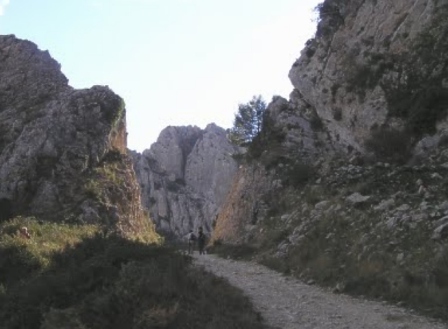 Grazing livestock is another classic example of economic activity that has left traces now exploited by walkers. This is not always an unmitigated blessing as large flocks of sheep and goats seeking scant forage can beat out a puzzling selection of paths, semi-paths, and thoroughly wayward ways, either running parallel to one another or branching off in bewilderingly contrary directions. By contrast, the great drove trails employed during the traditional transhumance are too often reduced nowadays to rather dull dirt tracks if not asphalted lanes. However, there is one curiosity that is worth noting and that is the incidence of comptadors or contaderos, counting gates, often making use of strikingly spectacular defiles and breaches in the rock, where shepherds counted their flocks down from the high pasture. Some of these provide the only access to crests and ridges, while others function as passes between villages on opposing flanks of a mountain range.
Cobbled mule trails are another source of walks, notably in Mallorca and the Alpujarras, but the defining paths in the Alpujarras have to be those following the acequias. Who first developed these irrigation channels tapping the aquifers of the high mountain is disputed, some crediting the Moors, others the Romans. Either way, it had become a Moorish ‘art’ by the time Felipe II expelled the remaining Moslems after the rebellion of 1568, as he made one family in each village stay behind to show the Christian settlers how the system worked, a situation sufficiently fraught with potential as to inspire my first novel, Walk On, Bright Boy. Some acequias were hacked into cliff faces by masons suspended over vertiginous drops, but most follow gentler slopes and are more like ditches dug into the hillside, providing perfect pathways to pleasure for leisure walkers.
For the most part, the people who engaged in all this chopping and trimming and burning and slaking and freezing and herding and siphoning remain anonymous. In the final blog in this mini-series, I shall tell the remarkable story of a man who was engaged in a more elevated activity, a man who not only made a mark on the mountains, but on history, too.
For examples of manmade snowpits see Walk! Mallorca, and Walk! The Costa Blanca Mountains. Counting gates can also be in Walk! The Costa Blanca Mountains, and on Walk! La Gomera.Acequias are a major feature in Walk! The Alpujarras. They can also be found in Walk! The Axarquia, and Walk! La Palma (where they are called ‘galerias’ or ‘canals’).
Read some previous posts by Charles Davis:
To The Ends Of The Earth – Brittany