 by Steve Davey
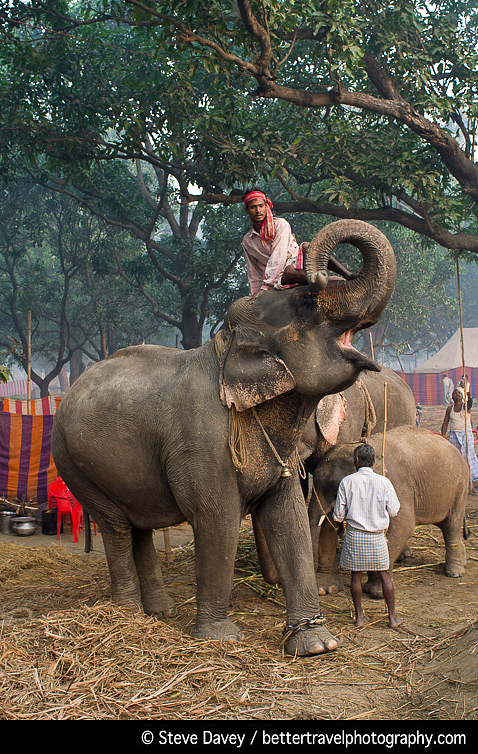
Many people are familiar with the Pushkar Mela: the so-called Pushkar Camel Fair where camels are traded in the Rajasthan desert, but the same Kartik Poornima full moon in November sees a less well known but much larger festival that attracts hundreds of thousands of pilgrims. The Sonepur Mela happens just outside of the town of Patna in Bihar at the village of Sonepur and is billed as being the largest livestock market in Asia. It is most famous for the Haathi Bazaar, where dozens of elephants are traded in a sprawling encampment under an shady canopy of ancient trees.
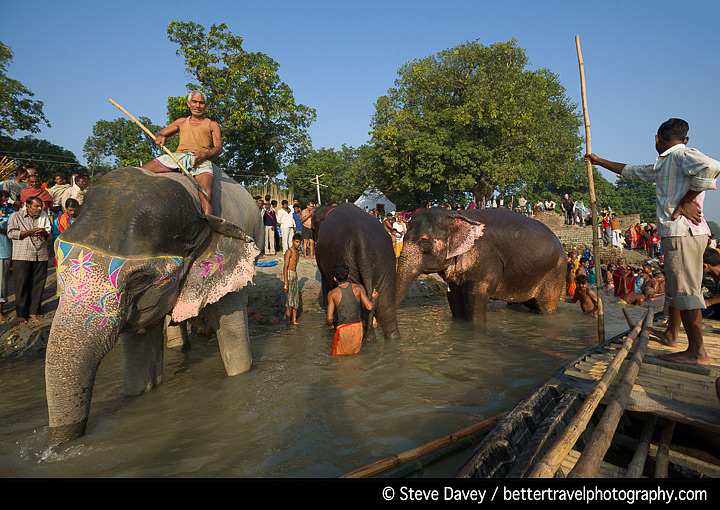
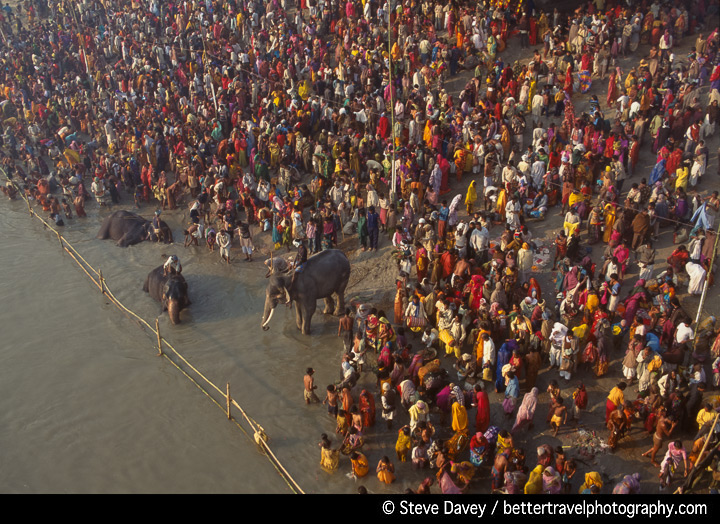 Every morning and afternoon, these great beasts are taken down to the river to be bathed, and then they have decorations applied to their skin with paint. This shows them off to their best advantage and helps the owner to command a higher price. Technically it is illegal to sell elephants in India and so the whole process is shrouded in mystery, and people work out an elaborate series of leases for the animals to circumvent the law.
Other animals are traded at the fair, including cattle, buffalo and horses. The buffalo market seems to be the most animated. Sellers argue loudly with the owners. Deals seem to be concluded by a group of buyers physically taking the buffalo. This is in complete contrast to the haathi bazaar where trading seems to progress at a slow pace, and then be concluded by touch with hands under a cloth, so that no one outside of the deal knows the agreement.
 The horse bazaar is chaotic, as riders run their horses up and down a dusty clearing, amidst crowds of onlookers and potential buyers. People seem to be riding horses that are too small for them, and favour a stiff legged trot, where the rider leans backwards, face frozen into a look of controlled seriousness. As they run up and down onlookers often come dangerous close to being knocked flying amidst shouts and recriminations.
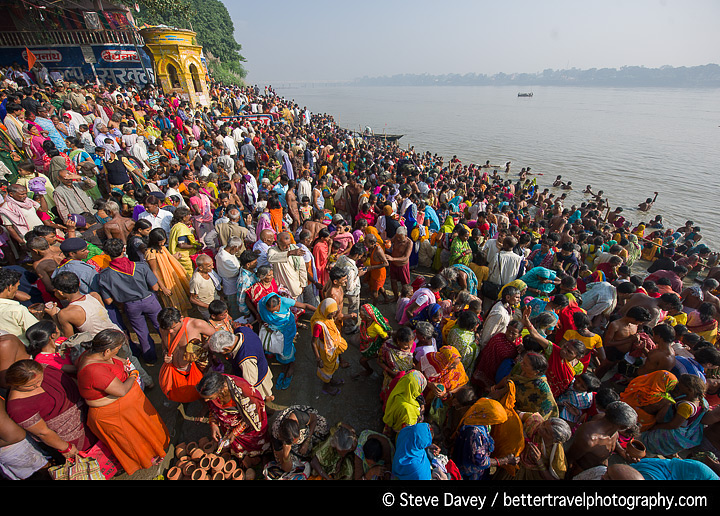
As well as being a livestock market, Sonepur is situated at the confluence of the holy rivers Ganga (Ganges) and Gandak and is considered holy by Hindus, who believe that bathing here at the Kartik Poornima full moon is auspicious and can help to wash away their mortal sins.
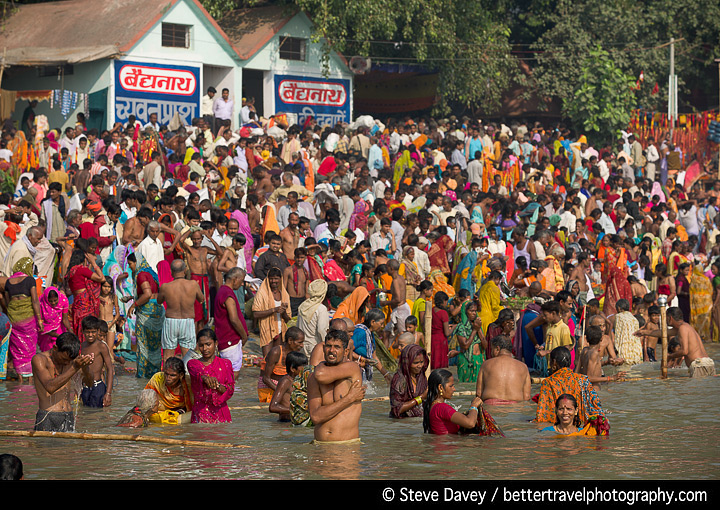 The ghats are completely lined with a mass of people: undressing, bathing, drying, dressing then moving off to try to force their way into the Hari Nath Mandir temple. The temple looks quite small and undistinguished, and it is rammed. Outside is an elongated and rather disproportional black elephant statue surrounded by offerings of flowers.
The origins of the festival lie in the mythical struggle between King Indrayamuna and the Gandharva chief Huhu, who were turned into a elephant and a crocodile after being cursed. Huhu the crocodile lay in wait for the elephant at Sonepur and when he came to drink bit his leg and attempted to drag him into the river. The two animals fought for years until the weakening elephant called upon Lord Vishnu for help. Vishnu intervened and cancelled the curses on the two. This means that it is an auspicious place to sell elephants and to bathe. More luckily, it also means that there are no crocodiles.
 In the mela ground there are a mass of stalls, and all sort of things being traded, from agricultural products through to cheap plastic goods. There are fairground attractions and even a saucy dance show. India is always a mix of the sacred and the profane.
Steve Davey is a writer and photographer who travels compulsively to festivals all over the world. He is the author of a major new book on festivals: Around the World in 500 Festivals (Kuperard, October 2013).
Steve is the author of Footprint Travel Photography (Footprint, November 2013), and has just finished the second edition of this guide to everything that you could ever need to know about travelling with your camera.
Steve leads photography tours to to some of the most exotic parts of the world, often coinciding with local festivals. More information of www.bettertravelphotography.com