Tim Cleary reviews the late Jean-claude Izzo’s collection of essays about Marseilles, European Capital of Culture 2013..
 A few years ago I read, in translation, an honest and quite hard-hitting novel about a formerly “respectable” man who travels south through France– now as a tramp – to see the sun of his beloved Marseilles before he dies. A Sun For the Dying had an impact on me as a humane look at what matters most when you have nothing left at all. I had plans to read more novels by the late Marseillais author,Jean-Claude Izzo (1945 – 2000), and to try to tackle his Marseilles Trilogy as the seminal texts of the Mediterranean Noir movement, but other interests and ideas distracted me.
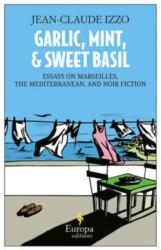
It was with delight then that I saw, recently, on display in a bookshop, the sky-blue cover of a posthumously published collection of essays by the same author.Garlic, Mint, & Sweet Basil, published by Europa Editions in May this year, set my mind racing about the least French of the French cities, her ties to the other shores of the Mediterranean and the cultural impact of this openness and cultural contact on the inhabitants of this port.
 Izzo’s Mediterranean“is not the one you see on the picture postcards”, but a raw “possibility for happiness”. In this collection, he discusses myth and ancient history (Marseilles was apparently founded by the Greeks as Massalia), music, Mediterranean cuisine, wine, crime, corruption, literature and the idea of “Mediterranean Creoleness”, to quote a term coined by Francophone Martinican author Edouard Glissant: “From Tangier to Istanbul, from Marseilles to Alexandria, from Naples to Barcelona,” in Izzo’s words, there is a “new culture, diverse, mixed, where man remains master both of his time and of his geographical and social space.” The city is “like bread to be shared by all” and where “hospitality, tolerance, respect for others [and] loyalty” are the accepted norm.
I felt this when I visited the city a few years ago. I felt at home among her mixed population of Arabs, Berbers, French, Italians and others from around the Mediterranean basin and beyond. Like many ports, she seemed, by turns, to welcome outsiders in and to look outwards to the vast sea and the world beyond it.
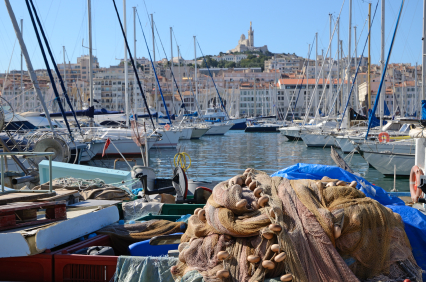
These were the feelings I had as I walked down the white steps of Saint-Charles station, looking down towards the city, the port and the sea below. Also, as I walked the streets of the old Panier quarter, and stopped for Pastis and bouillabaisse at cafés and restaurants overlooking the Vieux Port.
My mind wandered as I walked the windswept thoroughfare of La Canebière, through the many shady squares and then climbed the steep slopes leading up to Notre-Dame de la Garde basilica, which keeps watch over her whitewashed city.
The simple pleasure I had when I took a boat from the port to the beaches of the limestone inlets of the nearby Calanques.
Jean-Claude Izzo, in these essays – just like in his fiction – has put these raw impressions into clear, beautiful words.
A final note: some – but not all – of the best translations make it feel like you are not reading a text in translation. Well done to Howard Curtis for providing such a visible example of the invisible translator.
Marseille Travel Guides and Maps>
Browse our selection of Jean-Claude Izzo’s books>