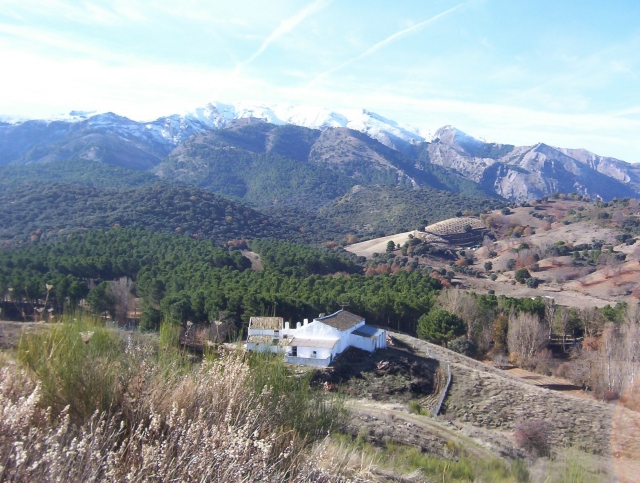
Author Charles Davis on the challenges of climbing La Maroma in the Sierra Tejeda in the Axarquía comarca of Andalusia.
The Spanish have an unjustified reputation for being anarchic individualists. They’re certainly anarchic. What other nation could make so much of a concept like Anarcho-syndicalism? But it’s the syndicalism that betrays their true nature. They are not so much individualists as inveterate members of groups.
One of the key words to understanding Spanish culture is convivencia or ‘living-together’. No Spanish teenager, for instance, would be seen dead in a disco without at least forty friends; Spanish infants of all ages love a good club, all the more so if it comes with a silly uniform; affiliation is so important that, in this very conservative and very Catholic society, gay couplings, including full scale wedding services with everyone in attendance, are literally ‘all part of the family’; living on top of one another, formerly in higgledy-piggledy villages, nowadays in flats, and always across the generations is a quintessentially Spanish custom; even their hermitages frequently cluster together in small colonies!
This gregarious character manifests itself in the most unexpected spheres. Walking is one example. For northern Europeans, walking is often a way of getting away from people and getting closer to nature, effacing oneself and communing with places that suggest the world is a little wider, a little larger, a little deeper, and a little more munificent than humanity’s petty disputes would suggest. To be fair, many Spaniards partake of this tradition, too, and being Spaniards they often push the pursuit that much further, communing with places that might be a tad too natural for most people, sometimes in a manner that seems downright suicidal. But if they can do it in a group, so much the better.
A striking example of this is to be seen in the Sierra Tejeda in the Axarquía comarca of Andalusia, the culminating point of which is La Maroma. La Maroma is the westernmost 2000 metre summit of the Iberian peninsula and, for many local people, climbing it is a rite of passage confirming their identity as true Malagueños. Some do it alone, most with a few friends, but at least twice a year the summit is besieged by groups determined to see it under special circumstances.
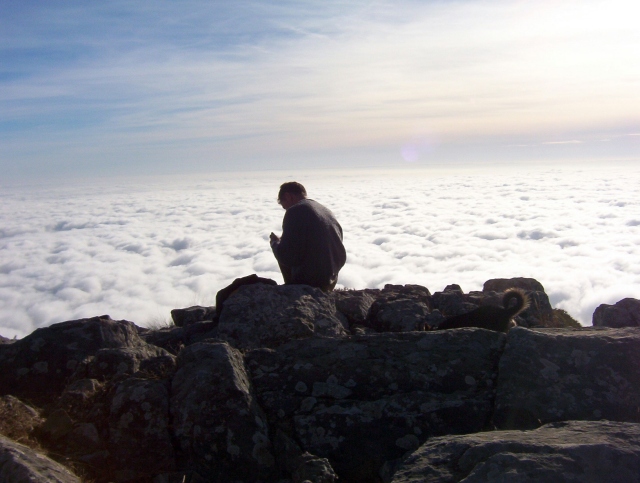
The first of these circumstances is when the mountain is under snow, which is inevitably a movable feast and generally a very ephemeral one, too, the Andalusian sun ensuring that only the heaviest snowfalls remain on the ground for more than a day or two. It’s not an easy walk and one best done the first time during more clement conditions, but the sight of hordes of Spanish youths disporting themselves in the snow on the summit is not one to be missed.
I, for one, will never forget looking on with horror as dozens of local students belted across the summit then flung themselves chest forward onto the nearest slope and gaily hurtled down toward . . . well, I’m none too sure what they thought they were hurtling toward. Oblivion, most like. La Maroma is not a dramatic mountain, but it does have the odd sheer drop dotted about it. It is, after all, in the nature of mountains to have the odd sheer drop and this one does climb 2000 metres within a few kilometres of the sea. And none of these students seemed to have reflected very deeply on how they were going to stop themselves shooting off the edge. Moreover, the fact that they were sliding belly down on a comparatively thin layer of snow that covered, in a very haphazard manner, a lot of sharp stones didn’t seem the best way to go about reversing Spain’s declining birthrate. I didn’t witness any accidents, but the spectacle certainly had me crossing my legs and wincing at the prospect of Bob’s-your-aunty
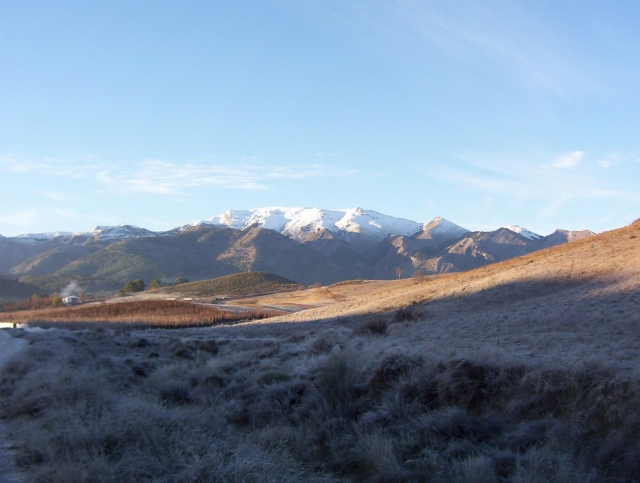
The other occasion comes at full moon during the summer months. I confess, I never got around to climbing La Maroma under moonlight when I lived in Andalusia, but I can imagine what it would be like, especially since I have subsequently discovered that the event is celebrated by numerous organized excursions walking through the night to enjoy a sunrise picnic on the summit. I don’t doubt for a moment that the sierra is speckled with enough head-torches to give the impression that it is strung with LED ropelights, nor that the mountain is positively humming with happily chatting Spaniards, and I suspect that the rising sun is greeted by something a little more boisterous than awed silence.
It’s not precisely my idea of how to enjoy a mountain, but then if you’re attached to your own precise ideas of how to do things, you’d probably be best advised to stay at home. So don’t be surprised if one day you see a tall, taciturn Englishman with a cyclopean white light in the middle of his forehead, labouring up La Maroma in the middle of the night, endeavouring to overcome his diffident and unsociable nature, and nattering with a couple of hundred Spaniards.
I’ll be the one on the edge of the group. But I will be part of the group.
Three approaches to La Maroma are described in Walk! The Axarquia